
Cask Fence Temecula plans and manages fence, gate and wall projects in Temecula and the surrounding towns of southwest Riverside County, with the installation done by licensed and insured contractors. Planning a fence here comes down to answering a fixed set of questions in order: what the fence is for, where the property line actually is, who has to approve it, what’s under the ground, and how slope, gates and fire rules change the build. Get those right and the price and the install follow.
What is the fence for, and which material fits?
Start with the job the fence has to do, because that narrows the material and height before anything else does.
Privacy and noise screening. A solid 6-foot fence in wood or vinyl is the usual answer on tract side and rear lines. Solid panels also catch the full force of the wind, which matters in a valley that designs to Exposure C. Board-on-board wood, shadowbox and full vinyl privacy panels each handle that differently; the privacy fence styles guide compares them.
Pets and kids. The height, the gap at the bottom and the gate latch matter more than the material. Dogs that dig find any gap left above grade. The dog fence guide covers heights and bottom details.
A pool. A pool barrier is an inspected safety enclosure, not a style choice. Temecula’s rules are stricter than the state minimum (see the permits section below and the pool fence requirements guide), and pool fence installation is priced to those rules.
Views and slopes. Where a back yard ends at a manufactured slope or looks out over the valley, open metal fencing keeps the view. Wrought iron and tubular steel or aluminum are the common choices, and Temecula’s block pilaster standard allows only open fencing like wrought iron to attach between pilasters. The aluminum vs. wrought iron guide sets out the differences.
Horses and acreage. Wine country, De Luz and the larger lots around Fallbrook use ranch rail, pipe and no-climb mesh. The horse fence installation page and horse fence materials guide go into those systems.
Security and property edges. Chain link is the practical choice for long runs, side yards and utility areas, and commercial fencing adds heavier framework and access control.
On material, wood is the most familiar and the easiest to repair board by board, but it needs finishing and it is a termite target where it touches soil. Vinyl avoids rot and paint, but it’s not maintenance-free and it can crack from impact, and the valley’s heat is hard on it: the NOAA normals for Fallbrook 5 NE average about 60 days a year at or above 90°F, which drives expansion in vinyl and checking in wood. The wood vs. vinyl guide, vinyl vs. composite guide and vinyl in heat and fire guide go deeper.
Where is the property line, and does the old fence mark it?
The old fence does not mark the property line. Fences get built a foot inside the line, a foot over it, or along a guess made decades ago, and they stay there because nobody checks. Planning a boundary fence from the old posts can put a new fence, and its cost, on the wrong side.
The reliable reference is the survey monuments, the pins set at the corners when the lot was mapped. They may still be in place, sometimes buried under landscaping. If you can’t find them, or the neighbor disagrees about where the line is, a licensed land surveyor can locate or reset them. A fence contractor can measure from pins, but can’t certify a property line, and shouldn’t be asked to. The property line survey guide covers when a survey is worth it and what it costs to skip one.
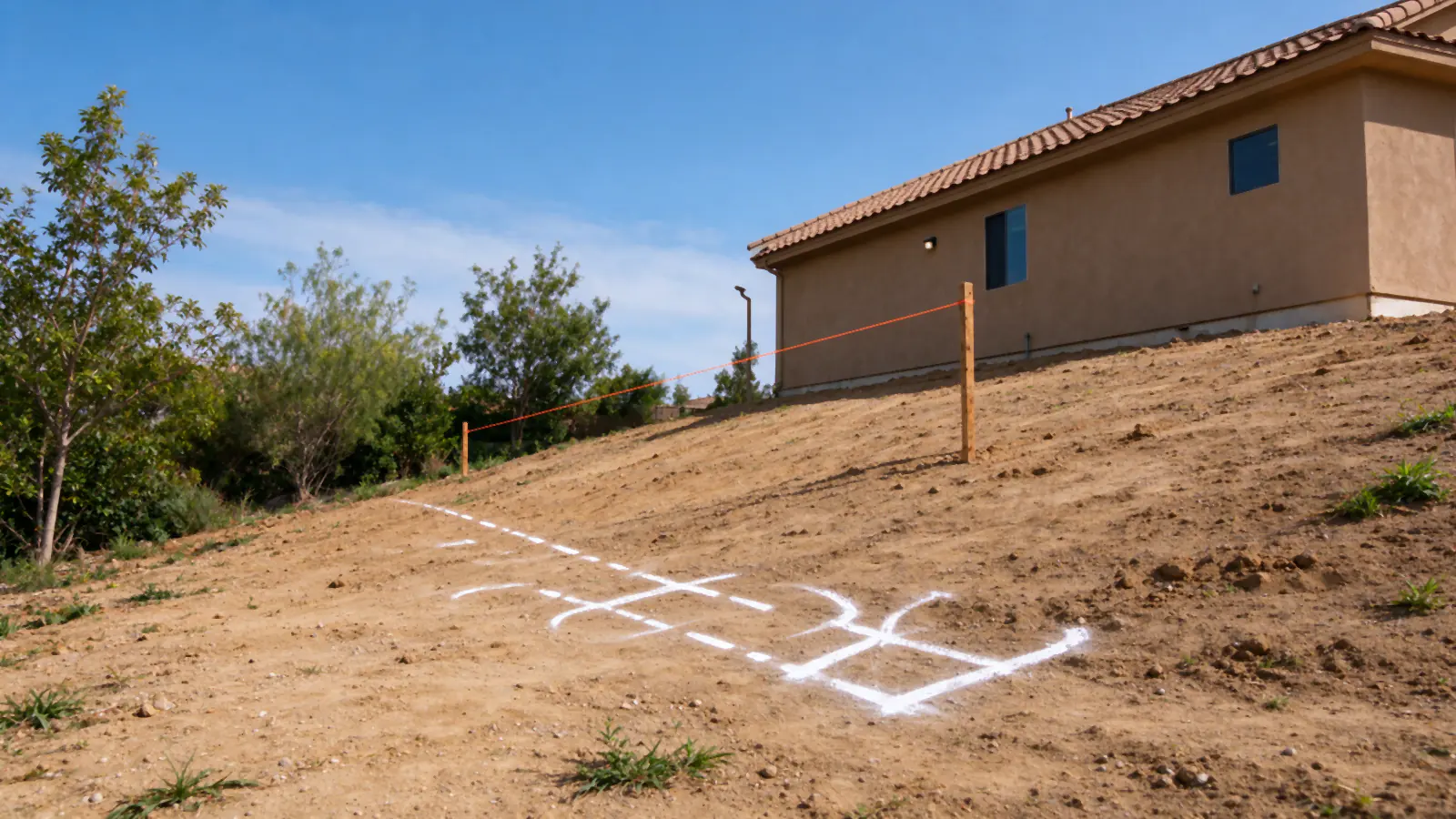
Once the pins are known, the fence line layout is set out with stakes and a tight string between them, offset from the line by whatever you and the neighbor agree. Corners, gate openings and the ends of each run are marked first, then post locations are spaced along the string to suit the system. This is also when you check what’s in the way: trees and roots in the line, sprinkler heads, a slope that drops away, a block wall the new fence has to meet.
Easements. Check your title report or the recorded tract map for utility or drainage easements along the line. A fence built inside an easement can block access the easement holder is entitled to, and depending on the easement’s terms you may have to remove it at your own cost if they need in. Drainage swales between lots matter too: a fence or wall should not block the water. Temecula’s block wall standard says plainly that no water course or natural drainage may be obstructed.
Do you need HOA approval first?
In most of Temecula’s planned communities, yes, and it comes before the permit and before you order anything. CC&Rs typically control the material, color, height, cap style and sometimes which side of the fence faces out. A fence built without approval can be ordered changed or removed.
California Civil Code 4765 sets the rules for how the association decides. Where the governing documents require approval of physical changes, the association must have a fair, reasonable and expeditious procedure with a stated maximum response time. Decisions must be made in good faith, can’t be unreasonable, arbitrary or capricious, and can’t require anything that violates building codes. They must be in writing, and a denial must explain why and offer a way to reconsider, including reconsideration by the board at an open meeting.
So the practical steps are: get the current architectural guidelines from your association, submit a drawing showing the line, height, material and color, and wait for the written answer before work starts. Canyon Lake runs its own approval through the property owners’ association, so the standards there are confirmed per project. The HOA fence approval guide has a submission checklist.
Do you have to tell the neighbor, and who pays?
For a fence on a shared boundary, yes. California Civil Code 841 says adjoining owners share responsibility for the boundaries and monuments between them, and presumes they benefit equally from a dividing fence and share equally in its reasonable cost, unless they’ve agreed otherwise in writing.
Before you replace or build that fence, the law requires 30 days’ prior written notice to each affected neighbor. The notice should describe the problem with the existing fence, the proposed solution, the estimated cost, how you propose to share it and the timeline. The equal-share presumption can be overcome with evidence, for example where one side gets far more benefit from an upgraded fence than the other.
A few practical points make the process smoother. Put the notice in writing even if you’ve already talked. Attach the quote. If the neighbor will pay a share, ask whether the contractor can write and bill each owner separately, which saves one neighbor from collecting from the other. And if the line itself is in doubt, settle it with the pins before you send the notice. Whether Civil Code 841 applies the same way to a block wall is confirmed per project. The good neighbor fence law guide covers disputes and non-responses.
How tall can it be, and when do you need a permit?
There are two separate questions here, and people mix them up. Zoning decides how tall a fence may be where it stands. The building code decides whether the fence needs a building permit.
Building permits. The 2025 California Residential Code, which Temecula enforces, lists fences not over 7 feet high as work exempt from a building permit. That’s the state baseline. Temecula’s own fee schedule carries a permit line for non-masonry fences 6 to 10 feet high, so a fence over 6 feet is a question to put to Temecula Building & Safety before you assume no permit. The cost guide lists the fees.
Height limits. Front yards, side and rear yards and corner lots near intersections usually have different limits. Temecula’s yard height limits are confirmed for your address with the Planning Division, and so are the rules in Murrieta, Menifee and Wildomar. Lake Elsinore’s code, by contrast, sets a 36-inch limit in required front yards, allows wrought iron to 5 feet there, and requires 6-foot side and rear fences; the Lake Elsinore page covers it. In the Temecula wine country, the county’s design guidelines discourage fences over 4 feet other than pool fences and retaining walls, and discourage chain link in public view. In Fallbrook, San Diego County limits solid front-yard fences to 42 inches.
Masonry walls. A block wall is not a fence for permit purposes. Temecula’s freestanding block wall standard (CD-24) tells owners to check with Building & Safety whether a permit is required, and the city’s fee schedule has a masonry wall line from the first foot of height. The same standard doesn’t allow more than 6 inches of grade difference across the wall; beyond that it’s a retaining wall. See block wall installation.
Retaining walls. The state baseline exempts retaining walls not over 4 feet measured from the bottom of the footing to the top of the wall, unless the wall supports a surcharge such as a slope, driveway or structure. Because the footing is buried, a wall that shows about 3 feet above grade can already be over 4 feet. Temecula Building & Safety decides whether your wall needs a permit, and retaining wall installation covers the city’s standard designs.
Pool enclosures. Temecula’s pool and spa handout (CD15) makes an enclosure meeting Health and Safety Code 115923 mandatory for a new or remodeled pool, where state law alone would accept other combinations of safety features. The handout requires fences and gates at least 5 feet high on the outside, no climbable decorative work on the side away from the pool, no more than 2 inches of ground clearance, and gates that swing away from the pool and are self-closing and self-latching with the latch at least 60 inches above the ground. A temporary fence and gate must be up when pool construction starts, which is where temporary fence rental comes in. The height and permit rules guide puts all of these thresholds in one place.
Who has to call DigAlert, and when?
Whoever digs. California Government Code 4216 requires the excavator to notify the regional notification center at least two working days, and not more than 14 calendar days, before digging, not counting the day of the call. In Southern California that’s DigAlert: mark the dig area in white paint or flags first, then call 811 or 800-422-4133, or file online.
Utility operators mark only their own lines, usually up to the meter. They don’t mark private lines: the gas line to a pool heater, the power to a spa or landscape lighting, a line to a fire pit or an outbuilding, irrigation. In a Temecula back yard those private lines are often exactly where a side-yard fence runs. Ask what’s buried along the line before the layout is final, and expect hand digging near anything marked; the law requires hand exposure within 24 inches of each side of a marked line before power equipment is used.
Who can legally build it?
In California, fence work is licensed by the Contractors State License Board. The C-13 Fencing Contractor class covers building and repairing all types of fences, corrals, railings, posts and gates, but it excludes masonry walls. Block walls fall under the C-29 masonry class, and concrete work under C-8. A B general contractor may also handle them as part of a larger multi-trade project.
The minor-work exemption is narrow. Since January 1, 2025, an unlicensed person may do jobs under $1,000 in combined labor and materials, but only if the work needs no permit of any kind and the person employs no one. Anyone advertising unlicensed work under that limit must say they are unlicensed. In practice, almost any full fence, any pool barrier and any block wall is over that line. Check a license number on the CSLB website before you sign, and check that the classification matches the work.
What’s in the soil, and how deep do the posts go?
There’s no single post depth that’s right everywhere, and Temecula is a good example of why. Depth is set by the fence height, the wind load on the fence, the soil and the system manufacturer’s instructions. Frost, the usual driver in colder states, isn’t a factor: the NOAA normals for Fallbrook 5 NE average 0.2 nights a year at or below freezing.
Wind is. Temecula’s Building & Safety design data lists a 97 mph wind speed and Exposure C, meaning open terrain. A solid 6-foot privacy fence presents a sail to that wind, and offshore wind events load solid panels and swing gates hard. Taller and more solid fences need heavier posts, closer spacing or deeper footings than open or shorter ones.
Then there’s what the auger meets:
- Temecula, Menifee and French Valley. NRCS soil maps show mostly sandy loams with low shrink-swell, over cemented hardpan (duripan) that sits roughly 0.5 to 1 meter down at sample points. An auger that reaches it stops, and the hole needs a rock bit or breaking tools. Graded tract lots sit on engineered fill, which digs differently again.
- De Luz and the rocky hills. Very stony soils and rock outcrop, with bedrock as shallow as 26 cm at the sampled point, mean rock drilling and often a stepped layout. See hillside fence installation.
- Canyon Lake. The sampled soil is a clay with high shrink-swell, which pushes and pulls on posts as it wets and dries. See the Canyon Lake page.
These are point samples; your lot may differ, and a test hole tells you more than a map. The fence posts and Temecula soil guide covers concrete, gravel and steel post options for each.
Post hole digging itself is set by the plan, not the other way round. Holes go where the layout puts them, terminal posts at ends, corners and gates get larger holes, and the hole is dug to the depth the design needs, not to wherever the auger stops. If hardpan stops the auger short, the answer is breaking through or changing the footing design, not a shallower post.
What happens on a slope?
A fence follows a slope in one of two ways. Stepped fences keep each panel level and drop a step at each post, which leaves triangular gaps under the high end of each panel. Racked fences tilt the panel so the rails run parallel to the ground and the bottom stays close to grade. Wood can do either. Many vinyl, aluminum and steel panels can be racked only within the manufacturer’s limit, and beyond it they have to step.
The choice matters for dogs (stepped gaps), for pools (the 2-inch maximum ground clearance has to hold along the whole run), and for looks. On Temecula’s tract back yards that end at a manufactured slope, there’s a structural question too: the city’s block wall standard requires footings near a slope to be at least 5 feet from the slope face. The stepped vs. racked fence guide shows both.
How should gates be planned?
Gates are where fences fail first, so plan them before the line is final. Gate posts carry the gate’s weight as a lever, so they need to be heavier and set deeper than line posts; a gate hung from a standard line post tends to sag. Decide which way each gate swings and check it clears the slope, the walkway and anything it might hit. A gate mounted to a stucco wall needs to be anchored into the framing behind it, not just into the stucco.
Widths depend on what has to pass through: a person with a wheelbarrow, trash bins, a mower, a trailer. A drive gate is a different class of project, with heavier posts or pilasters, and Temecula’s block pilaster standard limits a gate attached to a standard pilaster to 200 pounds and 4 feet wide per pilaster. Heavier or wider gates need a design beyond the standard.
If a drive gate will be electric, plan it as an automatic gate project from the start. Operators must be listed to UL 325, which requires entrapment protection such as photo eyes or edge sensors, and a modern operator won’t run without them. Where the driveway counts as a fire apparatus access road, which is common on long driveways on acreage, Riverside County Fire requires at least 14 feet of unobstructed width, gates that swing or slide, and a Knox key switch on electric gates (or a Knox box or padlock on manual gates that lock). The gate installation page, the swing vs. sliding gate guide and the sagging gate guide cover the rest.
Does your fire zone change the fence?
It can, mostly in the 5 feet next to the house. Fire hazard severity zones in Temecula are mapped parcel by parcel, and the city publishes an address lookup map from CAL FIRE’s updated maps. Zones vary inside every community: the wine country, De Luz, the Santa Rosa Plateau edge and hillside edges map as very high hazard at sampled points, while much of central Temecula does not.
California is moving toward “Zone 0” rules for that first 5 feet. A Board of Forestry staff memo describes proposed rules that, in the regulated zones, would bar new combustible fences within 5 feet of a home, let existing ones stay and be repaired with the same materials, and require a noncombustible section, such as a metal gate, where a fence or gate attaches to the house within five years. These rules are proposed; check their current status before you build. Separately, the Wildfire Prepared Home designation asks for noncombustible fence, posts and gates within 5 feet of the house.
The practical response, if you’re in a very high zone, is to plan a metal or masonry transition where the fence meets the house now, while the fence is being built anyway. The fire-resistant fence installation page covers materials.
What happens on install day?
A typical fence install runs in this order:
- Confirm the layout. The line is checked against the pins, approvals and DigAlert marks, and the string is set to the planned line and height.
- Tear-out, if replacing. Old panels come down, old posts and footings come out, and debris is hauled off. Survey pins near the line are protected. See fence replacement.
- Dig and set posts. Holes are dug at each marked location, terminal and gate posts first. Posts are set plumb and to height along the string, in concrete or as the system specifies, and braced while the concrete sets. Many jobs set posts on one visit and hang the rest after the concrete has cured to the maker’s instructions.
- Rails and rail attachment. Rails go on between posts: nailed or screwed to wood posts with brackets or into routed slots on vinyl, and bolted or welded on metal systems. Rail attachment is where long-term sag starts or doesn’t.
- Pickets or panels. On a site-built wood fence, pickets go on one by one at a consistent picket spacing, tight for privacy or gapped for airflow. Pool fences keep every opening small enough that a 4-inch sphere can’t pass. On panel systems, fence panel installation means fitting factory panels into the posts and cutting the end panel to fit.
- Post caps, trim and fasteners. Caps keep water out of the end grain of wood posts and the hollow tops of vinyl and metal ones. Fasteners should be rated for exterior use and compatible with treated lumber, or they corrode.
- Gates and hardware. Gates are hung, latches and stops set, and the gate adjusted to swing and latch cleanly.
- Clean-up and walk-through. Spoils and offcuts are removed, the line is checked for plumb, height and bottom gap, and gates are tested with you.
Ask before the day what happens to the dirt from the holes and to sprinkler heads along the line. A fence that ends above grade leaves a gap pets can dig under, so agree on the bottom gap in writing.
How do you look after it once it’s built?
Wood. Stain or a penetrating finish slows graying, checking and moisture cycling in the sun, and needs renewing over time. It won’t reverse rot that has already started. Keep soil, mulch and sprinkler spray off the bottom of the boards. UC IPM notes that subterranean termites infest wood in contact with soil and drywood termites nest in dry wood above ground, including fences, and advises removing untreated fence posts and buried scrap wood near structures. Keep a wood fence from touching the house where you can. The termites and rot guide has more.
Vinyl. Wash it occasionally with mild soap and water. Check rails and panels after hot spells and windy days, and keep heat sources and reflected sun from windows or grills away from it. A cracked panel or rail can often be replaced without replacing the fence, if the profile is still available.
Metal. Touch up chips in the coating before rust spreads, and keep sprinklers from wetting the same posts every day.
Gates. Gates take the most wear. Check the hinges, latch and post plumb a few times a year, and deal with a sag early. If a whole run is leaning or rotting, the repair or replace guide and the fence repair assessment help sort out whether a repair will do.
Putting the plan together
Before you ask for prices, you should be able to say what the fence is for, where the line is and how you know, whether the HOA has approved it, whether the neighbor has been given notice, what height you want and whether that needs a permit, and where the gates go. The fence cost estimator turns those answers into a budgeting range, and the planning checklist puts them on one page. Projects in Murrieta, Menifee, Wildomar and French Valley follow the same steps with their own permit offices.
When you’re ready to talk it through, call (951) 944-2778 or send the project details.