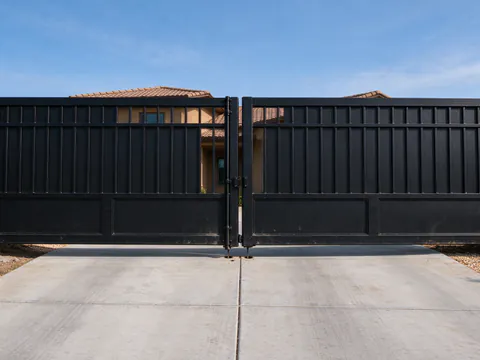
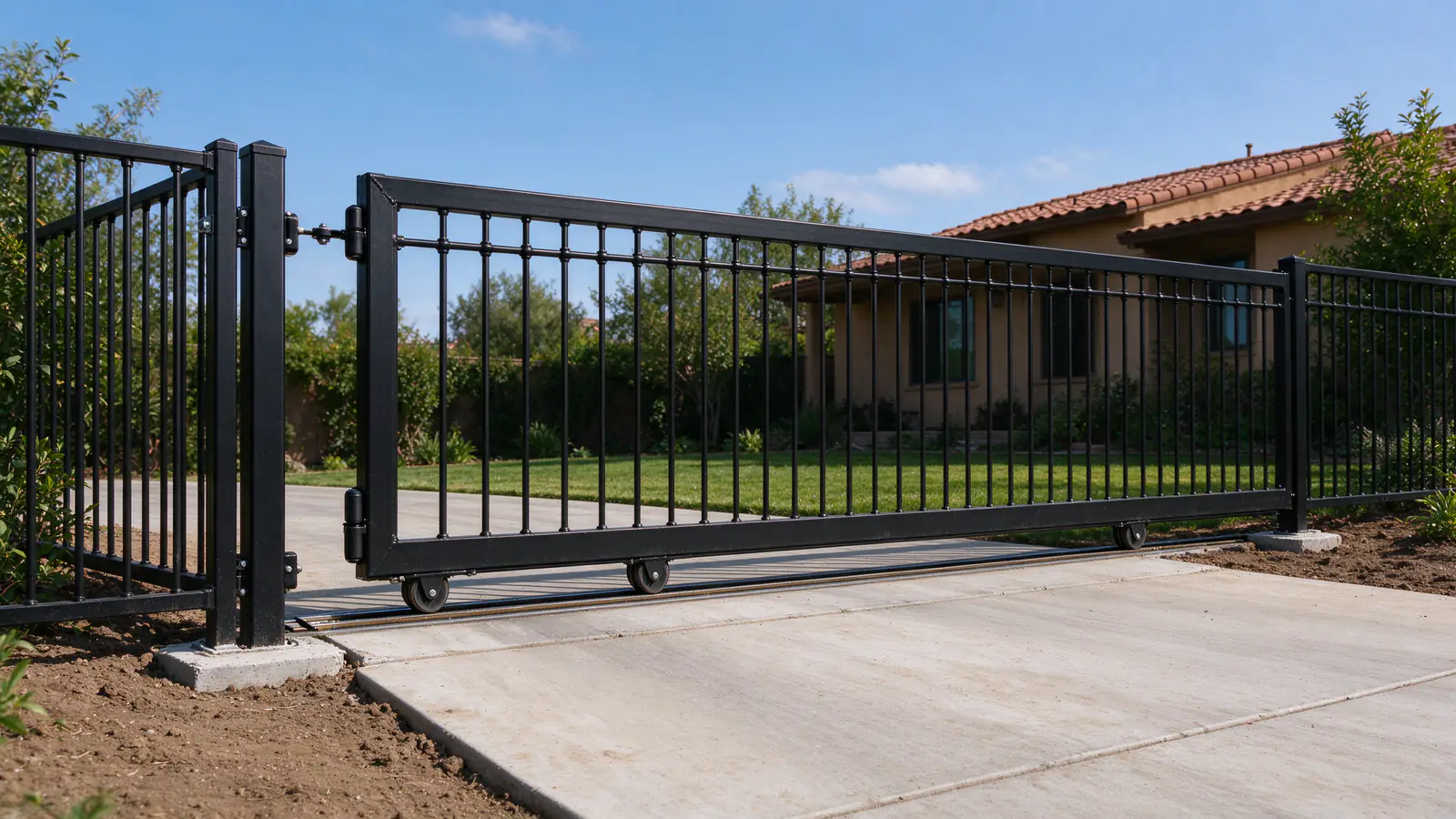
Choose by the space your driveway has. A swing gate needs clear ground for each leaf to arc open and works best where the drive is level or falls away from the gate. A sliding gate needs a straight, level run of fence line beside the opening for the gate to roll back along. Sloped drives favor swing gates; short setbacks and uphill swings favor sliding.
Cask Fence Temecula plans and manages gate, fence and wall projects across Temecula and southwest Riverside County, with each part carried out by licensed and insured contractors. Driveway gates here range from a pair of iron leaves on block wall pilasters in a tract to a long gate across an acreage driveway in De Luz or the Temecula wine country, where fire access rules come into play. The gate installation page covers how gates are built and hung; this guide is about choosing how a driveway gate moves.
Swing and sliding gates side by side
| Question | Swing gate | Sliding gate |
|---|---|---|
| Space it needs | An arc in front of each leaf, as deep as the leaf is long | A level run beside the opening, longer than the opening |
| Slope | Leaves swinging uphill hit the grade | The gate’s own travel path must be level |
| Setback from street | Needs room for the leaves and a waiting car | Can open with a car close to the gate |
| Common forms | Single leaf or double leaves | V-track, rear-wheel or cantilever |
| Wind | A solid leaf levers on its hinge post | Load runs into rollers and support posts |
| Automation safety | Edge sensors and photo eyes; screening not required by UL 325 | Photo eyes and edges; lower 6 ft screened; speed limit |
| Upkeep | Hinges, latch, drop rods | Rollers, track or carriage, guides |
| Budgeting | Double drive gate: $2,000 to $6,000 per gate (national) | No national range published here; priced per project |
The swing gate travel envelope
A swing gate needs its whole travel envelope clear: the quarter circle each leaf sweeps from closed to open, plus its open resting position. A single 12 ft leaf needs a 12 ft-deep arc; split the same opening into two 6 ft leaves and each arc is half as deep, which is why most driveway swing gates are pairs.
Walk the arc before you choose. Parked cars, a planter, a mailbox, a wall or the corner of the garage can sit inside it. In the open position, the leaf shouldn’t trap anyone against a wall or fence; ASTM F2200, the construction standard for automated gates, calls for a minimum distance to fixed objects in the open position unless electronic entrapment protection is used. A solid privacy-style leaf, like those in the privacy fence styles guide, adds wind load to all of this. A swing gate that opens inward also needs the car to pull far enough in from the street to clear the arc before it closes.
Driveway grade and swing clearance
Grade is where swing gates run into trouble. If the driveway rises behind the gate, a leaf swinging inward hits the slope partway open. The options are to swing the gate the other way where that’s allowed, raise the gate and accept a larger gap underneath, cut a level pad in the arc, or switch to a slide gate. A drive that falls away from the gate is the friendly case: the leaves swing over lower ground.
Any gap under a swing gate matters if it will be automated. UL 325 calls for a contact edge on the bottom of a swing gate where the gap between gate and ground is more than 4 inches but less than 16 inches anywhere in its arc. Hillside Temecula drives can drift into that range across the swing.
Sliding gate runback space
A slide gate needs runback: the straight, clear, level run beside the opening that the gate rolls into when it opens. That space is longer than the opening itself.
- V-track gates roll on wheels in an angle-iron track set in concrete across the drive, guided at the top by rollers. The panel runs about 3 feet longer than the clear opening, so the runback is the opening plus that overlap.
- Cantilever gates have no ground track. The panel hangs on four large rollers mounted on two heavy posts and carries a counterbalance frame behind it. A common rule of thumb adds 50% to the opening, so a 20 ft opening takes a gate about 30 ft long.
Whatever form it takes, the runback has to be free of walls, trees, meters, air-conditioning units and the neighbor’s line, and the fence along it has to be straight. If the gate is automated, UL 325’s installation instructions and ASTM F2200 call for the gate and the part of the adjacent fence it covers when open to be screened from the bottom to at least 6 ft so a 2-1/4 inch sphere can’t pass, which often means adding mesh to the fence along the runback.
Choosing a cantilever or track gate
A V-track gate is simpler and uses a shorter panel, but it depends on a clean, straight track. Gravel, leaves and grit in the track make the wheels jump, and even a small crown poured in the concrete for drainage can mean reworking the slab under the track. A cantilever gate keeps the drive clear of any track, which suits gravel or decomposed granite driveways and drives where debris collects, but it needs the longer runback and heavier posts. Covers belong on every exposed roller in either type.
Slope matters to both. Gates built on a slope aren’t compliant with UL 325, and a slide gate shouldn’t run up or down a grade, though the driveway itself can slope at a right angle to the gate line. On a hillside drive where the fence line beside the opening falls away, a swing gate or a regraded pad is the usual answer; hillside fence installation and the stepped vs. racked fence guide cover how the fence itself handles that grade.
Clear opening, RV gate width and fire access
The number that matters is the clear opening: the width that is actually open when the gate is fully back. Posts, hinges, latch hardware, stops and slide-gate guide posts all take width out of the nominal gate size. For an RV, a boat trailer or a horse trailer (see horse fence installation for pasture gates), measure the vehicle at its widest, mirrors included, and allow for the turn in from the street; a tight angle needs more width than a straight pull.
Wider gates mean heavier leaves. On block pilasters, Temecula’s standard limits a gate attached to a pilaster to 200 lb and 4 ft wide per pilaster, so a pair of leaves on standard pilasters tops out at about 8 ft of gate. Wider drive gates need steel posts or a pilaster designed beyond the standard, and the hinge posts need footings sized for the leaf, which the fence posts and soil guide explains.
Fire access. Where a driveway is a fire apparatus access road, Riverside County Fire policy for one- and two-family homes requires a gate across it to give at least 14 ft of unobstructed width. That happens on long driveways: an access road must reach within 150 ft of all parts of the first-story exterior walls (300 ft if the house is fully sprinklered), so a house set far back on acreage often puts its driveway under fire rules. The same policy allows swinging or sliding gates, requires gates in the State Responsibility Area to sit at least 30 ft back from the intersecting road, bars padlocking a manual gate unless a Knox padlock or key box is provided, and requires electric gates to open with a Knox key switch and use a UL 325-listed operator. The fire marshal confirms whether a given driveway counts.
Automation changes the comparison
Either gate can be automated, and the safety rules differ by type. UL 325 operators need at least two independent means of entrapment protection in each direction where there’s an entrapment zone, and the operator won’t run normally without them. Slide gates are limited to 1 ft per second; swing gates have no speed limit but need edge sensors and photo eyes placed for their arc. Controls must be at least 6 ft from the moving gate, and where people are likely to walk through, they need a separate pedestrian gate rather than the automated one. An existing manual gate often needs rework before an operator goes on: removing the latch, adding stops, guarding rollers and adding mesh.
A gate operator with a new circuit usually means an electrical permit from Temecula Building & Safety. The automatic gate installation page covers operators, power and sensors.
Materials and budget
Most driveway gates here are steel or aluminum, built like wrought iron fencing, which the aluminum vs. wrought iron guide compares; steel is the usual choice for wide or automated gates. A double drive gate, the common swing configuration, has a national budgeting range of $2,000 to $6,000 per gate. There’s no comparable national range published here for slide gates, track or cantilever hardware, or operators, so those are priced per project. A shared entry gate for an HOA or community falls under different operator rules and is covered under commercial fencing. The cost guide explains how gate quotes break into parts, and if an existing gate is dragging, the sagging gate guide covers the usual causes.
How to choose
Measure three things: the depth of clear ground in front of the opening, the length of straight, level fence line beside it, and the slope under each. If the arc is clear and level or falling, a swing gate is simpler. If the runback is there and the arc isn’t, slide. If neither space is clean, the site work that makes one of them possible is part of the gate. To talk through a driveway gate, call (951) 944-2778 or send the details.