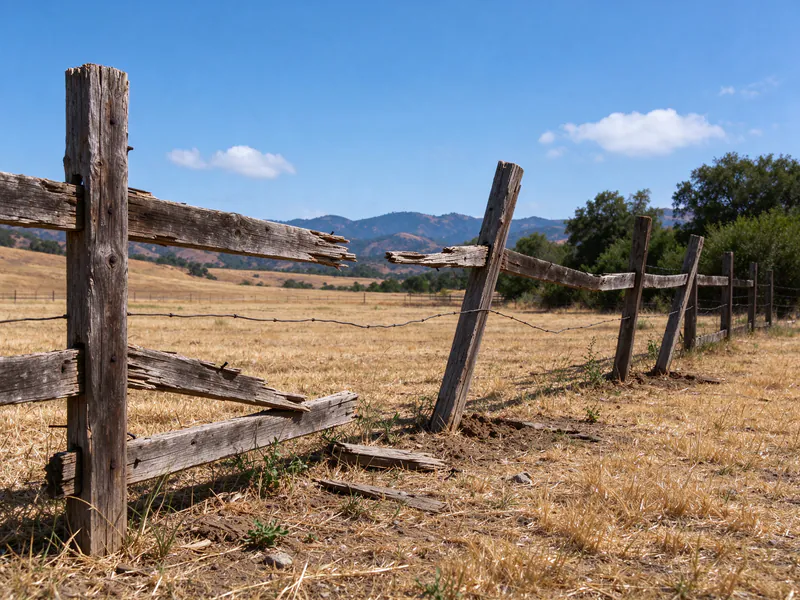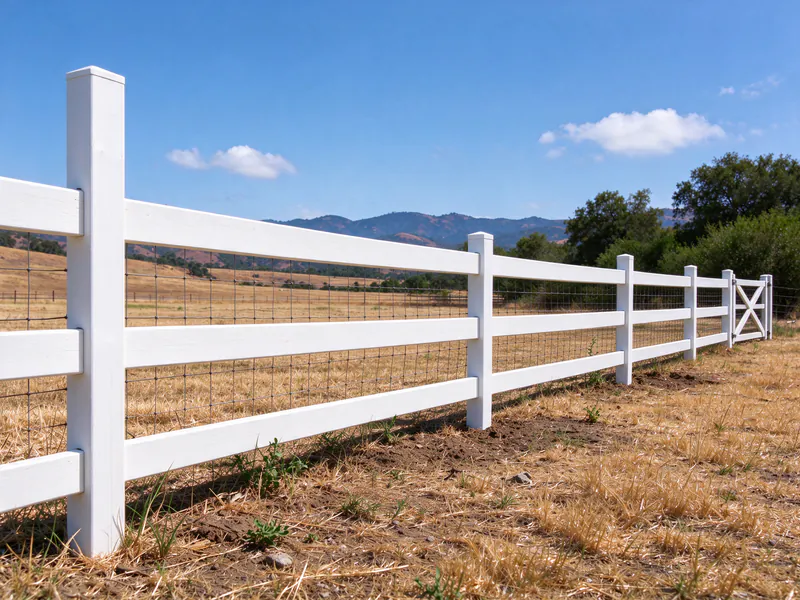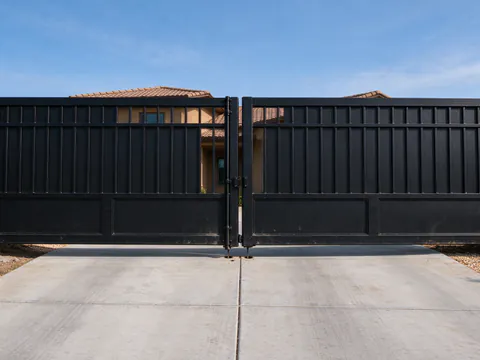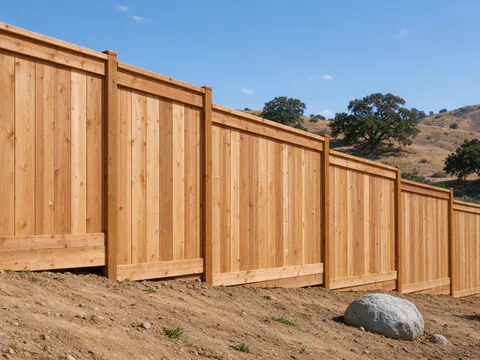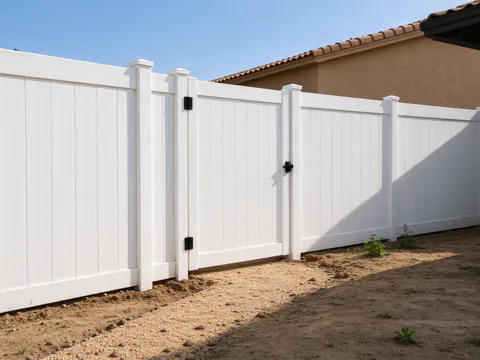
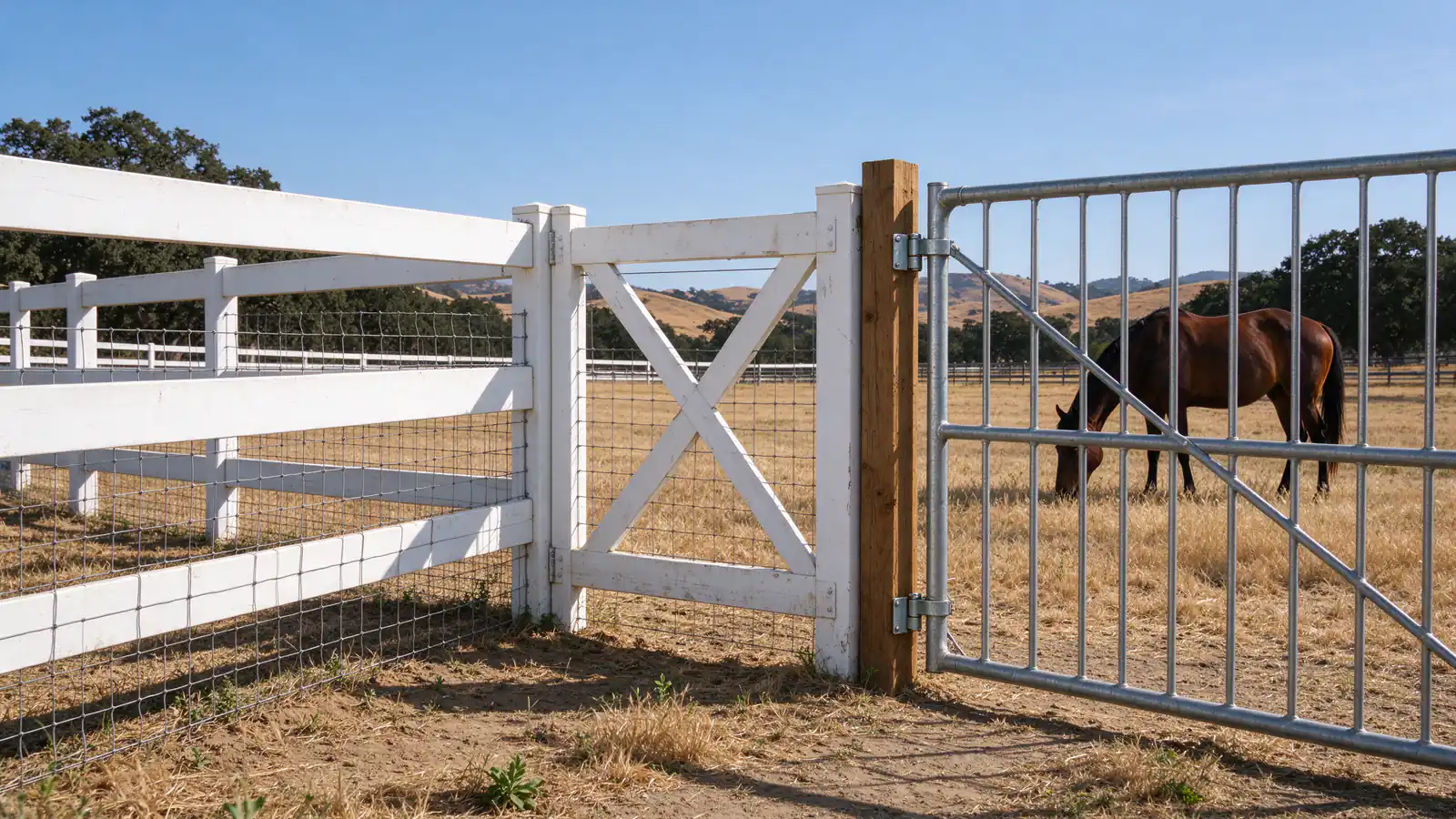
Cask Fence Temecula plans and manages horse and ranch fence installation for properties in Temecula, the Temecula wine country and acreage around Fallbrook and De Luz, with the work carried out by licensed and insured contractors. That covers pasture perimeters, paddocks, turnouts and round pens in horse-rated rail, vinyl ranch rail, steel pipe and no-climb mesh, plus the gates that go with them. The starting point is always the animal: how many horses, how big, whether there are foals or minis, and how hard the space gets used. The horse fence materials guide compares the systems in more depth; this page covers how they get built.
Pasture, paddock and turnout ask different things of a fence
A pasture perimeter is long, the horses spread out across it and they rarely hit it at speed. Its job is to be seen, to hold a line for years and to keep horses in if something spooks them at night. A paddock or a small turnout is the opposite. Horses spend hours beside the fence, lean over it for grass on the far side, rub on the posts and crowd the gate at feeding time. The same footage of fence takes far more abuse.
That difference decides the build. A long pasture line can use wider post spacing and a lighter system, while a paddock usually gets closer posts, stronger rails or pipe, and often an electric offset to keep horses off it. Mixing the two on one property is normal: a ranch rail or mesh perimeter, with pipe or heavier rail around the pens closest to the barn.
Horse-rated rail, split rail and board fencing
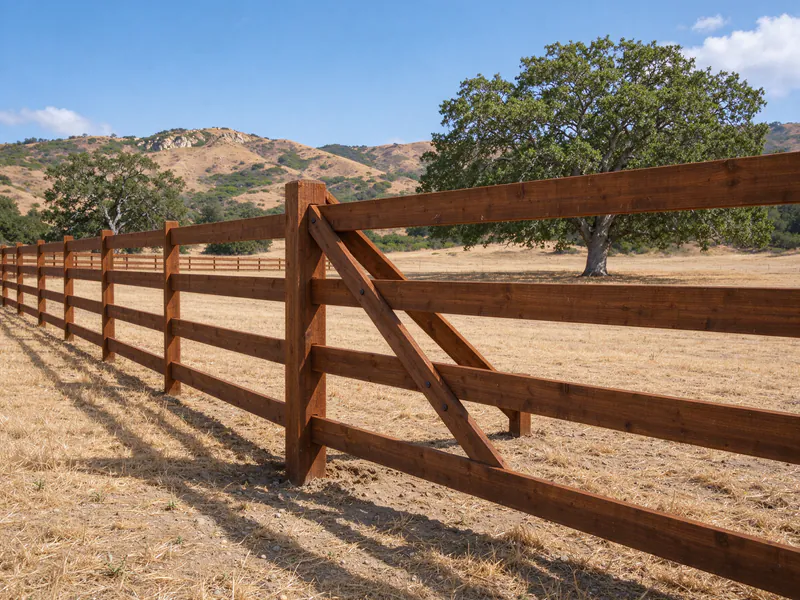
Ranch rail and board fencing, two to four horizontal rails on posts, are what most people picture around a horse property here. Split rail, with rough rails socketed into mortised posts, looks right on rural frontage but is better as a boundary marker than as horse containment: the rails lift out, and the gaps between them are wide.
What separates a horse fence from a decorative rail fence is mostly how it is put together. The rails or boards go on the side the horses are on, so a horse pushing on the fence presses the boards against the posts instead of prying them off. Fasteners are sized for impact, not just to hold the board’s weight. The top rail sits high enough that a horse doesn’t think about stepping over, and it is wide enough to read clearly against the hills.
Wood rails get chewed. Horses with time on their hands strip the top board, which is one reason many owners cap wood rail with a hot wire or tape on an offset. For anything that isn’t horse-rated, the wood fence page covers species and post choices that also apply here.
Vinyl ranch rail, steel pipe and no-climb mesh
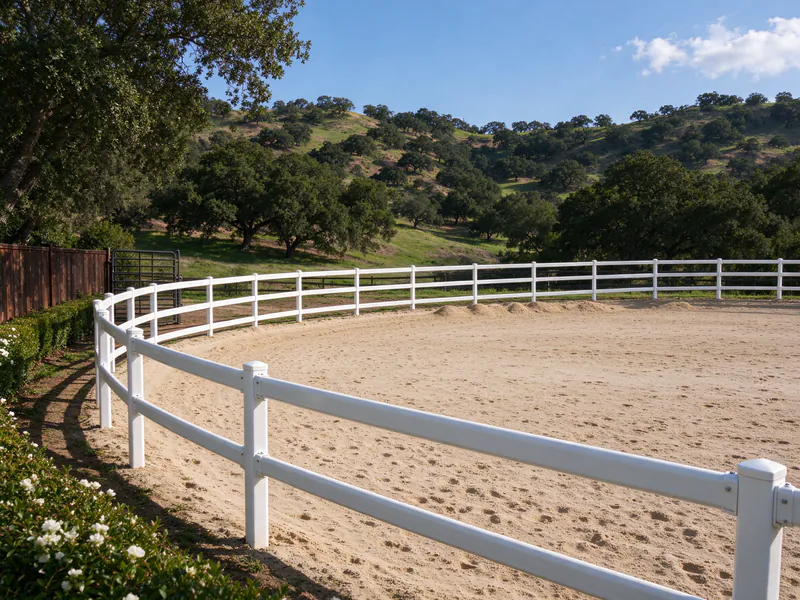
Vinyl ranch rail is popular in wine country because it stays white and doesn’t need paint. The catch is that vinyl can crack, and decorative rails can pop out of their post routes when a horse leans or rubs. Horse-rated vinyl uses thicker rails and stronger connections, and the product’s rating should be named in the written scope. The vinyl fence page covers how vinyl handles the local heat.
Steel pipe is welded or clamped tubing, usually painted. It is very strong and almost maintenance-free, which is why it is common around pens and arenas. Its rigidity is also the trade-off: a fence that doesn’t give at all transfers the force of a collision back into the horse, so spacing and rail height are set with that in mind.
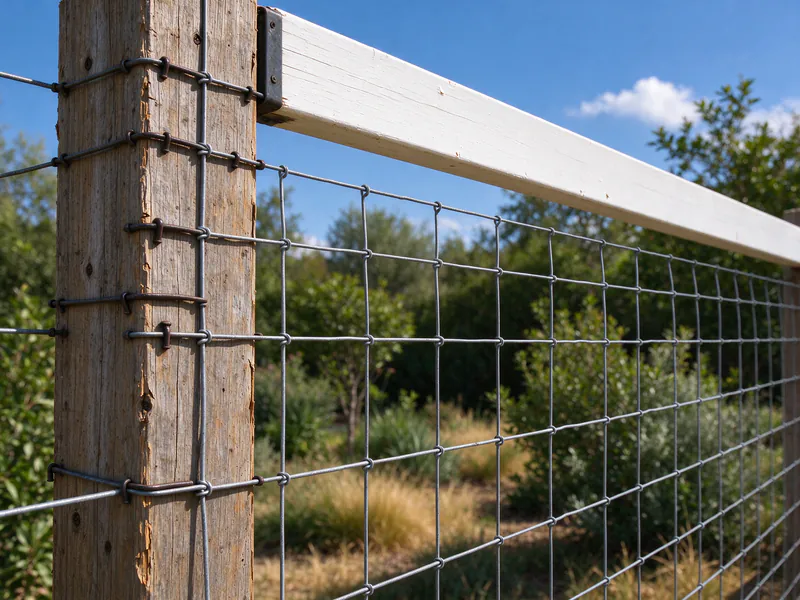
No-climb mesh is woven wire with small openings, stretched between posts, often with a rail or pipe along the top. The small openings keep hooves from going through and keep foals and small dogs on the right side. Mesh only works when it stays tight, and that depends on the ends.
Braced corners, braced ends and mesh tension
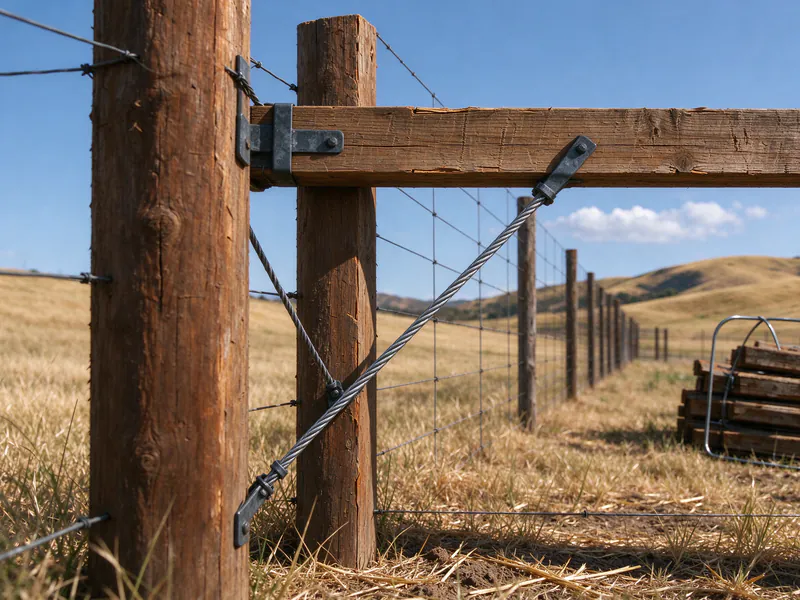
Wire mesh and tensioned wire pull constantly toward the middle of the run. A line post isn’t built to resist that. The corner and end posts are, which is why they get bracing: a horizontal brace to the next post and a diagonal tension wire, or an equivalent welded frame on pipe fence. When a brace is skipped or too light, the end post leans in, the mesh goes slack, and a slack fence is one a horse can push through or catch a leg in.
The same logic applies at gates, because a gate opening is two ends facing each other. Horses also add their own load. A horse scratching on a post, or leaning over the top rail to graze, pushes on the fence in one spot over and over. Over a season that loosens rails, rocks posts in dry soil and pulls staples out of wood. That is why mesh is attached to the posts with fasteners suited to its tension, why posts in a paddock are set closer, and why an offset wire is often the cheapest way to stop the rubbing. If a run starts to sag, the fence repair page covers resetting posts and retensioning.
Ground gaps, transitions and the details that injure horses
Most horse fence injuries trace back to a gap or a sharp edge rather than a fence falling over. The gap under the bottom rail matters: too high and a foal or mini can roll under; on a slope, a level fence can leave a wedge of open space on the downhill side. Stepped runs on hillside pastures need checking post to post, and the stepped vs racked guide shows why a racked fence follows the ground more closely.
Transitions are the other weak spot. Where mesh meets a gate post, where rail fence joins a block wall, or where an old fence meets a new one, small openings appear that a horse can get a hoof or head into. Nail heads backing out, cut wire ends turned toward the horse and open ends on pipe all get checked at the final walk. Foals and miniatures need smaller openings and a lower bottom line than a grown horse, so tell us about them before the system is chosen.
Visibility matters too. Horses see a wide board or a bright tape more easily than a thin wire, so a mesh or wire fence usually gets a top rail, a sight board or tape along the top.
Foals, minis or a stallion on the property?
Each one changes the mesh, the rail height or the gate plan. Tell us before we draw the line.
Gates for horses, trailers and tractors
A horse gate and a vehicle gate solve different problems. A walk-through gate between paddocks needs to be wide enough to lead a horse through without bumping a hip, latch with one hand, and close flush to the post so there’s no gap at the hinge or latch side that could trap a head or leg. Horses learn to work simple latches, so two-motion latches or a chain with a clip are common.
The field gate is set by the biggest thing that has to pass: a tractor with a mower, a hay truck, a horse trailer making the turn off the drive. Measure the widest piece of equipment, then allow for the turn, because an opening that fits a trailer straight on can be too tight at an angle. Gates on long spans need heavier hinge posts set deeper, and the gate installation page covers posts and hardware in detail. Where a driveway gate also has to admit fire engines, Riverside County Fire’s access rules apply on top.
Electric fencing as an add-on
Electric fencing is offered as part of a horse fence, not as a stand-alone system around a whole property unless that is what you want. The most common use is an offset: insulated brackets on the posts hold a wire or tape a short distance inside the rails or mesh, so a horse that reaches for grass or leans on the fence touches the hot line first and learns to stay off.
A few facts shape how it’s built. The energizer, the charger that pulses the current, has to be matched to the length of fence it powers. It needs good grounding, usually several ground rods, and Temecula’s dry soil conducts poorly for much of the year, which is why grounding is planned rather than improvised. Grass and weeds touching the line drain the charge, so the strand height and vegetation control go together. Use only an energizer made for livestock fencing and follow its maker’s instructions. If the energizer needs a new outlet or circuit, that is electrical work carried out by a licensed electrician. Where a fence runs beside a trail or a neighbor’s yard, warning signs and any local rules are confirmed for your address.
Wine country design guidelines and riding trails
Much of the area’s horse property sits in the unincorporated wine country, including the Valle de los Caballos equestrian community, where the county’s Temecula Valley Wine Country Design Guidelines apply. They describe a rural setting of vineyards, stables and riding trails and ask that fencing support that open character. In practice they encourage fencing mainly around building pads, say fences and walls generally should not exceed 4 feet other than pool fences and retaining walls, and discourage chain link, exposed metal and contrasting colors in public view. Along Rancho California Road, trails are separated from the road by planting and rail fencing.
That shapes material choice before anything else. A 4-foot ranch rail or vinyl ranch fence fits the guidelines naturally. A tall pipe fence or chain link along a road frontage may not, even if it would be practical. The wine country page covers the county permit office and the fire hazard zone there. Further south, San Diego County’s zoning lets qualifying lots of an acre or more in Fallbrook and De Luz use open rail, pipe corral or wire fencing up to 72 inches in front and side yards.
Vineyard and agricultural perimeters
Not every rural fence is for horses. Vineyard and orchard perimeters, garden enclosures and fences along a shared agricultural boundary are often wire mesh on wood or steel posts, sometimes with a top rail along the road. These runs are long, follow rolling ground and cross drainage, so the work is mostly about corners, braced ends and getting mesh to follow the grade without leaving gaps underneath. Where the boundary itself is uncertain, the property line survey guide explains when to bring in a surveyor first. Livestock fencing beyond horses is scoped case by case.
Posts in hardpan, granite and dry slopes
Soil survey data for the valley shows sandy and granitic loams, with a cemented hardpan layer within a few feet of the surface in places and shallow rock and steep slopes around De Luz. An auger that reaches hardpan slows down or needs a rock bit, and rock outcrops can move a post a few feet. Post depth is set by the fence type, height, soil and the loads on it, not by one rule. The fence posts and Temecula soil guide covers how that is decided, and the hillside fence page covers steep lines. Before any hole, a DigAlert ticket goes in at least two working days ahead.
Permits, licensing and fire zones
The CSLB’s C-13 Fencing class names corrals along with fences and gates, so horse fencing is fence work. Under the 2025 California Residential Code, fences not over 7 feet don’t need a building permit, though zoning, design guidelines and community rules still limit height and style; the height and permit rules guide covers that. Parts of the wine country map as a Very High fire hazard zone, where proposed Zone 0 rules would keep new combustible fencing out of the 5 feet around a home. Barns and pastures are further out, but the fence that meets the house is worth planning with the fire-resistant fence page in mind.
What horse and ranch fencing costs
A national budgeting range for ranch or split rail fencing runs about $15 to $35 per linear foot. Pipe and no-climb mesh are priced per project. What moves any of them is the total length, the number of corners and braced ends, how many gates and how wide, rail count and height, mesh or electric add-ons, terrain and slope, hardpan or rock at the post holes, access for equipment, and removal of old fence. The Temecula fence cost guide breaks those down, and the fence cost estimator gives a starting range for rail fencing. For a written scope, send the details.