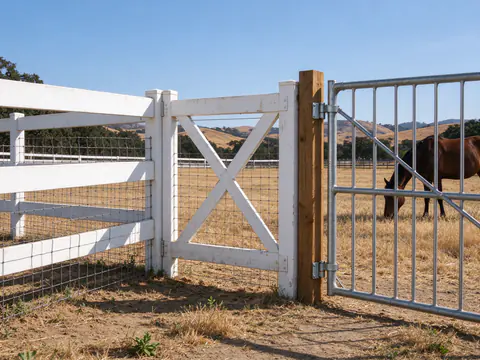
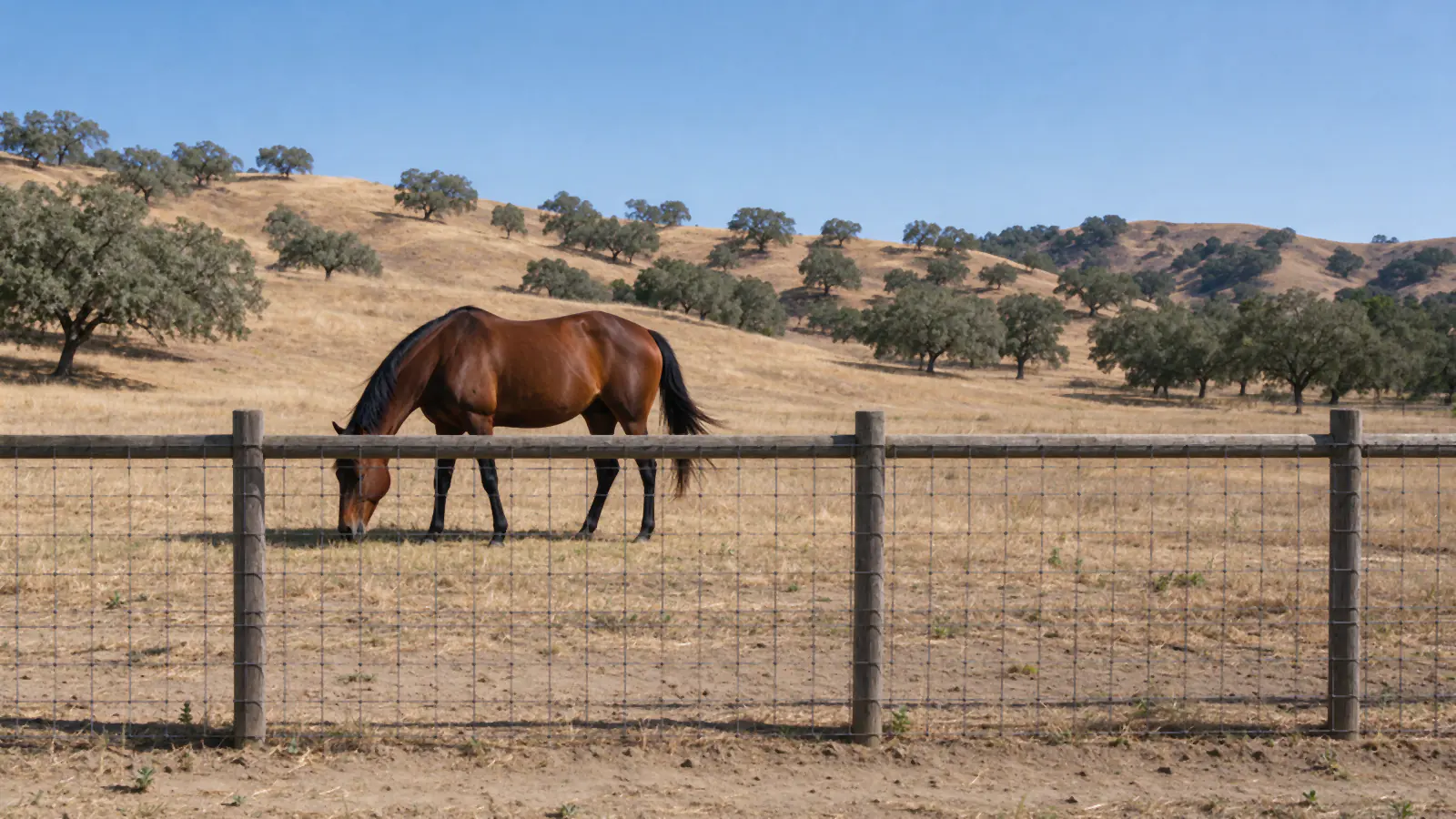
The best horse fence material depends on the horse and the use. For most pastures and paddocks it’s one of four systems: wood board, steel pipe, horse-rated polymer rail, or horse-rated woven no-climb mesh, often with a top rail. What decides between them is visibility, the size of any openings, strength against leaning and impact, and nothing sharp at horse height.
Cask Fence Temecula arranges horse fence installation in the wine country, Fallbrook, De Luz and the acreage around Temecula, with the work done by licensed and insured contractors. This guide compares the materials. The installation page covers corners, bracing, gates and layout.
Start with the horse, not the fence
Horses vary more than fences do. A quiet retired gelding in a large pasture puts little load on a fence. A young horse, a stallion, a mare with a foal or a herd sharing a fence line with neighbors’ horses tests it constantly. Small equines, ponies and minis can get through or under fences built for a full-size horse. How the space is used matters as well: a large pasture sees occasional contact, while a small turnout paddock sees horses leaning, rubbing and pacing the same stretch every day.
So the first questions are what horses, how many, how they get along, and whether the space is pasture or paddock. The system follows from that answer.
The main horse fence systems
| System | Visibility to horses | Strength and impact | Openings | Upkeep |
|---|---|---|---|---|
| Wood board | High | Strong, but boards can break and splinter on impact | Large spaces between boards | Paint or stain, replace chewed and broken boards |
| Steel pipe rail | High | Very strong and rigid; little give on impact | Large spaces between rails | Paint, check welds and caps |
| Horse-rated polymer rail | High | Designed to flex and stay intact under impact | Large spaces between rails | Low; check rail attachments and tension |
| Horse-rated woven no-climb mesh | Low on its own | Strong and gives on impact when tensioned | Small enough to keep hooves out | Keep tension, check the top and bottom |
| Mesh with a top rail or board | High | Mesh contains, rail adds visibility and stops leaning | Small | Both of the above |
| Decorative ranch rail | High | Not made for horse loads | Large | Low, but rails can come loose |
Wood board fencing, built much like a wood fence but with heavier rails, is the classic look and is easy for horses to see. Boards break under hard impact and can leave sharp ends, horses chew wood, and boards need finishing in this sun.
Steel pipe fencing is used for corrals and paddocks; San Diego County’s fence rules name pipe corral fencing outright. It’s strong and visible. It is also rigid, so a horse that hits it hard doesn’t get much give, and every cut pipe end and weld needs to be capped and smooth.
Horse-rated polymer rail is made for horse containment: rails designed to flex and stay intact under impact. That’s different from a residential vinyl ranch rail, which is made to mark a boundary.
Horse-rated woven mesh, often called no-climb, is woven wire with openings small enough that a hoof can’t pass through. It’s the usual choice for foals and small equines and for horses that paw at the fence. On its own it is hard for a horse to see, so it’s commonly paired with a top rail or board.
Decorative rail versus horse containment
This is the most common mismatch on horse property near vineyards and estate homes. A two- or three-rail decorative fence looks right and marks a boundary well, but it was never designed for a horse leaning over it to graze, rubbing an itch along it, or running into it. Rails can pop free of the posts, and gaps open. If the fence has to hold horses, it should be built from a system sold for that, with posts and attachments to match. Decorative rail still has a place along driveways, trails and road frontage where horses don’t touch it.
Fencing a pasture or paddock?
Tell us the horses, the acreage and how the space is used. That decides the system before anyone prices footage.
Openings, foals and small equines
Openings in a horse fence are either small enough that a hoof can’t go through, or large enough and high enough that a leg won’t wedge in them. The risk is in between: openings a hoof can push into but not easily pull back out of, such as wide-mesh field fence or a sagging wire strand. Those are the openings that can trap a hoof or leg.
Foals, minis and ponies change the math. They can roll or slip under a bottom rail set for a full-size horse and put a head or leg through openings an adult can’t. Mesh down close to the ground, or rails spaced lower, keeps them in. A pasture that holds both mares and foals is planned for the foals.
Visibility and contact hazards
Horses run into fences they can’t see. Mesh or wire alone can disappear against a dry hillside or at dusk, which is why a top rail, a board or a visible pipe rail is added along the top. Gateways and corners where horses move fast matter most.
At horse height, check for anything that could cut or snag: nail and screw heads backing out, cut wire ends at corners and gates, sharp edges on mesh where it’s been trimmed, uncapped pipe and T-post tops, and broken boards. Fasteners on the horse side of the fence are a common culprit. Attach rails and mesh so the smooth face is toward the horses where the system allows.
Horses also lean and rub, especially along a paddock fence or where the grass is greener on the other side. That load lands on the rails, the attachments and the posts. A top rail or offset that keeps horses from leaning directly on mesh protects the fence.
Electric offsets
An electric offset wire, a single hot strand set on brackets inside the fence, keeps horses from leaning, chewing or reaching over the main fence. It’s a specialist option. It needs a correct energizer, grounding and insulators, and it isn’t a substitute for a fence the horses can see and respect. Whether it fits your property is confirmed per project.
Local limits and ground
In the Temecula wine country, Riverside County’s design guidelines describe an area of trails, stables and equestrian facilities, but they also say fences and walls generally shouldn’t exceed 4 feet, apart from pool fences and retaining walls, and should avoid chain link, exposed metal and contrasting colors in public view. That favors wood or polymer rail and mesh on the street side, with heights confirmed per project. In Fallbrook and De Luz, San Diego County allows woven wire, wrought iron, pipe corral and rail fences to 72 inches in front and exterior side yards on lots of an acre or more in its agricultural and rural zones. The height and permit rules guide covers the details.
Under the fence, De Luz’s very stony ground and shallow bedrock make rock drilling common, and the layout often steps with the slope, as hillside fence installation explains. NRCS maps also show hardpan about 2 to 3 feet down at several sample points in the valley. The fence posts and soil guide explains what that means for posts.
As a national budgeting range, ranch or split rail fencing runs $15 to $35 per linear foot, and horse fence totals depend on length, braced corners and ends, terrain and gates. The cost guide explains those drivers, and the fence cost estimator gives a range for ranch rail footage. Gate openings for trailers and tractors are covered in the swing vs. sliding gate guide.
Inspecting a horse fence
Walk the fence after wind and on a regular schedule. Fix now: a broken board or rail with sharp ends, mesh torn or pulled loose, a leaning post that’s let the mesh sag, a gate that won’t latch. Plan for later: faded paint, chew marks on sound boards, a little slack you can re-tension. When a section is damaged, keep the horses off it until it’s fixed; a run of temporary fence panels can close off a damaged stretch.
To plan horse fencing for your property, call (951) 944-2778 or send the details.