There’s no single correct post depth, in Temecula or anywhere else. How deep a fence post goes is set by the fence’s height, the wind load on it, the soil or hardpan at your lot, any gate load, and the fence system’s own instructions. Frost, the driver in colder states, plays no part here.
Cask Fence Temecula plans fence, gate and wall work in Temecula and nearby southwest Riverside County communities, with posts set by licensed and insured contractors. This guide explains what holds a post up in local ground, why fences lean when it doesn’t, and what the post and footing choices are. If your posts are already moving, the fence repair page covers resets and replacements.
Why do fences lean?
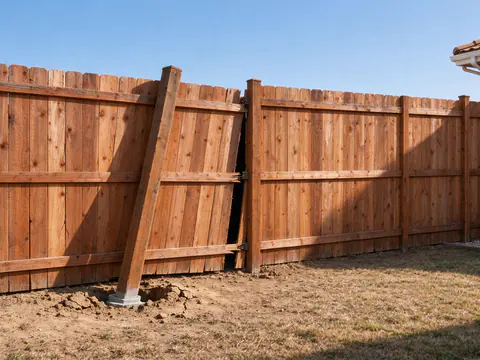
A post stays upright because the soil around its buried length pushes back when the fence above it is pushed. A fence leans when that resistance is lost. Three causes account for most of it, and they often act together.
Soil movement. Soil that swells when wet and shrinks when dry works a post loose over the seasons. Water that washes soil away from a footing, from a downspout, a sprinkler head or a heavy storm, takes away the support on one side. Temecula’s design rainfall is 3 inches an hour, which is a lot of water in a short time on a graded slope. Tree roots growing against a footing can also push a post out of line.
Wind. A solid 6-foot privacy fence works like a sail. The wind pushes on the whole panel, and that force acts as a lever on the post at the ground line. The city’s Building & Safety design data lists a 97 mph wind speed and Exposure C, the category for fairly open terrain, and offshore wind events load solid fences and gates hard. Homeowners report wind events knocking down many fences across a neighborhood at once.
Improper depth or footing. A post that is too shallow, a footing too narrow for the soil, or a post stopped short at hardpan doesn’t have enough buried length to resist the lever. It may stand for years and then go over in one storm.
Rot at the ground line. For wood posts there’s a fourth cause: the post itself decaying where it meets the soil. The fence leans not because the footing moved but because the post broke inside it. The termites and rot guide covers that.
| What you see | Likely cause | What to check |
|---|---|---|
| Post leans and the concrete collar tilts with it | Footing moved: shallow, undersized or undermined | Soil washed from one side, depth of the footing |
| Post leans but the concrete stays put | Post broken or rotted inside the collar | Probe the wood at grade |
| A whole run leans the same way | Wind on a solid run, or soil movement along it | Exposure, post spacing, drainage along the line |
| Post lifts or shifts with the seasons | Shrink-swell soil or a root | Clay soil, nearby trees |
| Gate post leans toward the gate | Gate load on an undersized post | See the sagging gate guide |
These are likely causes, not diagnoses. A leaning post can have more than one thing wrong with it, and some only show when the post comes out.
Why frost doesn’t set the depth here
In cold climates, posts go below the frost line so freezing soil can’t heave them. Temecula doesn’t have that problem. The NOAA 1991 to 2020 climate normals for the Fallbrook 5 NE station, on the south edge of the valley, show an average of 0.2 days a year with a low at or below 32°F, and a winter mean low near 47°F. Temecula’s own building design data lists wind, seismic, rainfall and climate zone values, and no frost depth. Rules of thumb written for frost country don’t transfer, which is why depth here comes back to wind, soil, height and the system.
What the auger hits, area by area
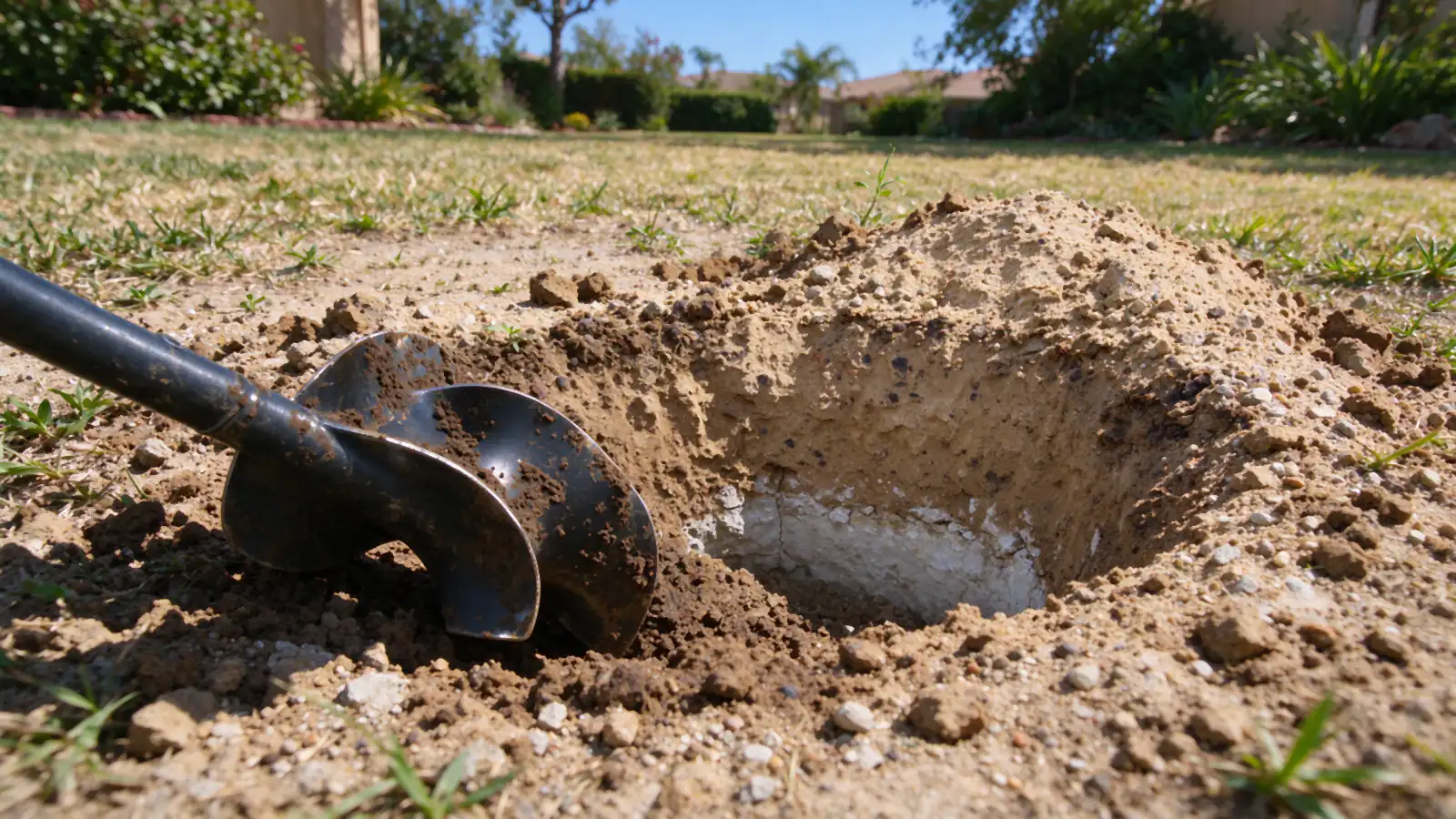
The USDA Natural Resources Conservation Service soil survey gives a good picture of what’s under the surface at sample points. The common surprise is a cemented layer called a duripan, or hardpan, that the auger can’t get through on its own.
| Area (sample point) | Mapped soil | What it means for post holes |
|---|---|---|
| Central Temecula | Arlington and Greenfield fine sandy loams | Hardpan at about 24 in. (61 cm) at the sampled Arlington soil |
| Paseo del Sol | Ramona and Buren loams | Hardpan at about 37 in. (94 cm) in the Buren soil |
| Redhawk, Old Town | Hanford coarse sandy loam | Coarse, sandy digging with low shrink-swell |
| Wolf Creek, Harveston | Mapped as gullied land before development | Now graded tracts on engineered fill, which digs differently from native soil |
| Menifee | Yokohl loam | Hardpan at about 26 in. (66 cm) |
| Winchester | Domino silt loam, saline-alkali | Hardpan at about 27 in. (69 cm) |
| French Valley | Monserate sandy loam | Hardpan at about 28 in. (71 cm) |
| Canyon Lake | Bosanko clay | High shrink-swell clay; weathered bedrock about 37 in. (94 cm) |
| De Luz | Cieneba-rock outcrop complex, very stony | Bedrock about 10 in. (26 cm) down, 40% rock outcrop |
| Lake Elsinore | Vallecitos loam | Hard bedrock about 48 in. (122 cm) |
| Fallbrook | Fallbrook sandy loam | Bedrock about 47 in. (119 cm) |
| Wildomar | Gorgonio loamy sand | Sandy; holes can cave in |
These are single points on a map, not a test of your lot. The soil a few streets away can differ, and grading moves soil around. A test hole tells you more than any map, and the area pages for Canyon Lake, Menifee, French Valley and Fallbrook cover local conditions.
When the auger stops short
Hitting hardpan or rock changes the method, not the depth. A standard auger stalls on a duripan, and the hole is finished with a rock auger bit, a core drill or a breaking bar or jackhammer. On rocky hillside ground in De Luz, every hole can be a drilling job, and the layout often steps down the slope; the hillside fencing page covers that.
That work takes time and is hard to predict from the surface, which is why a post set in concrete with rock below sits at the top of the $120 to $400 per post national budgeting range for post replacement. Before any digging, California law requires a DigAlert ticket at least two working days ahead, and utility locators mark only their own lines, not the private lines to a spa, pool heater or landscape lights.
Hit rock on the first hole?
Tell us where the fence runs and what the auger found. The footing plan can change before the posts go in.
Concrete, gravel or steel posts?
Concrete footings are the most common way to set fence posts here because they spread the post’s load into more soil and resist wind and gate loads best. The top of the concrete should be crowned so water runs away from the post rather than pooling against it. Some bagged post mixes are made to be set dry and take up ground moisture; homeowners report questioning crews who set posts that way. Whether it’s right depends on the product, so follow the mix maker’s instructions.
Gravel or crushed rock drains well and makes a wood post easier to pull and replace later. It gives less lateral resistance than concrete in loose sandy soil, so it suits lighter or shorter fences better than tall solid ones or gate posts.
Galvanized steel posts don’t rot and termites can’t eat them, which takes the fence’s usual weak point out of the ground. They’re set in concrete or driven, depending on the system, and carry wood rails and boards with brackets. The wood fence installation page compares them with wood posts.
Vinyl and metal systems each come with their own post sizes, footing guidance and, for vinyl gate posts, often a metal insert. The system’s instructions are the starting point for depth and diameter.
Gate posts, corner posts and end posts carry more load than line posts and get bigger holes and heavier posts. In expansive clay, the footing shape and drainage under the post matter as much as the fill around it.
Leaning posts: fix now or watch?
Fix soon:
- A post leaning over a walkway, a driveway or a neighbor’s yard.
- A post that moves freely when you push it, especially on a solid fence before a windy stretch.
- A pool fence post leaning enough to open a gap or stop the gate from latching.
Watch and plan:
- A slight lean that hasn’t changed in a long time.
- A post that is plumb but has soil washed from one side; restore the grade and fix the water source.
Before the posts go in
Ask any quote to name the post material and size, the spacing, how the footings are set, and what happens if hardpan stops the auger. A plan that says “posts set in concrete” and nothing else leaves out most of what this guide covers. For the order of steps before digging, see the planning guide; for a slope, the stepped vs. racked guide.
To talk through the posts for your fence, call (951) 944-2778 or send us the details.