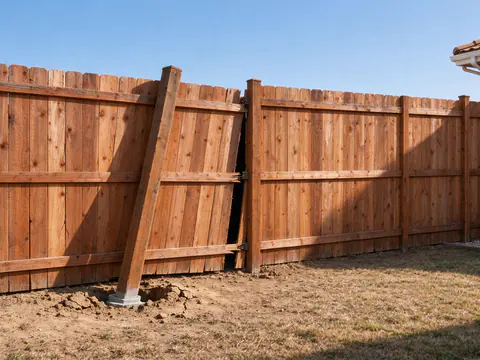
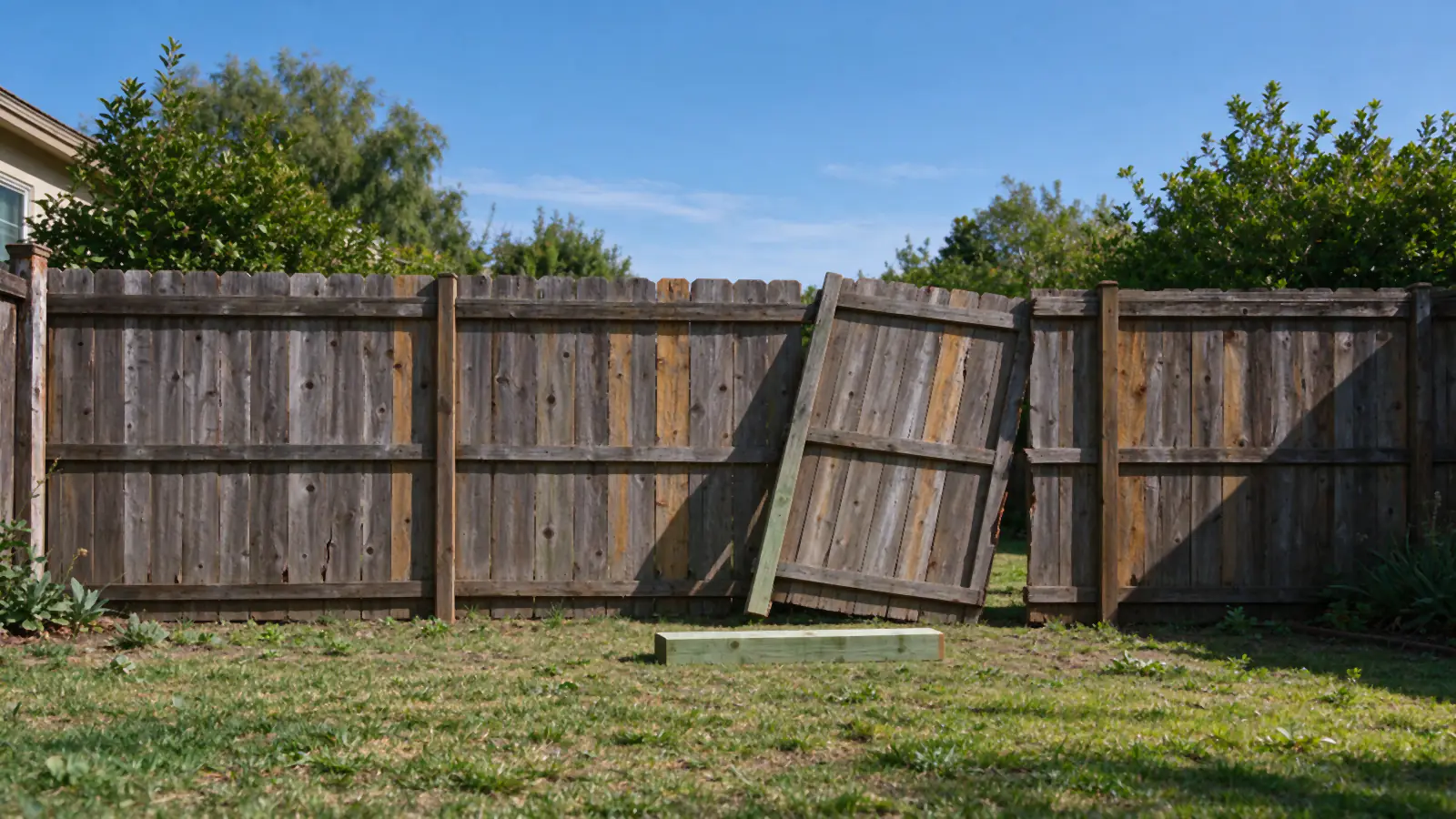
Repair a fence when the failure sits in one part, such as a post, a few boards, a gate or a single panel, and the rest of the fence is still sound. Replace it when the same failure keeps turning up along the whole line, or when the fence itself has to change: a new height, a new material or a fire-safe section at the house.
Cask Fence Temecula arranges both kinds of work across Temecula and the surrounding southwest Riverside County towns, from a single post reset through fence repair to a full tear-out and rebuild through fence replacement, with the work done by licensed and insured contractors. The question this guide answers is which one your fence needs.
Is it one part, or the whole fence?
Every fence is a system: posts in the ground, rails or a frame between them, boards, panels or fabric on the rails, and gates with their hardware. A repair works when one of those parts has failed for a reason that doesn’t apply to the rest. It stops working when the same part is failing everywhere, because then each repair just moves the problem to the next post.
| What you see | Usually points to | Leans toward |
|---|---|---|
| One post leaning, the rest plumb | That post’s footing, a washout, a tree root or a car or wind impact | Repair: reset or replace the post |
| Several posts leaning the same way along one run | Wind on a solid run, or soil movement along that stretch | Repair of that run, if the posts are still solid |
| Posts soft or crumbling at the ground line all along the fence | Rot or termites in the posts as a set | Replace |
| A few cracked or missing boards | Impact, a dog, a failed fastener | Repair |
| Boards loose everywhere, rails split or sagging between posts | Fasteners and rails at the end of their life | Replace, or rebuild on the existing posts if they test sound |
| A cracked vinyl panel or rail | Impact or a hard knock in cold or aged material | Repair, if the system can be matched |
| Vinyl chalky and cracking in many places | UV aging across the whole fence | Replace |
| A gate that drags or won’t latch | Hinge post, frame or hardware | Repair, see the sagging gate guide |
| Chain link fabric loose or bellied | Lost tension, bent rail or post | Repair: re-tension and fix the framework, not just the tie wires |
Visible symptoms don’t always prove one cause. A leaning post might have a rotted base, a shallow footing or a heaving clay soil around it, and you often can’t tell which until it comes out. That uncertainty is a reason to get the posts checked before anyone quotes a fix, not a reason to assume the worst.
Checks you can do from the yard
You can learn most of what matters without tools beyond a screwdriver.
- Count the posts that move. Push gently on the fence near each post. One or two that rock is a repair list. Half the fence rocking is a replacement conversation.
- Probe wood posts at the ground. Press a screwdriver into each wood post right at the soil line. Sound wood resists. If the tip sinks in easily, the post is decaying where it matters most.
- Look at the base of each post. Soil washed away from concrete, a concrete collar that has cracked or tilted, or soil and mulch piled against the boards all tell you how water is moving around the footing.
- Check for termite signs. Mud tubes on posts or boards near the ground point to subterranean termites. The termites and rot guide explains what to look for.
- Sight down the line. A fence that has wandered out of straight along a long run has posts moving as a group.
The fence repair assessment walks through these questions and sorts the answers into a planning category. It can’t see inside a post, but it does tell you what to ask about.
How long does a fence last here?
There’s no honest single number, and no fence comes with a guaranteed lifespan. What a fence’s life depends on is easier to say.
For wood, the post at the ground line sets the clock. A post rated for ground contact, or a galvanized steel post, lasts far longer than an untreated one, and homeowners do report finding untreated posts after an install. Sprinklers that wet the post bases every night shorten it. So do termites, which UC IPM notes attack wood in contact with soil. The boards above usually outlast the posts, which is why a fence with sound boards on rotting posts is still a replacement.
For vinyl, rot isn’t the issue. Age shows up as UV chalking, brittleness and cracks from impact, and the valley’s long run of hot days is part of that. The vinyl heat and fire guide covers how heat affects it.
For metal, the coating sets the pace. Where the paint or powder coat fails and rust starts at the base of the posts, the fence is aging; surface rust on a rail is maintenance.
Urgent, or can it wait?
Fix soon:
- A pool barrier gate that no longer self-closes and latches, or a gap opening at the bottom of a pool fence. That’s a safety enclosure, not a style feature; see the pool fence requirements guide.
- A section leaning over a walkway, a driveway or the neighbor’s yard after a wind event.
- A broken fence that a dog or a horse can now get through.
- A post snapped at the ground and held up only by its rails.
Can wait and be planned:
- Gray, weathered boards that are still solid.
- One loose board or a missing cap.
- A gate that rubs a little but still latches.
- Faded vinyl with no cracks.
Not sure which list your fence is on?
Send a few photos of the posts at ground level and the worst section. That's usually enough to tell a repair from a rebuild.
What tips the decision in Temecula
Wind. The city designs for a 97 mph wind and Exposure C, and homeowners report wind events knocking down many fences in a neighborhood at once. When a solid fence comes down in wind, check whether the posts snapped at rot or pulled out of shallow footings. Snapped rotten posts mean the rest are close behind. Pulled footings may mean the fence just needs deeper or heavier posts on that run. The fence posts and soil guide explains why.
Hardpan and rock. Replacing a post here can mean breaking out an old concrete footing and then drilling through cemented hardpan, which is why one post can cost more than people expect. That doesn’t change the repair-or-replace answer by itself, but it changes the math.
Shared fences. Under Civil Code 841, adjoining owners are presumed to share the reasonable cost of a boundary fence equally unless they agree otherwise in writing, with 30 days’ written notice before the work. A full replacement on a shared line is a bigger conversation than fixing one post, and the good neighbor fence law guide covers it.
HOA rules. A like-for-like repair rarely changes how the fence looks. A replacement can, and if the material, color or height changes, your association’s approval process applies. Check your CC&Rs before choosing a new material; the HOA approval guide has the steps.
Fire zones. In very high fire hazard zones, California is moving toward Zone 0 rules for the 5 feet next to a house. The proposed rules, described in a Board of Forestry staff memo, would let an existing combustible fence stay and be repaired with the same materials, would bar new combustible fencing within 5 feet of the home, and would require a noncombustible section where a fence or gate attaches to the house within five years. Those rules are proposed, not final. If you are replacing the section that meets the house anyway, building it in metal or masonry now saves doing it twice. See fire-resistant fence installation.
What the two paths cost
These are national budgeting ranges, not a Temecula price and not a quote. A typical fence repair job runs $200 to $950, a fence post replacement $120 to $400 per post, a 6-foot wood privacy fence $10 to $50 per linear foot, and removal of an old fence $3 to $7 per linear foot.
| Illustrative scenario: 100 ft of 6 ft wood fence | Math | Illustrative range |
|---|---|---|
| Repair: replace 4 failed posts | 4 × $120 to $400 per post | $480 to $1,600 |
| Replace: new 6 ft wood fence | 100 ft × $10 to $50 per ft | $1,000 to $5,000 |
| Replace: tear-out and haul-away | 100 ft × $3 to $7 per ft | $300 to $700 |
| Replacement total | $1,300 to $5,700 |
This example is illustrative only. It shows the shape of the decision: four posts can be a sensible repair, but if four more will fail next year and four the year after, the repairs add up toward the price of a new fence without ever giving you one. The cost guide breaks down the rest of a price, and the fence cost estimator gives a range for a full replacement.
Getting a straight answer
Ask whoever looks at the fence to say which posts are sound, which are not, and why. A good assessment separates the parts that failed from the parts that are fine, and tells you whether the failure is likely to spread. If the answer is “replace everything” with no post-by-post reason, or “just patch it” on a fence that is soft at every post, ask again.
To have your fence looked at, call (951) 944-2778 or send the details and a few photos.