
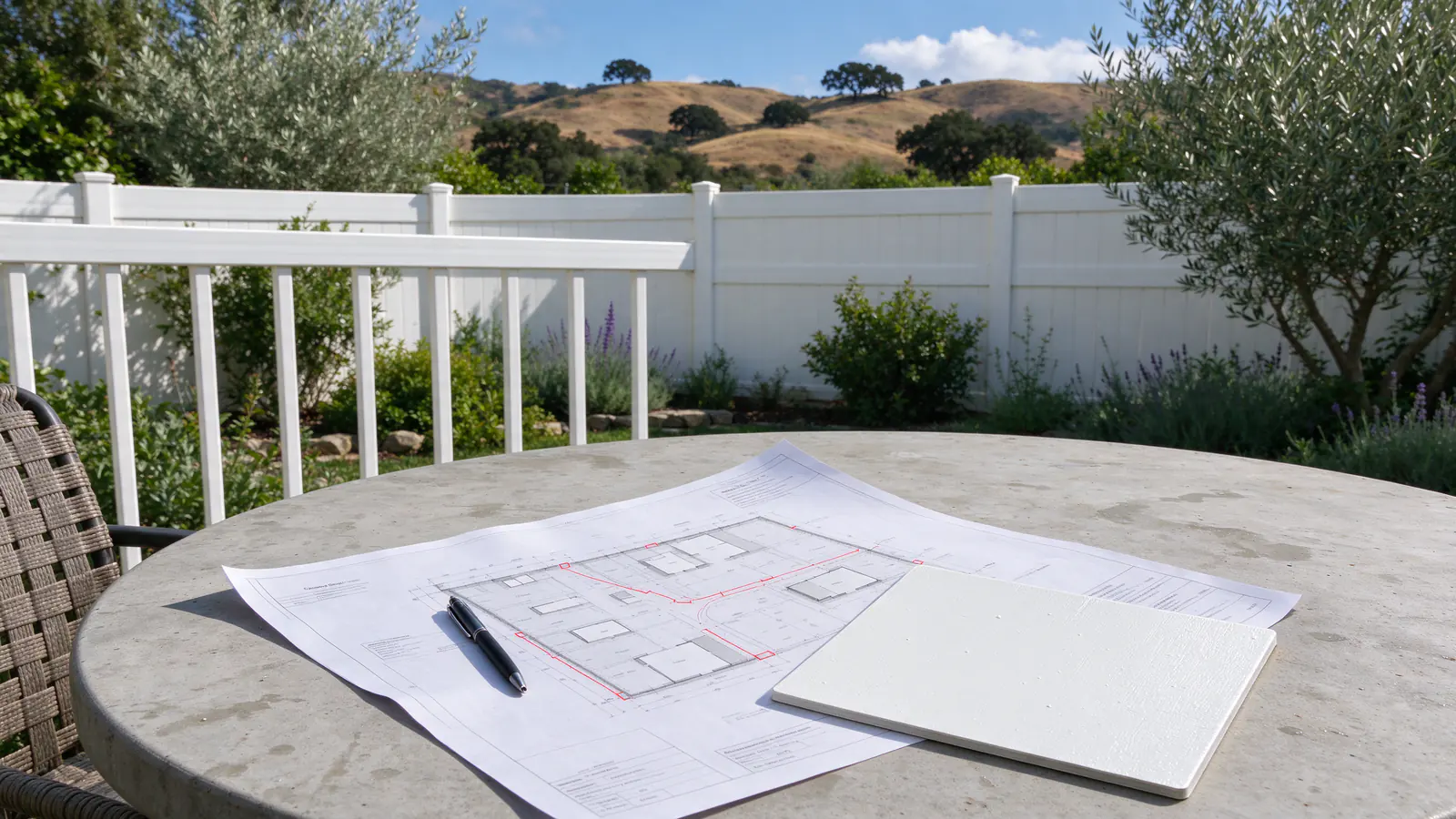
Get your association’s current architectural guidelines, submit a drawing and product details for the exact fence you plan to build, and wait for a written decision before any post goes in. California Civil Code 4765 requires the association to decide in writing, in good faith, within the maximum time its procedure states, and to explain any denial and offer board reconsideration.
Cask Fence Temecula plans and manages fence, gate and wall projects in Temecula and the surrounding towns, carried out by licensed and insured contractors, and the HOA submittal is part of the paperwork step on projects in planned communities. Owners are often surprised by how much the association can control and by how much state law controls the association in turn. This guide covers both.
What state law requires of the association
Civil Code 4765 applies whenever an association’s governing documents require approval before an owner makes a physical change to their lot or to common area. A fence almost always counts. When it applies, the association must meet these requirements:
- A fair, reasonable and expeditious procedure, written into the governing documents, with prompt deadlines and a stated maximum time to respond to an application or to a request for reconsideration.
- Good faith. A decision can’t be unreasonable, arbitrary or capricious.
- Lawful outcomes. Whatever the documents say, a decision can’t violate the law, including fair housing law and any building code or other law on land use or public safety.
- Writing. The decision is in writing. If it’s a denial, it explains why and describes how to ask the board to reconsider.
- Reconsideration. An owner whose change is denied is entitled to reconsideration by the board at an open board meeting. That doesn’t apply when the board itself, or a body with the same members, made the original decision at a properly held meeting.
Two more parts are useful. The association must give members notice every year of what kinds of changes need approval, with a copy of the review procedure, so the rules shouldn’t be a mystery. And the statute doesn’t let the association authorize a change to common area that’s inconsistent with its governing documents unless the law requires the change.
What a fence application usually includes
Each association sets its own form, but architectural committees ask for much the same information, and a submittal that answers it all the first time avoids a round trip:
- A site plan of your lot showing the fence line, its length, gate locations and how it relates to the property line, the house and any easements. A copy of the recorded lot map with the fence drawn on it often works.
- Height of each run, and how it steps or follows a slope.
- Material and style: board-on-board wood, a vinyl privacy profile, tubular steel, block with pilasters. Include the manufacturer’s product sheet or photos.
- Color and finish, with a sample or the color name if the guidelines list approved colors.
- Which side faces out, and what the cap and post tops look like.
- Gates: width, swing and hardware.
- Neighbor information for a shared fence, if the guidelines ask for it, such as the adjoining owner’s acknowledgment.
- Contractor details, if the form asks for them.
If you aren’t sure where the line is, settle that before you draw it; the property line survey guide covers how. Style choices are easier to compare in the privacy fence styles guide and the aluminum vs. wrought iron guide.
Why rules differ between Temecula communities
Owners in Redhawk, Harveston, Wolf Creek, Paseo del Sol, Meadowview, Morgan Hill, Temeku Hills, Crowne Hill, Vail Ranch and Roripaugh Ranch go looking for their community’s fence rules for a good reason: they aren’t interchangeable. Each association writes its own guidelines and revises them on its own schedule. We don’t summarize any community’s rules here, because the only reliable version is the current one from your association.
The things guidelines tend to cover are predictable, even when the answers aren’t. Material, color and height are almost always there. Many guidelines also address view fencing along rear slopes, how a fence meets a block wall or pilaster, the finished side facing the street, and what can be attached to or grown on the fence. In Temecula tracts built with block walls and pilasters, the city’s own block wall standard already limits what can attach between pilasters to open fencing like wrought iron, and guidelines often build on that.
Canyon Lake is its own case: architectural review for the gated city runs through the property owners’ association, so fence standards there are confirmed per project with the POA. The Canyon Lake page has more.
How long approval takes, and what to do meanwhile
The timeline is whatever your association’s procedure says; the statute requires a stated maximum response time but doesn’t set one. Ask the management company for that figure when you request the form, and note the date you submit.
The wait doesn’t have to be dead time. For a shared boundary fence, the 30-day written notice to the neighbor under Civil Code 841 can run at the same time; the good neighbor fence law guide covers what it must say. Check height and permit questions with the city in parallel, using the height rules guide. Don’t book the build or order special colors until the written approval is in hand, because a condition of approval can change the material or the height.
Putting together an HOA submittal?
Send the guidelines and the fence line. A complete drawing and product sheet saves a resubmittal.
If the application is denied
Read the written explanation first; it should say what’s wrong. Often it’s fixable: a color that isn’t on the approved list, a height over the guideline, a missing site plan. Revise and resubmit, or ask what change would be approved.
If you think the decision is wrong, request reconsideration by the board at an open meeting, following the procedure the denial describes. Bring the guideline language, photos of comparable approved fences in the community if they exist, and anything showing the decision is inconsistent with the documents or the law. Board reconsideration is separate from the formal dispute resolution procedures elsewhere in the Civil Code, which an attorney familiar with community associations can explain.
Building without approval
It’s tempting when a fence is down after a windstorm and the dog needs a yard. The risk is that the governing documents typically let the association require changes to, or removal of, an unapproved fence, on top of any fines its rules allow. If you need something up quickly, ask the association whether it has an expedited path for replacing a damaged fence with an identical one, and get that answer in writing. A temporary fence can hold the line while the application is reviewed.
Where HOA rules meet city and state rules
The association’s approval is one layer. The city’s height limits and permits are another, and the strictest rule controls each stretch of the line. Some situations come up repeatedly:
- Pools. Temecula requires an enclosure that meets Health and Safety Code 115923 for a new or remodeled pool. An association can choose the look but can’t approve a barrier that falls short. See the pool fence requirements guide.
- Fire zones. In very high hazard zones, proposed state rules would bar new combustible fences within 5 feet of a home. They’re proposed, so check their current status, but a design that uses a metal section where the fence meets the house is worth raising with the committee now. See fire-resistant fence installation.
- Shared fences. HOA approval doesn’t replace the neighbor notice, and the neighbor’s agreement doesn’t replace HOA approval.
When the approval is in hand, the planning guide covers the steps that follow, and a vinyl or wood quote can be written to the approved specification. Call (951) 944-2778 or send your guidelines and fence line to start.