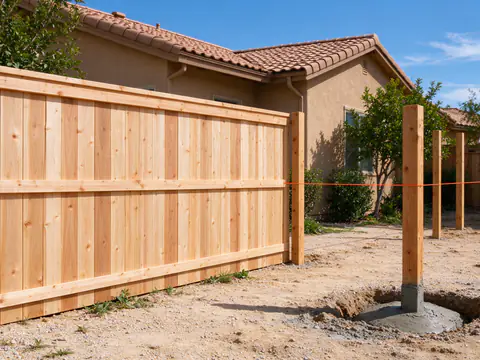
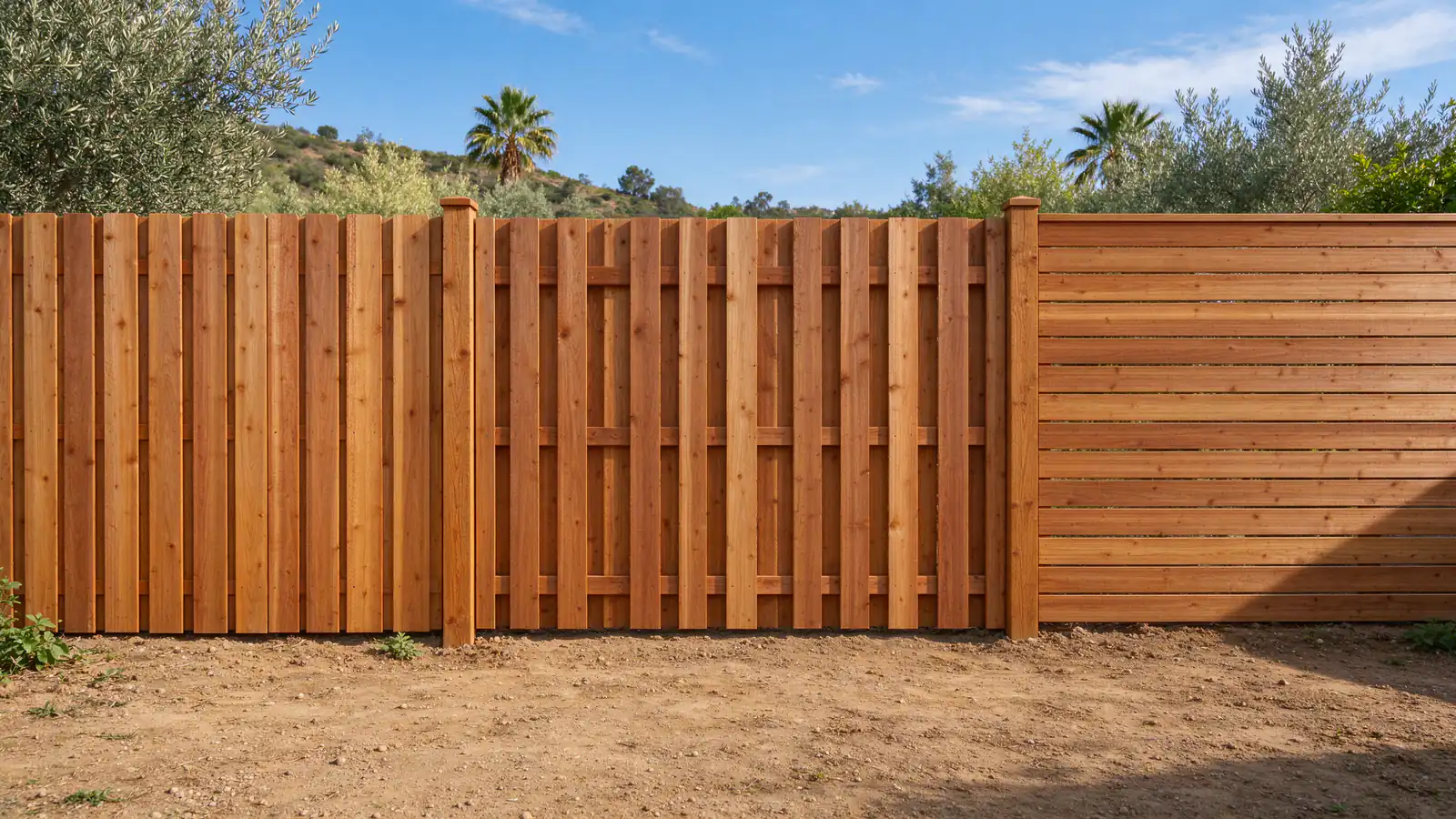
Board-on-board gives the most complete privacy and stays closed as boards shrink; shadowbox comes close and looks the same from both sides; stockade is the simplest solid fence; horizontal suits modern houses; lattice-top, spaced-board and picket fences trade privacy for light and airflow. The more solid the style, the more wind it catches, so the posts have to match.
Cask Fence Temecula plans and manages fence projects for homes in Temecula and nearby southwest Riverside County towns, with the work done by licensed and insured contractors. Most styles here are built in wood, and several have vinyl versions; the wood fence installation and vinyl fence installation pages cover how each is built. This guide is about choosing the style itself.
Styles at a glance
| Style | Privacy | Wind it catches | Neighbor’s side | Board use | Fits best |
|---|---|---|---|---|---|
| Board-on-board | Complete, even as boards dry | Full: acts as a solid wall | Rails show on one side | Most boards per foot | Side and rear lines where privacy matters most |
| Shadowbox | Near complete head-on, partial at an angle | Somewhat less than solid | Looks alike from both sides | More than single layer | Shared lines where both owners see the fence |
| Stockade | Complete when new; slits open as boards shrink | Full | Rails show on one side | Single layer | Budget privacy runs |
| Horizontal | From complete to partial, set by the gap | Near full when gaps are tight | Depends on build; can look alike both sides | Long boards, closer posts | Modern and contemporary houses |
| Lattice-top | Complete below the band, open above | Less in the open band | Usually framed both sides | Lattice plus boards | Softening a tall line, adding light |
| Spaced picket or semi-privacy | Partial | Noticeably less | Often alike both sides | Fewest boards | Front yards, gardens, pets that need to see out |
Full privacy: board-on-board, stockade, solid panels and horizontal
A full privacy fence blocks the view from any angle. Four styles get there in different ways.
Board-on-board hangs two layers of boards on the same side of the rails, the second layer overlapping the gaps in the first. Its advantage shows in summer. Inland boards dry out and shrink across their width during the long run of 90°F afternoons the valley gets, and a single layer of boards that was tight at install opens up into a row of slits. The overlap hides that. The cost is more boards per foot and more weight on the posts.
Stockade butts single boards edge to edge, usually with pointed or dog-ear tops. It’s the plainest solid fence and the lightest on lumber. It’s private on day one; how private it stays depends on how dry the boards were when installed.
Solid vinyl panels give complete privacy with no shrinkage gaps, because the panel is a single interlocking face. The trade-offs are covered in the wood vs. vinyl guide.
Horizontal fences run boards between the posts instead of up and down. With tight joints they’re as private as any vertical style. The catch is span: a long horizontal board sags or bows between posts unless the posts are closer together or the boards are thicker, and that adds posts and cost.
Semi-privacy: shadowbox, lattice-top and spaced boards
Semi-privacy styles give up some screening to let light and air through. They fit lines where you want the yard defined and the view broken up, but don’t need it blocked completely.
Shadowbox alternates boards on each side of the rails, offset so each board covers part of the gap on the other side. Head-on it reads as nearly solid; at an angle you see through. Because it looks the same from both sides, it’s a natural pick for a shared boundary, and the offsets let some wind pass.
Lattice-top puts a short band of open lattice above a solid fence. It lightens a tall line and catches less wind in the top band. It doesn’t add legal height for free: height limits are generally measured to the top of the lattice.
Spaced boards in any orientation, vertical or horizontal, leave a deliberate gap. A narrow gap screens most of the view from a distance and still reads as a fence up close.
The choice between privacy and semi-privacy usually comes down to two questions. What are you screening, and from where? A patio below a neighbor’s upstairs window needs height and no gaps. A back line facing open slope may only need the yard to feel enclosed.
Picket fences
A picket fence isn’t a privacy fence; it marks a line and keeps small dogs and children in without hiding the house. It’s usually 3 to 4 feet high, which lines up with front-yard limits in many local codes. Lake Elsinore caps fences in required front yards at 36 inches, except wrought iron to 5 feet. In Fallbrook, San Diego County limits solid front-yard fences to 42 inches. Temecula’s own front-yard limits are confirmed for your address with the Planning Division. In the Temecula wine country, the county’s design guidelines discourage any fence over 4 feet other than pool fences and retaining walls, so picket and rail styles are often the natural fit there; see the wine country area page.
Wind load on solid fences
A privacy fence doesn’t stop wind; it takes the push. Temecula’s Building & Safety design data sets a 97 mph wind speed in Exposure C, the category for fairly open terrain, and offshore Santa Ana events push hardest on exactly the fences people build for privacy. A solid 6 ft fence presents its whole face, and that force pries at every post where it enters the ground. Add height to a solid face and you add area catching wind, with the push acting farther up the post, so the bending at the ground line climbs faster than the height does.
That is why style and structure have to be chosen together. Solid styles call for stiffer posts, closer spacing or deeper footings than open styles of the same height, and galvanized steel posts are a common answer on exposed lines. There is no single post depth that suits every fence, because height, solidity, exposure, soil and the system’s instructions all set it; hardpan sits about 0.5 to 1 m down at NRCS sample points in Temecula, Menifee and French Valley. The fence posts and soil guide covers footing options. Gates in solid styles act as sails on their hinges, so the gate installation page is worth reading before you choose a solid gate.
Height, permits and slopes
The 2025 California Residential Code exempts fences not over 7 feet from a building permit, but the City of Temecula’s fee schedule carries a fence permit line beginning at 6 feet, and zoning sets yard-by-yard height limits. An 8 ft privacy fence is a question for Temecula Building & Safety before it’s a design. The height and permit rules guide has the thresholds.
On a slope, style affects how the fence follows the grade. Site-built wood styles can rack or step freely, while many vinyl panels rack only within the manufacturer’s limit. The stepped vs. racked fence guide shows both.
The neighbor’s side and the HOA
Most styles have a finished face and a rail side. On a shared boundary, who gets which side is part of the conversation, and Civil Code 841 calls for 30 days’ written notice before a shared fence is replaced. Shadowbox and some horizontal builds sidestep the question by looking alike from both sides. The good neighbor fence law guide explains the notice. In a planned community, the architectural guidelines may already name the style, height, cap and which face points out, so check them before choosing; see the HOA fence approval guide.
What style does to the budget
The national budgeting range for a 6 ft wood privacy fence is $10 to $50 per linear foot, and vinyl privacy fencing runs $15 to $85. Style moves a job within those ranges: board-on-board and shadowbox use more boards than stockade, horizontal adds posts, and lattice adds a second material. The cost guide and the fence cost estimator put numbers to your footage.
Choosing a style
Start from what you need to screen and from where, then check what the HOA and the zoning allow, then size the posts to the style. If pets are part of the plan, the dog fence guide covers bottom gaps and heights. To talk through a style for your yard, call (951) 944-2778 or send the details.