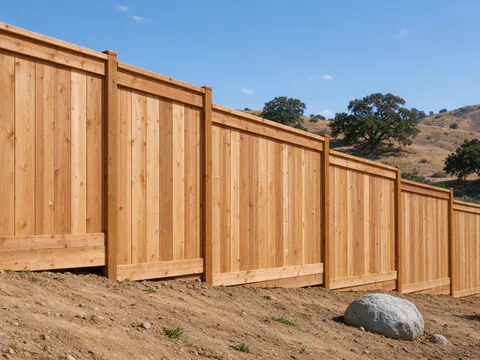
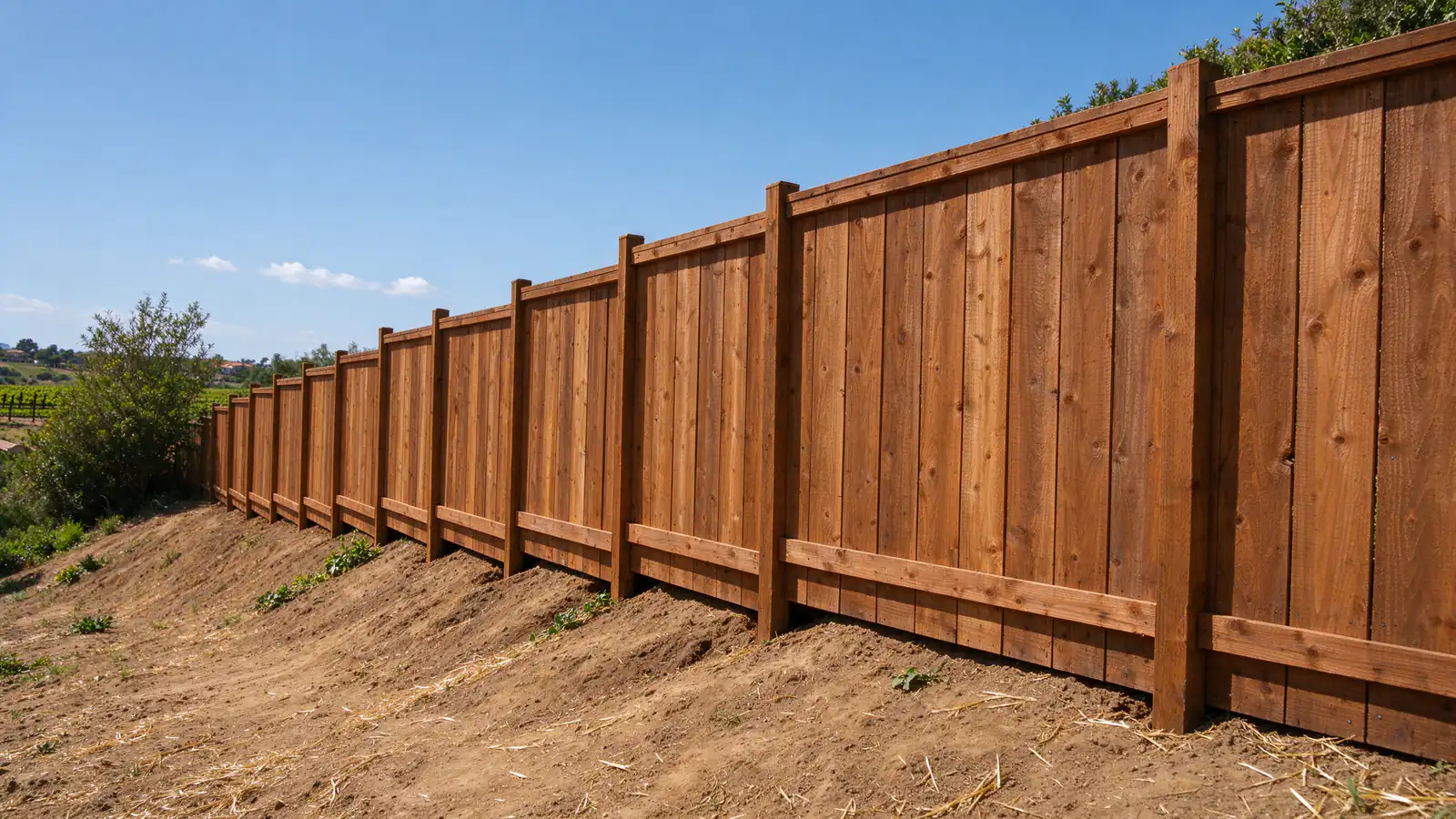
Rack when the grade is gentle and steady and the material allows it: the panels tilt with the ground and the bottom stays close to grade. Step when the slope is steep, uneven or beyond a panel’s rack limit: each section stays level and drops at the post, leaving triangular gaps underneath that may need closing for dogs or a pool.
Cask Fence Temecula plans and manages fence and wall projects on sloped lots across Temecula and southwest Riverside County, carried out by licensed and insured contractors. Slopes are everywhere here, from tract back yards that end at a manufactured 2:1 slope to the rocky hills of De Luz and the rolling lots of the wine country. The hillside fence installation page covers how those jobs are built; this guide covers the choice between the two ways a fence follows the ground.
How the two methods compare
| Question | Racked | Stepped |
|---|---|---|
| How it follows the grade | Rails run parallel to the slope; pickets stay plumb | Each section level; height drops at each post |
| Gap at the bottom | Small and even along the run | Triangular gap under the high end of each section |
| Top line | Follows the slope | Stair-step profile |
| Slope it suits | Gentle, steady grades | Steep or uneven grades |
| Materials | Site-built wood freely; manufactured panels within the maker’s limit | Any panel or system |
| Posts | Standard height | Taller posts on the downhill side of each step |
| Pools and pets | Easier to hold a small bottom gap | Gaps must be closed with filler boards or other means |
| Look | Continuous, follows the land | Crisp and level, reads clearly from the house |
What a sloped yard does to a fence
Every fence on a slope has to solve the same geometry: the ground falls away while posts stay plumb. Something has to give. Either the panel tilts to match the ground (racking) or the panel stays level and the fence drops at each post (stepping). Sloped yard fencing goes wrong when that choice is made by default on install day, not in the plan, because it changes post heights, material lengths, gate locations and how the fence meets the ground.
Before the layout, measure the drop. Stretch a level string from the top of the first post location to the second and measure down to the ground at the far post. Repeat along the line. A steady drop of a few inches per section points toward racking. Large or changing drops, a sudden grade break, or a run that goes over a crest point toward stepping, or a mix of both.
Rackable panels and site-built racking
A racked fence keeps the rails parallel to the ground and the pickets or boards plumb, so the panel becomes a parallelogram. In wood that’s easy: the rails are cut and fastened at the slope angle on site and each board is set plumb. That’s one reason wood is so common on hillside lots.
Manufactured panels are different. Rackable fence panels in vinyl, aluminum and steel are built so the pickets can pivot on the rails, but only through a set range, which the manufacturer states as a rack limit. Within it, the panel follows the grade cleanly. Beyond it, the pickets bind or the panel won’t seat, and the fence has to step or use a panel built for that slope. Many vinyl privacy panels have little or no rack, so ask for the limit of the specific system before you choose it for a sloped line. The aluminum vs. wrought iron guide covers which metal systems usually rack.
Stepped fence installation
A stepped fence keeps each section level and drops at each post. The posts on the downhill side of each step are taller, because they carry the top of one section and the top of the next, lower one. Step heights look best when they’re even, so the layout often adjusts post spacing slightly so each step drops the same amount.
The result is a triangle of open space under the high end of each section. On a gentle slope it’s small; on a steep one it can be a foot or more. It can be closed with a filler board cut to the grade, with longer boards that run down to the dirt in wood, or in metal with a panel that has extended pickets. Whatever closes it, keep the wood off the soil: UC IPM notes subterranean termites infest dead wood in contact with soil, and a board buried at the bottom of a step is exactly that.
Combining the two
Most real slopes aren’t a single grade. A line can rack across a gentle section of the yard and step where it drops over the edge of a pad. The trick is to put the change at a post, keep the steps even, and decide on paper where each transition goes so the gates land on level ground.
Pools, pets and the gap at the bottom
Pools. Temecula’s pool handout (CD15) allows no more than 2 inches of ground clearance on a pool enclosure, and that limit applies along the whole run, including the low end of every step. A racked metal fence can usually hold it; a stepped fence needs each triangle closed. The pool fence requirements guide covers the rest of the rules.
Dogs. Dogs find the gap. Owners in Temecula have described installers leaving a fence bottom about an inch and a half above grade, with fill dirt pushed under it to close the gap that then washed out in rain and let dogs dig through. On a slope that problem is bigger, so agree in writing how the bottom will meet the ground. The dog fence guide has bottom details.
Drainage and soil against the fence
A fence on a slope sits across the path of runoff. Temecula’s block wall standard states that no water course or natural drainage may be obstructed, and the same logic applies to any fence: a racked fence set tight to the ground or a stepped fence with filler boards packed into the soil can act as a small dam during a winter storm, and the city designs for 3 inches of rain an hour.
Leave the drainage swale between lots open, and don’t build up soil against the fence to level it. Soil held back by fence boards makes the boards a retaining wall they weren’t designed to be. The city’s standard treats more than 6 inches of grade difference across a block wall as a retaining wall, which is a different structure with its own design and possibly a permit. If the yard needs a grade change, the retaining wall installation page covers it.
Posts at the top of a slope
Many tract yards end at a manufactured slope, and the fence runs along the top. Posts set right at the edge have little soil in front of them to resist the push of wind on a solid fence, and Temecula designs to a 97 mph wind in open Exposure C terrain. Temecula’s block wall standard requires footings near a slope to keep at least 5 feet of horizontal distance to the slope face; a fence post isn’t a block wall footing, but it’s a good picture of how much ground a footing needs in front of it. Setting the line back from the edge or deepening the footing are the usual answers, and hardpan or rock can change how deep a hole can go. The fence posts and soil guide goes into the options, and rocky hillside lots in De Luz, where NRCS samples show bedrock about 26 cm down, often step simply because the holes can’t go where a racked layout would put them.
Gates on a slope
A gate that swings uphill hits the ground. Put gates on the flattest part of the line, swing them downhill, or level a short pad at the opening. For driveways, the slope often decides between a swing and a sliding gate; the swing vs. sliding gate guide explains why, and gate installation covers posts and hardware.
What a slope does to cost
Slope pushes a fence toward the top of its national budgeting range: a 6 ft wood privacy fence runs $10 to $50 per linear foot and vinyl $15 to $85. Stepped runs use taller posts and more cuts, racked manufactured panels can cost more than flat ones, and filler boards add material. The cost guide explains each factor and the fence cost estimator runs your footage.
To talk through a fence on a slope, call (951) 944-2778 or send the details.