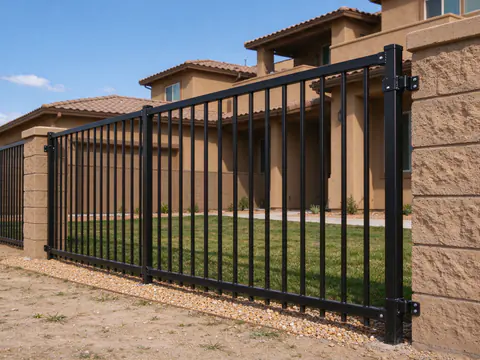
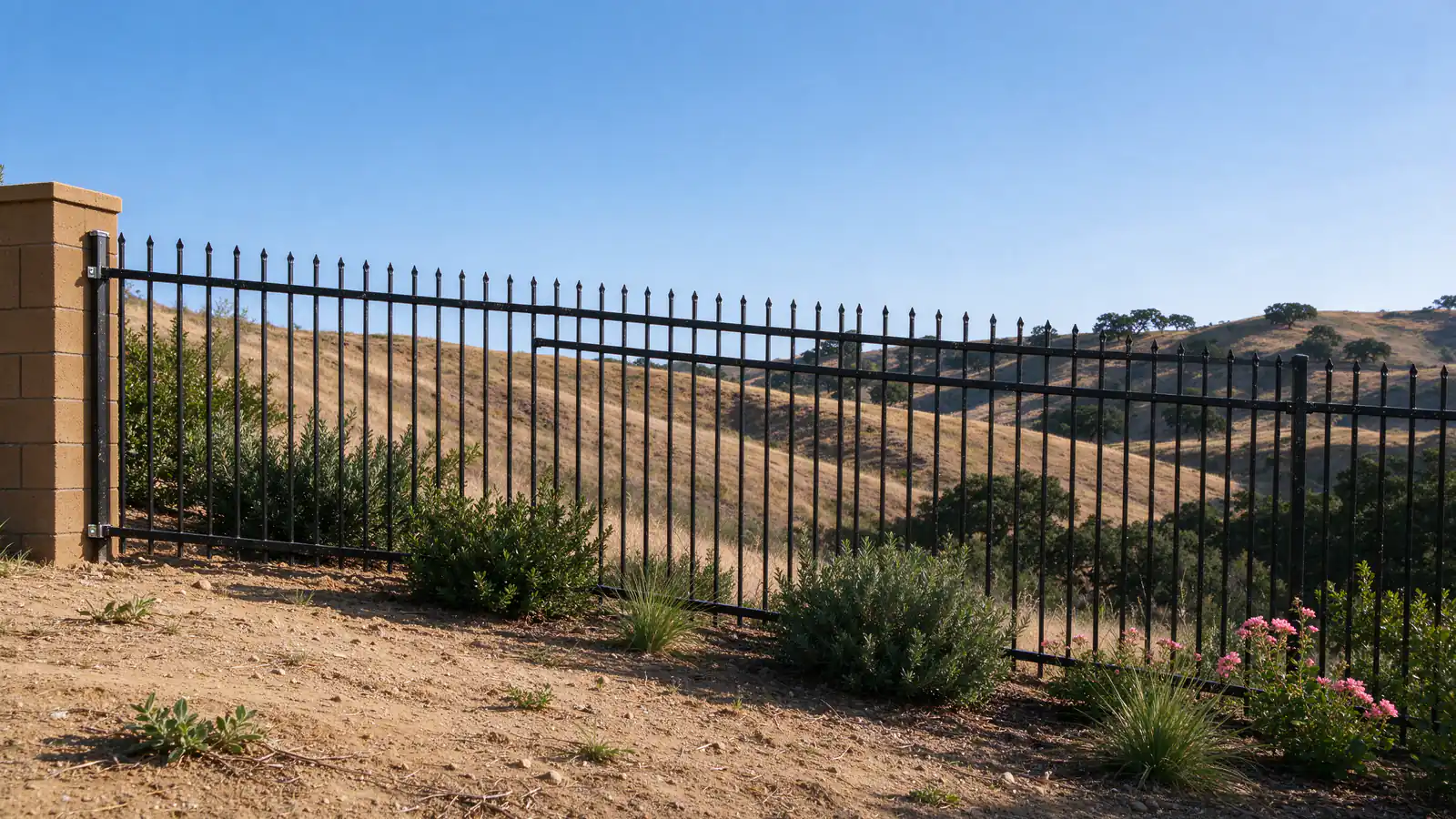
Pick aluminum for a light, rust-free open fence around a pool or along a view slope; pick steel, which is what nearly all new “wrought iron” fencing is, for drive gates, security and custom work where stiffness matters. National budgeting ranges: aluminum $40 to $75 per linear foot, wrought iron or tubular steel $25 to $85. Steel rusts where its coating breaks; aluminum doesn’t.
Cask Fence Temecula plans and manages metal fence and gate projects across Temecula and southwest Riverside County, with the work done by licensed and insured contractors. Open metal fencing is common here because so many back yards end at a manufactured slope or look out over the valley, and Temecula’s block pilaster standard allows only open fencing like wrought iron between pilasters. For the build details, see wrought iron fence installation.
What “wrought iron” means today
True wrought iron is a historic, hand-worked material that is rarely produced now. When a fence is sold as wrought iron today, it is almost always steel: solid bar or square tube, cut and welded into panels, then painted or powder-coated black or bronze. “Ornamental iron” and “tubular steel” describe the same family. Solid bar is heavier and harder to dent; tubular steel is lighter and cheaper but can rust from the inside if water gets into the tube.
Aluminum fencing looks much the same from the street. It is extruded aluminum, usually sold as pre-made panels in standard heights, with pickets fastened or welded to the rails and a factory powder coat. The difference shows in weight, stiffness and what happens over time at a scratch.
Aluminum and steel compared
| Question | Aluminum | Steel (“wrought iron”) |
|---|---|---|
| National budgeting range | $40 to $75 per linear foot | $25 to $85 per linear foot |
| Weight | Light; easy to carry into tight side yards | Heavy; solid bar heavier than tube |
| Stiffness | Flexes and dents sooner under impact or load | Stiffer over long spans and wide gates |
| Rust | Does not rust; coating can chip | Rusts wherever the coating breaks |
| Typical coating | Factory powder coat | Paint or powder coat, ideally over galvanizing |
| Customization | Standard panels and heights | Fabricated and welded to fit, including on site |
| Slope | Many panels rack within the maker’s limit | Can be built to follow the grade |
| Drive gates | Narrow, light gates within maker’s limits | The usual choice for wide or automated gates |
| Within 5 ft of the house | Noncombustible | Noncombustible |
Coatings: what protects the metal
On steel, the coating is the whole defense, so how it is applied matters more than the color. Three layers are common. Galvanizing puts zinc on the steel, which protects it even at small scratches because the zinc corrodes first. Primer and paint seal the surface and are easy to touch up but need recoating on a cycle. Powder coat is a baked finish that is tougher and more even than paint. The longest-lasting steel fences combine galvanizing under powder coat; powder coat over bare steel looks the same on day one but has nothing behind it once chipped.
Aluminum doesn’t need a coating to resist rust, because it forms its own thin oxide layer. The powder coat on aluminum is mainly for color and looks. When it chips, the bare spot turns dull rather than red, and the damage stays cosmetic unless the metal itself is bent or cracked.
Fabrication also matters. A weld made on site after coating burns the finish around the joint, and a cut end is bare metal. Both need cleaning and touch-up the same day. Ask whether a steel fence will be fabricated and coated before delivery or welded in place, and how field welds will be finished.
Where corrosion starts
Corrosion attacks the metal parts of a fence at predictable points, and it starts wherever the coating has a break.
- The base of each post. Soil, mulch, irrigation and standing water keep the bottom of a post wet. On steel, this is where a fence fails, often out of sight below the concrete collar.
- Inside hollow tubes. Water that gets into a tubular post or rail through an open top or an unsealed weld rusts it from the inside. Post caps and drain points matter.
- Welds, cut ends and fasteners. The finish is thinnest here. Mixing metals, such as plain steel screws in aluminum, can also cause corrosion at the contact point.
- Sprinkler overspray and pool splash. A fence that is wet every morning from a sprinkler head, or splashed with pool water, sees far more wetting than the weather alone gives it.
- Mower and trimmer strikes. A string trimmer chips the base of every post on a lawn edge.
Temecula sits well inland, and no source points to coastal salt as a fence factor here, so the corrosion that matters is local and fixable: water at the base, broken coatings and trapped moisture. Look for bubbling paint, orange streaks below a joint, and flaking at the ground line. Surface rust is a recoating job. A post rusted through at grade is a fence repair that replaces the post, and widespread rust at many posts points toward fence replacement; the repair or replace guide helps sort which.
Strength, wind and gates
An open picket fence lets most of the wind through, so in a valley that designs to 97 mph, Exposure C, an aluminum or steel view fence carries far less wind load than a solid wood or vinyl fence of the same height. Strength matters more for impact, people leaning or climbing, and gates.
Gates are where steel earns its cost. A wide drive gate needs a frame that won’t sag or rack over its span, and if it will be automated, the gate should be built to ASTM F2200, the construction standard the California Fire Code requires for automatic gates across fire apparatus access roads. Aluminum suits walk gates and narrow single gates within the maker’s limits. On block pilasters, Temecula’s standard limits a gate to 200 lb and 4 ft wide per pilaster, which rules out many steel drive gates without a heavier design. The swing vs. sliding gate guide and gate installation page go further.
Pools, slopes and local design rules
Pools. Temecula’s pool handout (CD15) requires an enclosure at least 60 inches high, no more than 2 inches of ground clearance, no climbable decorative work on the side away from the pool, and gates that swing away from the pool and are self-closing and self-latching with the latch at least 60 inches above the ground. State law adds that openings must not pass a 4-inch sphere. Both metals can meet these, but scrolls, wide rail spacing and decorative rings can create footholds. See the pool fence requirements guide and pool fence installation.
Slopes. Aluminum panels usually rack, tilting to follow the grade within a limit set by the manufacturer. Steel can be fabricated to the slope on site. The stepped vs. racked fence guide compares the two approaches.
Local rules. Lake Elsinore allows wrought iron fences to 5 ft in required front yards where other fences stop at 36 inches. In the Temecula wine country, the county’s design guidelines discourage exposed metal and contrasting colors in public view. Near the house in a Very High Fire Hazard Severity Zone, metal is the noncombustible option that proposed Zone 0 rules point toward; see fire-resistant fence installation.
What to budget
The national budgeting ranges overlap: aluminum $40 to $75 per linear foot, wrought iron or tubular steel $25 to $85. The low end of steel is plain tubular panels; custom fabrication, solid bar, on-site welding and powder coat push it up. Aluminum’s spread is narrower because it is mostly standard panels. A double drive gate has its own national range of $2,000 to $6,000 per gate. The cost guide explains the factors, and the fence cost estimator runs your footage.
How to choose
Choose aluminum for pool enclosures, long view fences, tight access and lots where you’d rather not think about rust. Choose steel for drive gates, security, custom designs and fences that need to resist impact, and ask for galvanizing under the finish. To talk through a metal fence for your property, call (951) 944-2778 or send the details.