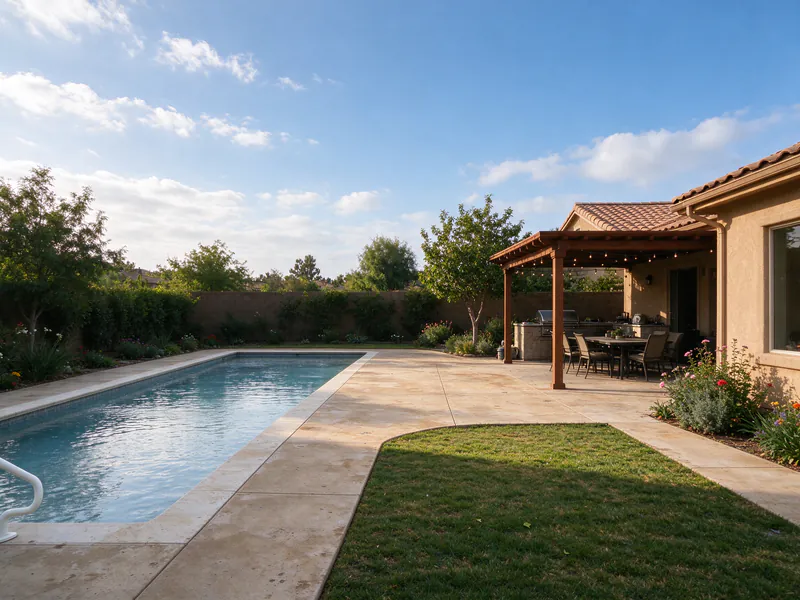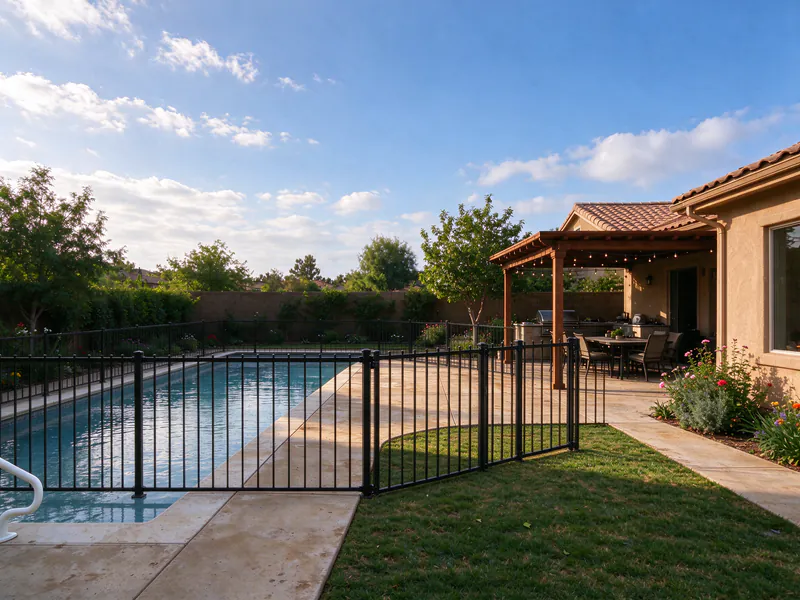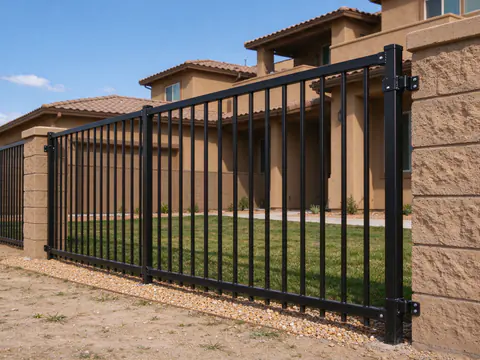
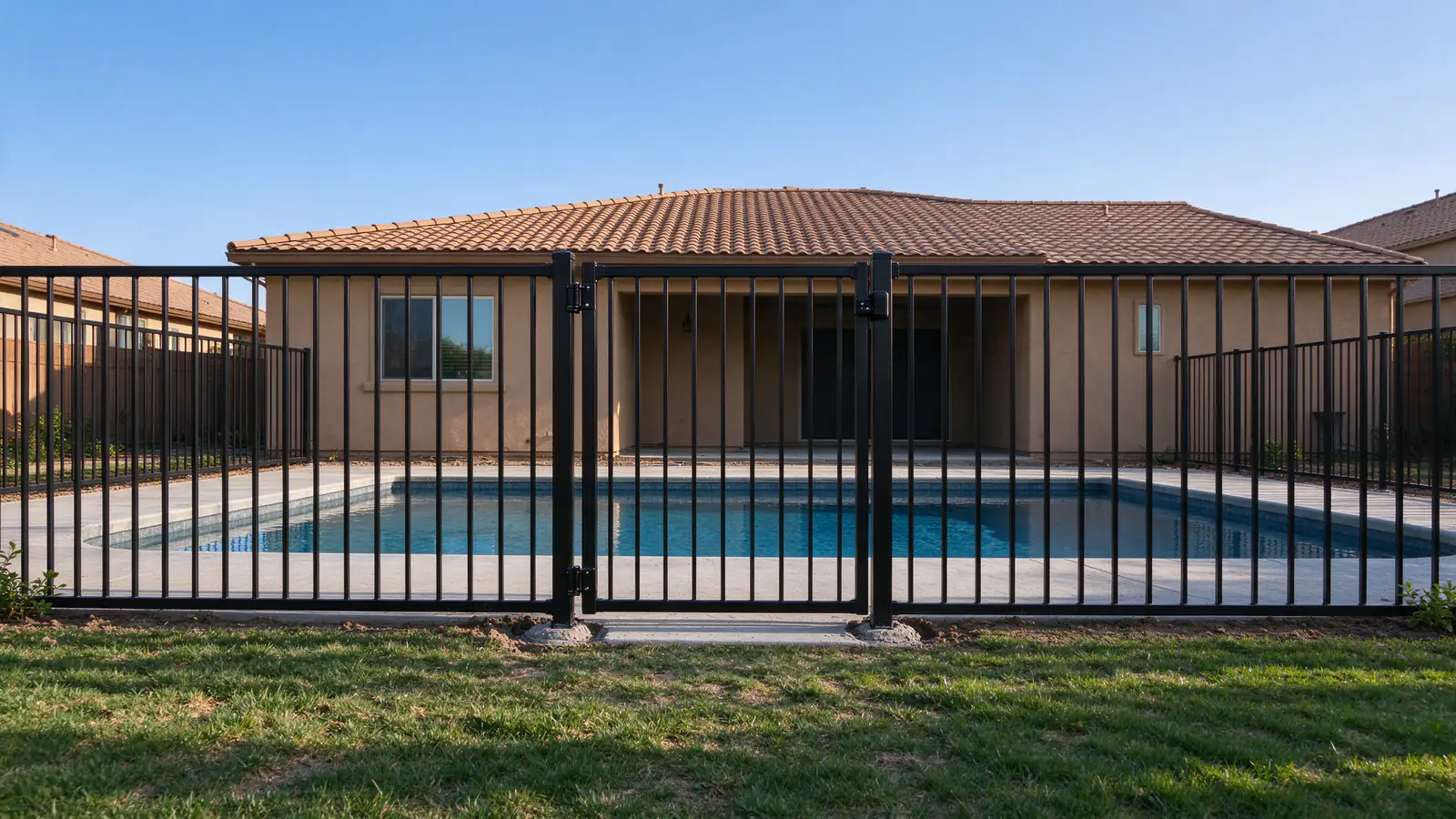
Cask Fence Temecula plans and manages pool fence installation for homes in Temecula and the surrounding towns of southwest Riverside County, with the work carried out by licensed and insured contractors. A pool fence here is not a style choice. When the city issues a permit for a new or remodeled pool, the barrier is an inspected safety enclosure with fixed numbers: at least 60 inches tall on the outside, no more than 2 inches off the ground, and gates that swing away from the water, close by themselves and latch at 60 inches or higher. This page covers how those rules shape the fence. The Temecula pool fence requirements guide goes through the code language itself.
Why Temecula asks for more than the state minimum
California’s Swimming Pool Safety Act, in Health and Safety Code 115922, says that when a building permit is issued for a new or remodeled pool or spa at a single-family home, it needs at least two of seven drowning-prevention features. The list includes an enclosure, a removable mesh fence, a safety cover, exit alarms on the house doors, self-closing and self-latching devices on doors, a pool alarm, and other approved means. On paper, a homeowner could choose a cover and door alarms and skip a fence entirely.
Temecula closes that option. The city’s pool and spa handout, CD15, applies Temecula Municipal Code 15.04.020(R): one of the two required features must be an enclosure that meets Health and Safety Code 115923. So every permitted pool in the city ends up with a real barrier, and the second feature is layered on top of it. That one rule is why pool fencing shows up on nearly every pool build in town.
The enclosure section of the state code adds details the handout builds on. Openings in the fence must not let a 4-inch sphere pass. The outside face must not offer hand or footholds. The handout also says decorative work on the side away from the pool must not be climbable, and it accepts only fencing certified as non-climbable where a product is offered as a substitute for a standard fence. Both are confirmed with Building & Safety for the system you pick.
Height, ground gap and what counts as climbable
The minimum height is 5 feet, measured on the outside of the enclosure, because that’s the side a child approaches from. Grade matters here. If a planter, a retaining wall cap or a raised patio sits against the outside of the fence, an inspector can treat that higher surface as the ground, and a 5-foot fence quietly becomes a 4-foot climb. How it’s measured at your fence is confirmed with Building & Safety.
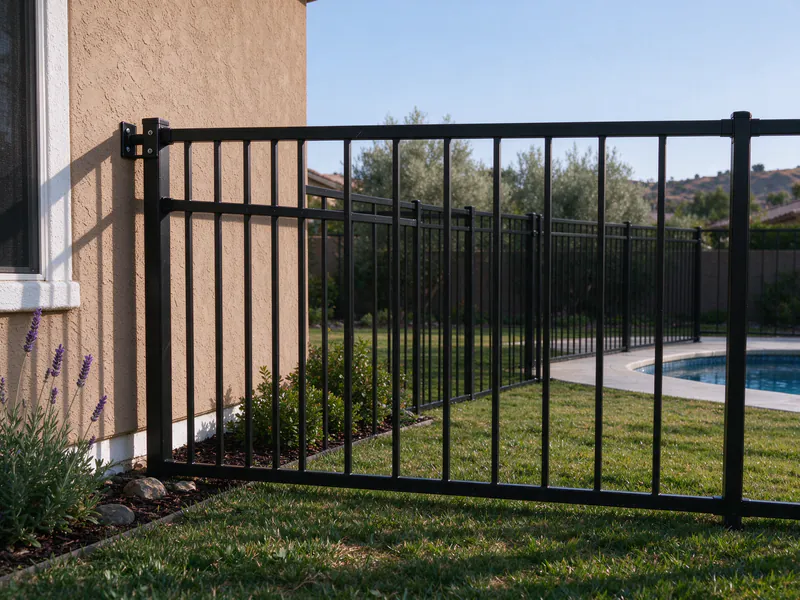
The 2-inch ground gap is the rule that trips up more finished fences than any other. It has to hold everywhere, not just at the posts. Temecula back yards often fall toward a manufactured slope or toward the house drain, and on a run that changes grade, a stepped fence leaves a triangle of open space under each panel. A racked fence follows the slope instead and keeps the bottom rail close to the dirt. The stepped vs racked guide shows both. Where the gap still opens up, a concrete mow strip or a grade adjustment closes it. Soil also moves: a heavy rain can wash out a few inches under a panel, so the line is worth walking before the final inspection and again each winter.
Climbability is about horizontal members and objects. A fence with its rails on the outside face hands a child a ladder. Pool-rated aluminum and steel systems put the rails toward the pool side or space them so they can’t be used as steps, and vertical pickets carry the barrier. Things placed near the fence count too. An AC condenser, a woodpile, a bench or pool equipment set against the outside face can defeat a fence that measures perfectly.
Pool gates: swing direction, closers and latch height
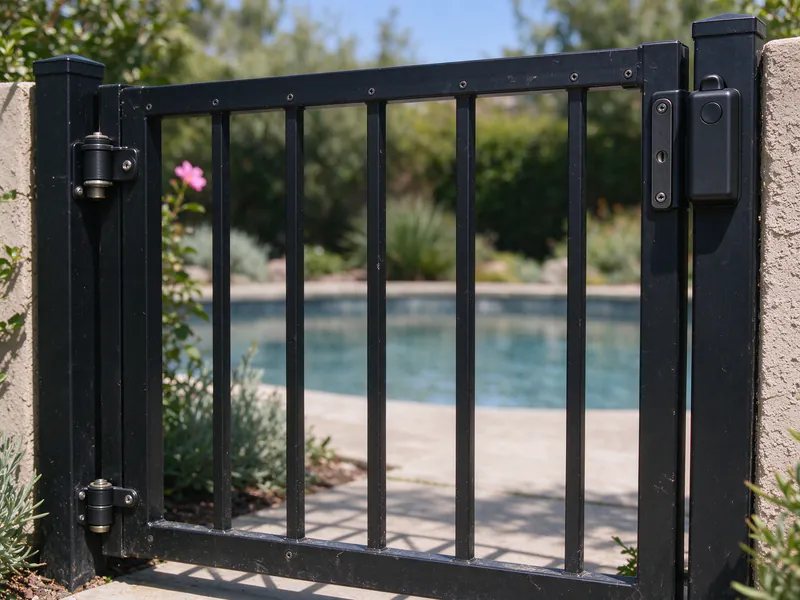
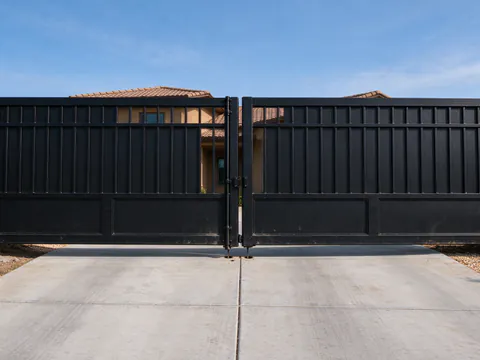
Most of what makes a pool fence work is in its gates, which is why the gate installation page and this one overlap. CD15 requires every gate in the enclosure to swing away from the pool, close on its own and latch on its own, with the release mechanism at least 60 inches above the ground. A gate that only closes when pushed hard, or that rebounds off the latch and sits open an inch, fails.
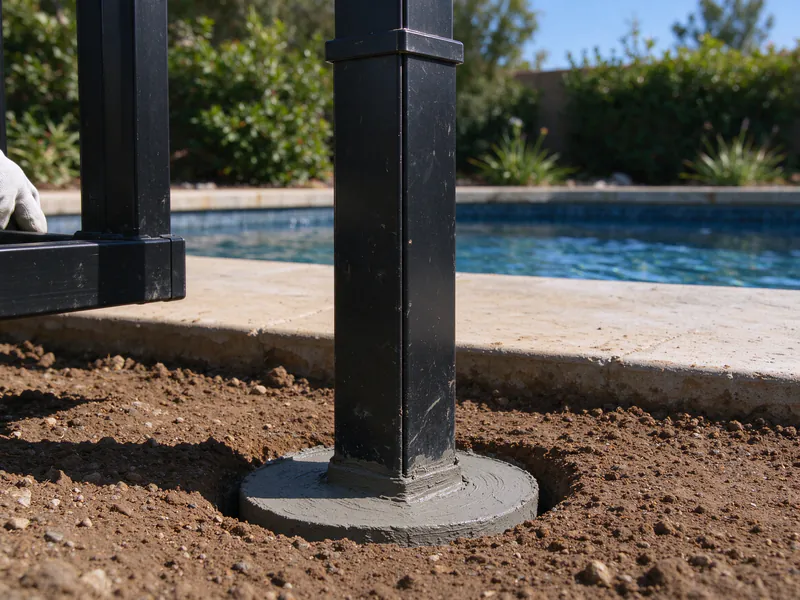
Three parts do the work. Spring or hydraulic hinges pull the gate shut from any open angle. A self-latching latch catches the gate as it arrives, without anyone lifting a lever. And the gate itself has to stay square, because a sagging leaf drags on its latch and stops short. Heat makes that harder in Temecula: a gate that closes cleanly in March can bind in August if the frame expands or the post leans. The gate post is sized up and set deeper than a line post for that reason.
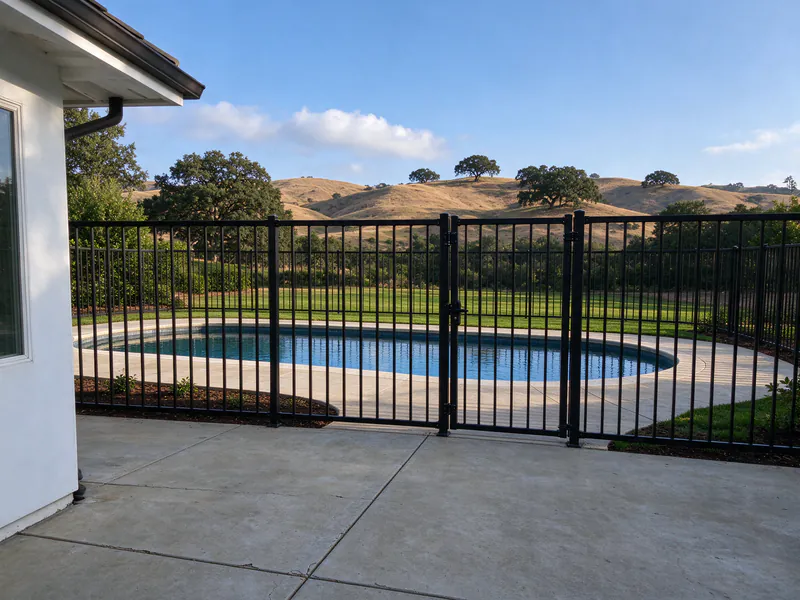
Double-leaf gates are allowed into a pool yard if the inactive leaf is held by a padlocked cane bolt, so only one leaf opens in normal use. A man door from the garage into the pool area has to meet the same gate requirements, which often means adding a closer and moving the latch. House doors that open onto the pool are often where the second safety feature goes, such as exit alarms or self-closing devices.
Not sure where the gates should go?
Mark the doors, the side yards and the equipment pad on a sketch. Gate placement drives the layout and the hardware list.
Aluminum, tubular steel, vinyl or mesh
Aluminum is the most common pool barrier material because it doesn’t rust near chlorinated or salt water, it keeps the view to the pool open, and its light gates hold self-closing hinges well. Powder-coated finishes resist sun fade, though a scratch through to bare metal is worth touching up. The aluminum vs wrought iron guide compares it with steel.
Tubular steel, the material most people call wrought iron, is stronger and heavier. It suits a pool fence that doubles as a perimeter or security fence, or one that has to match iron already on the property. The weight lands on the gate: a steel pool gate needs heavier posts and hinges strong enough to swing it shut every time. The wrought iron fence page covers fabrication and coatings.
Vinyl works when privacy matters as much as safety, but pool-rated vinyl gates need a metal-reinforced frame or they sag, and vinyl can crack from impact or get brittle with age and sun. It isn’t maintenance-free.
Removable mesh is a useful second feature, especially for families who want the pool open for entertaining and closed the rest of the time. In Temecula it is not the required enclosure. It can sit inside a permanent fence, close to the water, as the extra layer.
Planning around the pool build
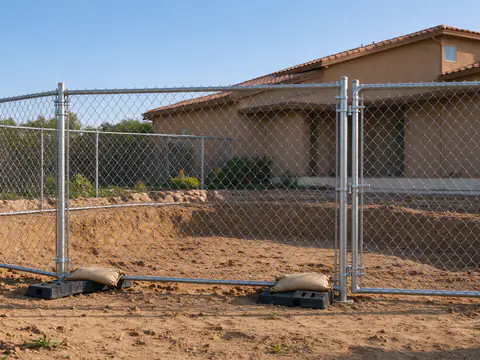
On a new pool, the fence is scheduled around everything else. CD15 requires a permit before any digging and a temporary fence and gate in place from the day pool construction starts. That temporary barrier is a separate job from the permanent enclosure, and the temporary fence rental page covers it. The permanent fence usually goes in after decking and before the final inspection, once grade near the pool is set.
Utilities sit right where pool fences run: the gas line to the heater, power to the pump and lights, irrigation in the planters. A DigAlert ticket is required at least two working days before digging, but utility locators mark only their own lines, so the pool builder’s plans help find the private ones. Posts on concrete decking are either cored into the slab or surface-mounted with base plates, and that choice is made with the deck in mind.
In a planned community, the association may also review the fence. The HOA approval guide covers that step. In parts of the wine country, county design guidelines hold most fences to 4 feet but exempt pool fences, as the wine country page explains. In Lake Elsinore, pool equipment within 10 feet of a property line needs a 6-foot masonry wall on the neighbor’s side, a separate rule covered on the Lake Elsinore page.
Where a pool enclosure attaches to the house in a Very High fire hazard zone, California’s proposed Zone 0 rules would move fences toward a noncombustible section at the house. Aluminum and steel enclosures already meet that idea. The fire-resistant fence page has the details.
What a pool fence costs
A national budgeting range for a pool barrier fence runs about $10 to $45 per linear foot. Gates are the biggest swing factor, because every pool gate needs self-closing hinges and a self-latching latch at the right height. Other drivers are the material and picket style, total footage, the number of gates, grade changes that need racking or a mow strip, posts cored into existing decking, and removal of an old fence that no longer meets the rules. The Temecula fence cost guide shows how those lines add up, and the fence cost estimator gives a starting range. For a written scope built around your pool plan, send the details.