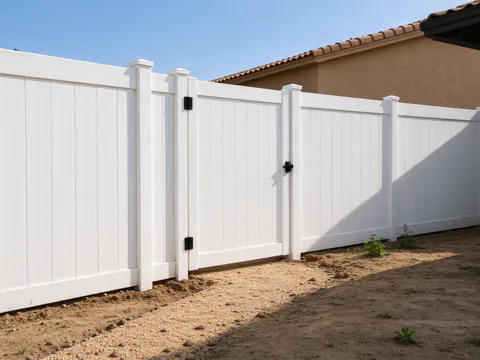
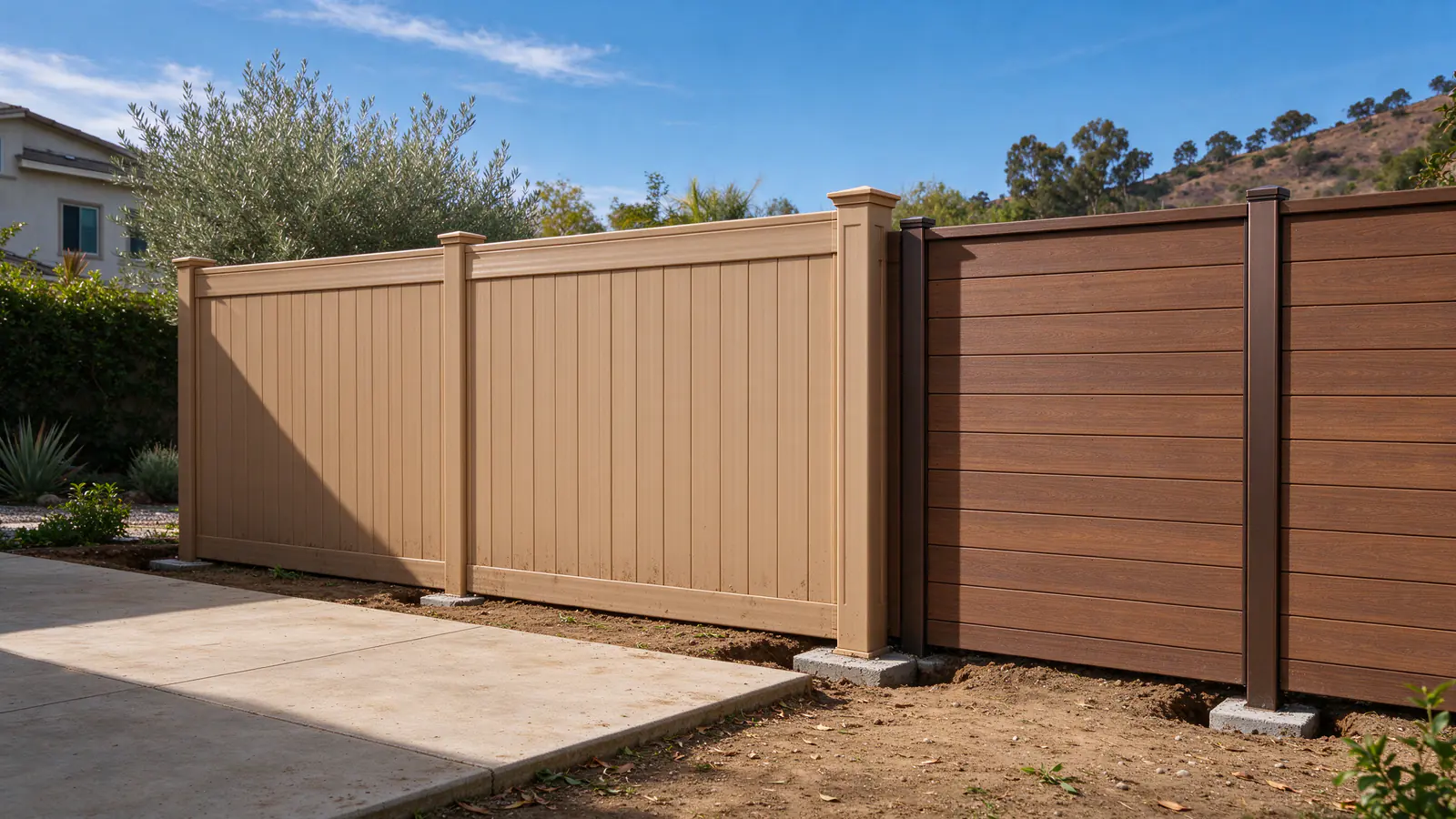
Choose by what the fence has to look like and carry. Vinyl is a hollow PVC profile: light, never painted, sold as matched panels, with a national budgeting range of $15 to $85 per linear foot. Composite is a solid board of wood fiber and plastic: heavier, closer to the look of wood, usually hung on metal posts. Both are combustible and both still need upkeep.
Cask Fence Temecula is a Temecula fence company that plans and manages fence, gate and wall work in the city and nearby southwest Riverside County towns; licensed and insured contractors carry it out. Composite isn’t a system with its own service page on this site, so this guide explains what it is and how it stacks up against vinyl fence installation, the low-upkeep option most Temecula tracts already know. If you’re also weighing natural wood, the wood vs. vinyl guide covers that pairing.
What composite fencing is
Composite fence boards are made from wood fibers or flour bound in plastic, the same family of material as composite decking. The boards are solid or have a cored profile, they are colored through at the factory, and many have an embossed grain. Most composite fence systems slide or fasten the boards into aluminum or steel posts or channels, though some are designed to hang on wood or steel framing.
That construction gives composite three traits that set it apart from vinyl. It is heavier per foot, so the posts carry more weight. It cuts and fastens more like wood. And because it contains wood fiber, how it handles moisture, mildew and insects depends on the product’s formulation, not on the general name; the manufacturer’s literature is the place to confirm those claims for the board you’re considering.
Vinyl is a different animal. A vinyl fence is extruded PVC formed into hollow posts, rails and pickets or panels that lock together. Its strength comes from the profile shape and any aluminum or steel reinforcement in the rails and posts, and it is designed as a complete system from one maker.
Vinyl and composite compared
| Question | Vinyl | Composite |
|---|---|---|
| What it is | Hollow extruded PVC profiles | Boards of wood fiber and plastic |
| National budgeting range | $15 to $85 per linear foot | No national range published here; priced per system |
| Weight on posts | Light | Heavier per foot of fence |
| Typical posts | Vinyl posts, often with metal inserts at gates and ends | Aluminum or steel posts or channels, depending on system |
| Look | Smooth or textured plastic, fixed colors | Wood-like grain and color |
| Upkeep | Wash; no paint | Wash; no paint; watch damp shaded spots for mildew |
| Sun and heat | Expands and contracts; surface ages in strong sun | Expands and contracts; color can settle with sun exposure |
| Impact | Can crack, especially aged rails | Dents and scuffs; less prone to shatter |
| Repairs | Swap parts while the line is still sold | Swap boards if the product and color are still made |
| Slope | Panels usually rack within a set angle | Board-in-channel systems usually step; some rack |
| Within 5 ft of the house | Combustible | Combustible |
Sun, heat and color in the Temecula Valley
Summer here is long and hot: NOAA’s Fallbrook 5 NE normals count roughly 60 afternoons a year of 90°F or more. Both materials move with that heat. Vinyl rails lengthen on a hot afternoon, which is why vinyl systems leave expansion room in the post pockets. Composite boards move too, and their systems set gaps at the ends and between boards for the same reason. Boards or rails installed without that room bow or bind in August.
Color behaves differently. Vinyl’s color is in the plastic and changes slowly, although a long run of hard sun ages the surface and makes an old profile more likely to crack on impact. Composite’s color can settle or lighten in its first stretch of sun before it stabilizes, by an amount that varies with the product and the exposure. Dark composite and dark vinyl both get hot to the touch on a south or west line, which matters beside a play area or a dog run. For what happens when vinyl meets reflected window glare or a fire, read the guide to vinyl in heat and fire.
Wind, weight and posts
Temecula designs for 97 mph winds in Exposure C, the open-terrain category, according to the city’s Building & Safety handout. A solid fence of either material catches the full face of that wind, and the posts carry it. The difference is what else the posts carry.
Composite’s weight sits on its posts all the time, and wind adds to it, so composite systems usually rely on metal posts and set firm limits on post spacing. Vinyl is light, so its challenge is stiffness, not weight: a hollow post flexes unless the system reinforces it. In both cases the post footing does the real work, and its size depends on fence height, wind, soil and the system’s instructions, not a single depth. Hardpan sits about 0.5 to 1 m down at NRCS sample points in Temecula, Menifee and French Valley, which the fence posts and soil guide explains.
Gates need extra attention in both. A vinyl gate needs a metal-reinforced frame and hinge post to stay square. A composite gate is heavy and usually built on a metal frame. Either way the hinge post should be heavier than a line post; gate installation covers the hardware.
Repairs and matching parts
Both are manufactured systems, so every repair comes back to one question: can you still buy the same part? A cracked vinyl rail or a scuffed composite board can usually be replaced on its own, provided the identical profile and color are still available. If the line has been discontinued, a single-section fence repair can become a mismatched patch or a full section replacement.
Before choosing either, ask which manufacturer and product line you’re getting, and keep a note of it with the house papers. If an existing vinyl or composite fence is failing in several places at once, the repair or replace guide helps separate a parts problem from a system that has reached the end.
Fire rules for the 5 feet next to a home
Neither vinyl nor composite resists fire; both burn, so they sit with wood in the state’s proposed Zone 0 rules. Draft regulations described by Board of Forestry staff would keep new combustible fences out of the first 5 ft around a home in the regulated zones, let existing fences remain and be fixed, and call for a noncombustible piece wherever a fence or gate joins the house, phased in over five years. Those rules are proposed, with final adoption not yet confirmed officially, but they show where design near a house is heading.
On a lot mapped Very High, the common answer is a short run of metal, or a metal gate, at the house, with vinyl or composite carrying on past the 5 ft mark. Fire-resistant fence installation explains these transitions, and wrought iron or tubular steel is one way to build them. The wood vs. vinyl guide shows how hazard zones vary from one Temecula street to the next.
HOA approval and appearance
Composite’s wood-like look is the reason most owners consider it, and it’s also why HOAs treat it carefully. An architectural standard that names “wood” or a specific vinyl color doesn’t automatically cover composite, so ask before you order. Under Civil Code 4765 the board owes you a written decision and reasons if it says no, yet what it approves remains its own call. The HOA fence approval guide has the submittal steps.
What to budget
Vinyl has a national budgeting range of $15 to $85 per linear foot for a privacy fence. There’s no comparable national range on this site for composite, so a composite fence is priced per project from the system, the post type and the footage. Either price climbs with rock in the holes, a sloped line, extra gates, removal of an existing fence and any premium product the association specifies. The cost guide breaks those down, and the fence cost estimator gives a vinyl range for your footage.
How to choose
Vinyl makes sense if you want a light, matched system with a known budgeting range, the yard is mostly level, and you can confirm the panels will be orderable later.
Composite makes sense if a wood look matters, the HOA accepts it, the line is fairly level or can step, and you’re comfortable with metal posts carrying a heavier board.
In the 5 feet next to a house in a Very High zone, plan a metal section instead of either one. If you’d like help weighing the two for a specific line, phone (951) 944-2778 or use the contact form.