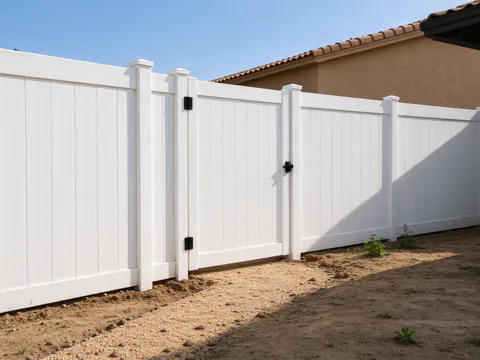
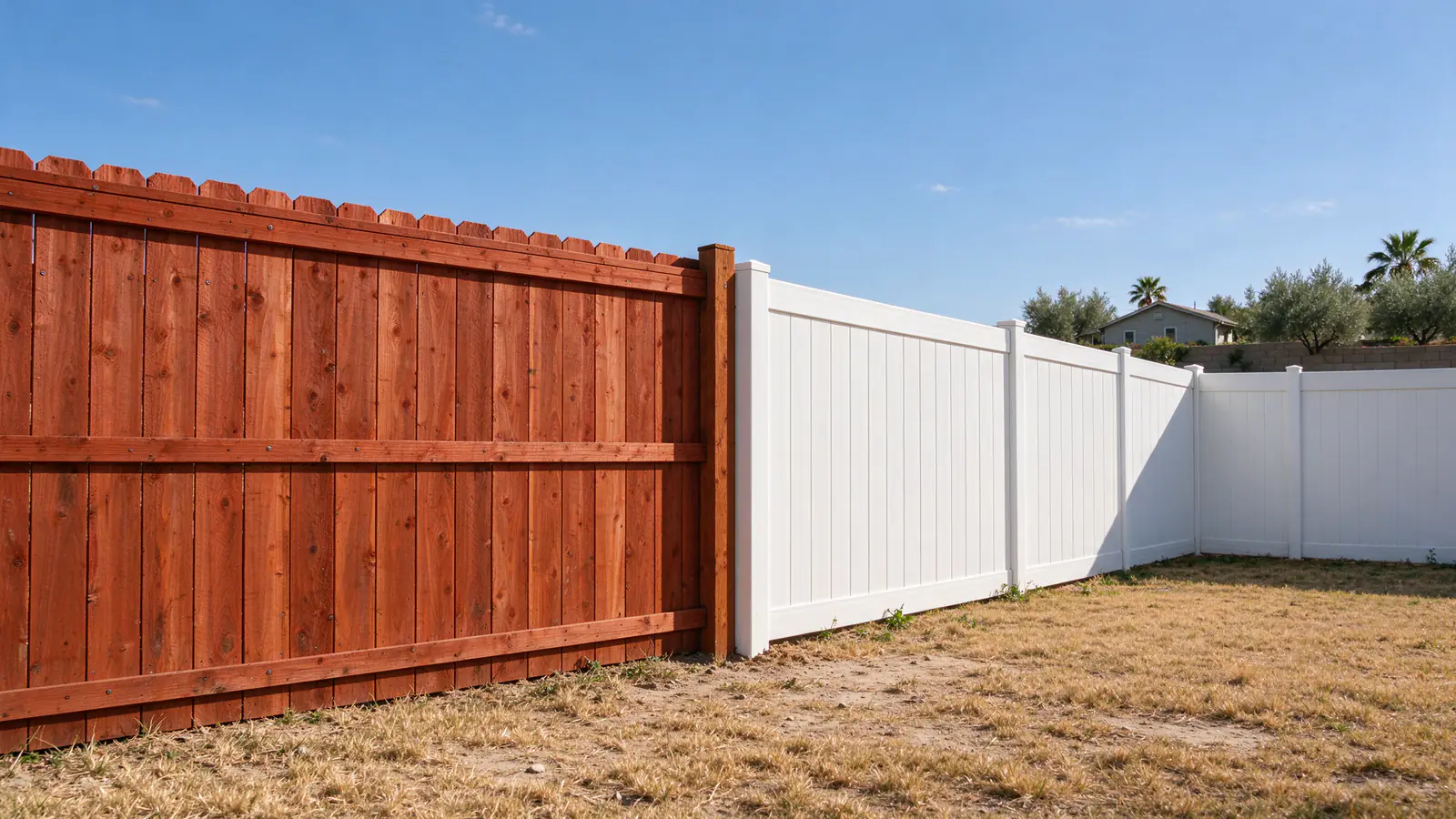
Neither material is better everywhere. Wood costs less to start, a national budgeting range of $10 to $50 per linear foot for a 6 ft privacy fence against $15 to $85 for vinyl, and it repairs board by board. Vinyl skips the paint, rot and termites, but it can crack, it moves with heat, and its repairs depend on matching parts.
Cask Fence Temecula plans and manages fence projects across Temecula and southwest Riverside County, with the work carried out by licensed and insured contractors. This guide sets wood and vinyl side by side for the conditions that actually decide the choice here: inland heat, a 97 mph design wind, termites in the soil, HOA specifications and the fire rules being written for the 5 feet next to a house. For each material’s own build details, see wood fence installation and vinyl fence installation.
Wood and vinyl side by side
| Question | Wood | Vinyl |
|---|---|---|
| National budgeting range, 6 ft privacy | $10 to $50 per linear foot | $15 to $85 per linear foot |
| Routine upkeep | Stain or seal on a cycle; tighten and replace fasteners | Wash off dust and sprinkler spotting; no paint |
| Termites and decay | Posts in soil are the weak point; steel posts remove it | Nothing for termites to eat; no rot |
| Heat and sun | Boards dry, shrink, check and can cup | Expands and contracts; sun ages the surface over time |
| Impact | Dents and splinters; rarely shatters | Can crack, especially rails and gate frames |
| Repairs | Cut and replace any part with stock lumber | Swap rails or panels if the system is still made |
| Slope | Site-built, so it can rack or step freely | Many panels rack only within the maker’s limit |
| Gates | Needs a stiff frame and heavy posts | Needs metal reinforcement inside the frame and posts |
| Within 5 ft of the house | Combustible | Combustible |
| Look | Natural grain, any stain or paint | Fixed colors and profiles from the manufacturer |
A wood fence on galvanized steel posts takes away wood’s biggest weakness. A vinyl fence with aluminum-reinforced rails and gate frames takes away a good part of vinyl’s. Most of the real difference sits in how each one is built, not in the name of the material.
What inland heat and sun do to each
The NOAA normals for Fallbrook 5 NE, at the south edge of the Temecula Valley, average about 60 days a year at or above 90°F. That heat works on both materials in different ways.
Wood loses moisture through the summer. Boards shrink across their width, so a single layer of boards that was tight when built shows gaps by the second summer. Surfaces check, and boards fastened on one face can cup. A finish slows the drying and the graying, and it is the main upkeep cost of a wood fence. Styles that overlap boards hide the shrinkage, which the privacy fence styles guide compares.
Vinyl doesn’t shrink, it expands. Rails grow in length on a hot afternoon and pull back at night, which is why vinyl systems build expansion room into the rail pockets of the posts. Rails cut too tight to the post bind and bow in the sun, and rails cut too short can work loose. Long exposure to strong sun also ages the surface, and an aged profile is more prone to crack when something hits it. Vinyl is not maintenance-free and not unbreakable; it trades paint for different failure points. Heat, melting and reflected sun from windows are covered in the vinyl fence heat and fire guide.
Termites, rot and the ground line
This is wood’s real weakness in Southern California, and it lives at the bottom of the post. UC IPM notes that subterranean termites, the most destructive kind in California, occur in nearly all regions and infest dead wood in contact with soil, while drywood termites nest above ground in dry wood such as lumber, utility poles and fences. A wood post in the ground is food and shelter in one place, and decay fungi work the same damp zone.
Two answers hold up. Ground-contact rated posts slow the problem. Galvanized steel posts with wood rails and boards remove it from the ground line entirely. Vinyl sidesteps it: there is nothing in the post for termites or fungi to use, though the concrete footing and the soil around it still decide whether the post stays plumb. The termites and rot guide covers how to inspect an existing wood fence.
Wind, posts and gates
Temecula’s Building & Safety design data lists a 97 mph wind speed with Exposure C, the category for fairly open terrain. A solid 6 ft privacy fence presents its full face to that wind in either material, and that load levers on each post at the ground line. Height, spacing and the post itself matter more than the panel.
In wood, stiffer posts or steel posts, closer spacing and footings sized to the soil handle it. In vinyl, the post is a hollow profile, and its strength in wind comes from the system: the post wall, any aluminum or steel insert, and how the rails lock in. There is no single post depth that is right for either, because height, wind exposure, soil and the system’s instructions all set it; the fence posts and Temecula soil guide explains how hardpan changes the footing.
Gates show the difference most. A wood gate can be framed and braced on site to any width. A vinyl gate is a hollow frame and depends on metal reinforcement in the frame and the hinge post; without it, the frame flexes, the latch stops meeting and the corners crack. Whichever material you choose, a gate needs heavier posts than the line, and the gate installation page covers that.
Repairs over the life of the fence
Wood forgives. Any board, rail or post can be cut from stock lumber and replaced, and the new wood blends in after a season or a coat of stain. That makes a fence repair on wood a small job more often than not.
Vinyl repairs depend on the system. A cracked rail, picket or panel can often be replaced without replacing the fence, but only if the same profile and color can still be bought. Before you choose vinyl, ask which manufacturer’s system you are getting and whether spare panels or rails can be ordered. When a fence is old enough that parts can’t be matched, the repair or replace guide helps sort a section repair from a fence replacement.
Near the house in a fire hazard zone
Wood and vinyl are both combustible. That matters most in the 5 feet next to a house in a Very High Fire Hazard Severity Zone. A Board of Forestry staff memo on proposed Zone 0 rules describes draft rules that would bar new combustible fences within 5 ft of a home in the regulated zones, let existing ones stay and be repaired, and require a noncombustible section, such as a metal gate, where a fence or gate attaches to the house within five years. Final adoption and an effective date have not been confirmed at an official source, so treat it as the direction the rules are moving rather than a rule in force.
Hazard zones vary by street here. CAL FIRE’s maps put the Redhawk point sampled in a Very High zone while the Temecula city centroid, Paseo del Sol and Wolf Creek points are outside a mapped wildland zone. You can check an address on the City of Temecula fire hazard map. Where it applies, the practical answer is the same for wood and vinyl: a short metal section or gate where the fence meets the house, which fire-resistant fence installation covers.
HOA rules and the neighbor’s side
In many Temecula planned communities the choice is partly made already. CC&Rs and architectural guidelines often name the fence material, color, height and cap, and some require one material on lines visible from the street. California Civil Code 4765 requires the association to decide in writing and explain any denial, but it doesn’t force it to approve vinyl where its standard calls for wood, or the reverse. Get the guidelines before you price either. The HOA fence approval guide covers the submittal.
On a shared line, the neighbor’s view of the fence counts too. Civil Code 841 presumes adjoining owners share the reasonable cost of a boundary fence and requires 30 days’ written notice before replacing one, so a change of material is part of that conversation. The good neighbor fence law guide explains the notice.
What each costs to budget
Using only the national budgeting ranges, an illustrative 120 ft back-yard run works out like this. It is not a quote and not a Temecula price.
| Line | Wood | Vinyl |
|---|---|---|
| 120 ft of 6 ft privacy fence | 120 × $10 to $50 = $1,200 to $6,000 | 120 × $15 to $85 = $1,800 to $10,200 |
| One walk gate ($200 to $1,500 per gate) | $200 to $1,500 | $200 to $1,500 |
| Illustrative total | $1,400 to $7,500 | $2,000 to $11,700 |
The ranges overlap, so a plain vinyl fence can cost less than a redwood board-on-board fence. What moves a job inside its range is the same for both: hardpan in the post holes, slope, gates, tear-out of the old fence and the HOA’s specification. The cost guide explains each factor, and the fence cost estimator runs the numbers for your footage.
How to choose
Lean toward wood if you want the lowest starting cost, a natural look, a fence that follows a slope freely, or repairs you can make from stock lumber, and you’re willing to finish it on a cycle. Put it on steel posts if termites or the ground line worry you.
Lean toward vinyl if you’d rather never paint, the yard is mostly level or gently sloped, the system’s parts can be ordered later, and nothing heavy is likely to hit it. Ask for reinforced rails and gate frames.
Either way, check the HOA standard, the property line and the fire zone first; they can settle the question before taste does. To talk through a fence for your yard, call (951) 944-2778 or send the details.