
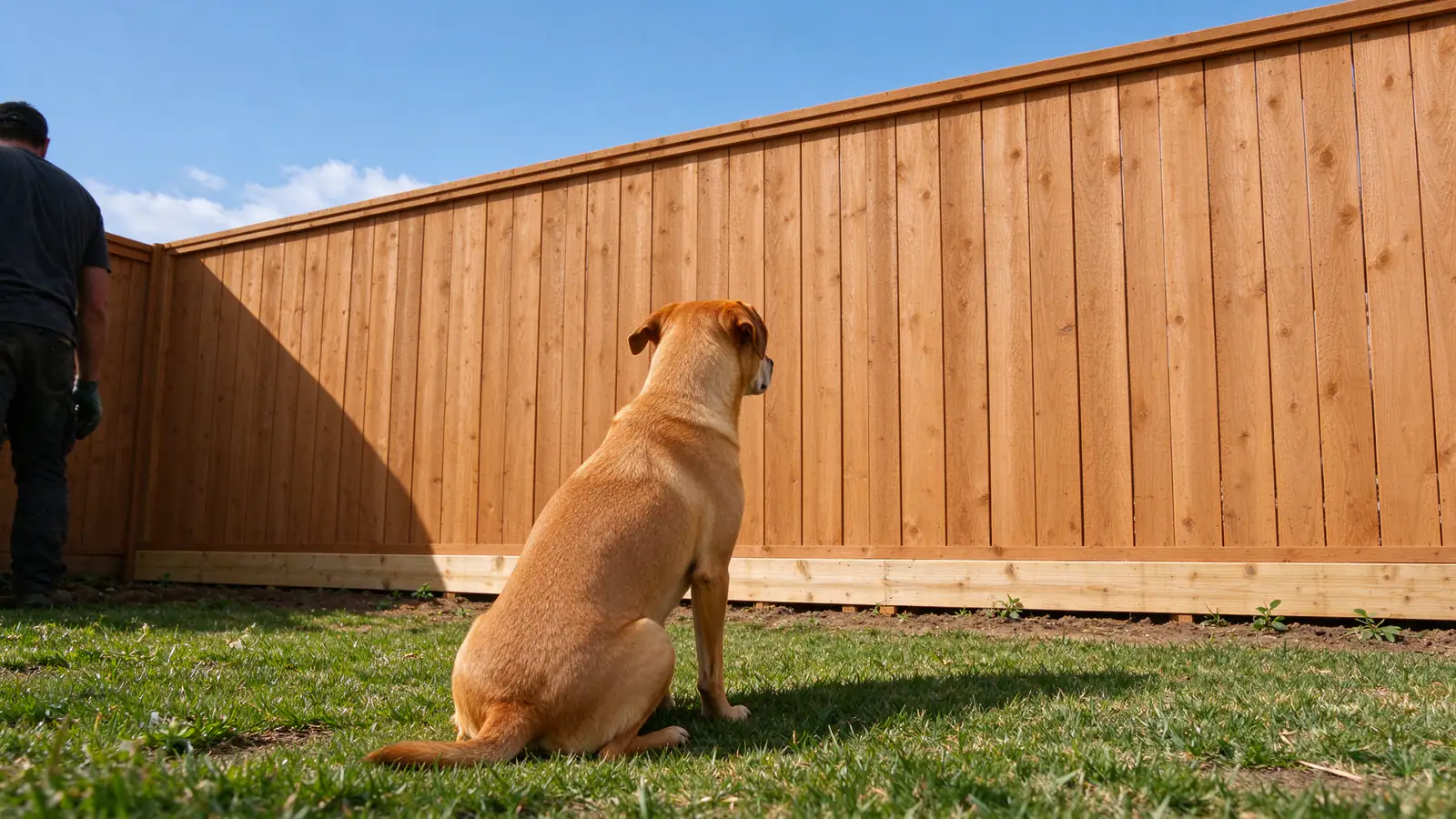
The best fence for a dog is the one built against how that dog gets out. Diggers need a barrier at the bottom, jumpers and climbers need height with nothing to grip, reactive dogs settle better behind solid panels, and every dog needs a gate that closes and latches by itself. The bottom, the height and the gate matter more than the material.
Cask Fence Temecula plans and arranges fences and gates for homes in Temecula and southwest Riverside County, built by licensed and insured contractors, including wood, vinyl, chain link and wrought iron. This guide is about keeping a dog in: what each kind of escape needs, how to compare materials, and what your city and HOA may limit.
Match the fence to how your dog gets out
| How the dog escapes | What stops it | Watch out for |
|---|---|---|
| Digs under | A buried mesh apron, a rot board set into the soil, or a concrete mow strip | Gaps on slopes, washouts after rain, soft planting beds along the line |
| Jumps over | Height, within what your city allows | Things near the fence the dog can launch from: benches, planters, woodpiles |
| Climbs | Smooth faces, rails on the outside, small mesh | Horizontal boards or rails on the dog’s side, chain link with large openings |
| Squeezes through | Tight picket spacing, mesh backing, no gaps at posts and gates | Open metal pickets and stepped panel corners |
| Chews | Metal, vinyl or masonry at the bottom | Soft wood bottoms and kickboards |
| Slips out the gate | Self-closing hinges and a self-latching latch | Gardeners, guests and kids leaving it open |
| Barks or lunges at passers-by | Solid panels where people and other dogs pass | See-through sections along a sidewalk |
Many dogs do more than one of these. Plan for the worst habit, not the most common one.
The bottom of the fence
This is where most fences fail dogs. Homeowners in Temecula report installers leaving the bottom of a fence about 1.5 inches above grade after agreeing to set it down to the dirt. That leaves a gap a dog can start digging in, and fill dirt pushed into it later tends to wash out in the rain. The fix is simple to state: agree on the bottom clearance before the work starts, and write it into the scope.
Then add a dig barrier if your dog digs:
- A buried mesh apron. Welded wire mesh fastened to the bottom of the fence and laid outward under the soil on the dog’s side. A dog digging at the fence hits wire and usually gives up.
- A rot board or kickboard. A horizontal board along the bottom of a wood fence, set slightly into the soil. It has to be rated for ground contact, or it will rot and become the next gap.
- A concrete mow strip. A narrow concrete curb under the fence line. It stops digging and keeps sprinklers and soil off the bottom boards.
- Chain link. A bottom tension wire, the fabric tied to it closely, and mesh buried along the base keep dogs from pushing under the fabric.
Slopes add their own gaps. A stepped fence leaves a triangle under the high end of every panel, while a racked fence follows the ground more closely. The stepped vs. racked fence guide shows both, and on hillside lots hillside fence installation covers the options.
Dog getting out under the fence?
Tell us the length of the run and what the ground is like. Closing the bottom is often a repair, not a new fence.
Height, climbing and the view
A 6-foot fence is typical on side and rear lines, but local limits decide what you can build, especially in front yards. Lake Elsinore, for example, caps solid fences in required front yards at 36 inches and wrought iron at 5 feet, and San Diego County limits solid front-yard fences around Fallbrook to 42 inches. Temecula’s limits are confirmed for your address. The height and permit rules guide covers the thresholds.
Climbers use whatever they can grip. On a wood fence, horizontal rails facing the yard make a ladder; building the fence with the smooth side toward the dog fixes that, though on a shared line or in an HOA the “good side” rules can decide which way the fence faces. Vinyl privacy panels are smooth on both faces, which is one of their advantages for dogs. Chain link is easy to climb unless the mesh is small.
On solid versus see-through, think about what the dog reacts to. A dog that barks at every walker on the sidewalk often calms behind a solid privacy fence. A calm dog in a yard with a view does fine behind open metal, but picket spacing matters for small dogs and puppies, which can fit through gaps a larger dog can’t.
Gates are part of the fence
A dog fence is only as good as the moment someone leaves the gate open. Self-closing hinges and a self-latching latch close it without anyone remembering to. A latch mounted high, or on the outside, keeps a clever dog from nosing it open. The gap under the gate should match the fence bottom. A gate that sags stops latching, and the sagging gate guide covers why. Gate installation explains post sizing.
If your yard also has a pool, its gates must meet the pool barrier rules, which in Temecula include self-closing and self-latching gates that swing away from the pool. See pool fence installation.
Comparing materials for dogs
| Material | Strengths for dogs | Weak points |
|---|---|---|
| Wood privacy | Solid view block, easy to add a rot board or mesh | Chewing, rot at the bottom, rails can be climbed |
| Vinyl privacy | Smooth faces, nothing to chew or climb | Bottom rail gaps, panels can crack from impact |
| Chain link | Strong, see-through, mesh is easy to bury | Climbable, dogs can push under loose fabric |
| Wrought iron or aluminum | Open view, hard to chew | Picket spacing for small dogs, climbable cross rails |
| Block wall | Solid, can’t be dug through at the footing | Cost; built under the masonry class, not the fence class |
Fix now or plan it?
Fix now:
- A gap at the bottom your dog has already dug at.
- A gate that won’t latch or swings open on its own.
- A broken board or bent fabric the dog has found.
Plan it:
- Adding height where the dog has started testing the top.
- Swapping a see-through section for solid where the dog reacts to passers-by.
Before you build
Check your HOA’s rules and get approval for anything that changes how the fence looks; the HOA fence approval guide has the steps. Then write the scope around the dog: bottom clearance, dig barrier, which side faces in, gate hardware and latch height. The planning guide covers the rest of the paperwork.
To plan a fence around your dog, call (951) 944-2778 or tell us about the yard.