
Not always. If the corner pins are in place and you and the neighbor agree where the line runs, a fence can be laid out from them. Bring in a licensed land surveyor when pins are missing or disturbed, when the neighbor disputes the line, when the fence will sit right on it, or when an easement, slope or wall makes a few inches matter.
Cask Fence Temecula manages fence, gate and wall projects in Temecula and nearby towns, carried out by licensed and insured contractors, and every project starts by walking the line and looking for pins. That step decides more about a fence than most owners expect. This guide covers how to judge whether you have enough to build from, and what a survey adds when you don’t.
Why the old fence isn’t proof of the line
Owners assume the existing fence marks the boundary because it has stood there for years and nobody complained. That’s not how fences end up where they are. Builders set fences inside the line to keep footings off the neighbor’s lot. Replacement crews reuse old post holes, so a fence that was a few inches off in the first build stays off in the second. Fences jog around a tree, a rock outcrop or a slope and never come back. And on a lot that changed hands several times, nobody alive may remember why the line went where it did.
A question homeowners post online puts it plainly: the survey showed the fence was a foot into their own property, so how accurate are surveyors? More accurate than a fence set by eye. Build the new fence on the old line and you may be paying for a fence on someone else’s ground, or giving away a strip of yours, and either mistake is cheaper to catch before the posts are set.
What actually marks a property line
Monuments. When a tract or parcel was mapped, a surveyor set physical markers at the lot corners and sometimes along the lines. They’re typically a metal pipe or a length of rebar, often with a plastic or metal cap stamped with the surveyor’s license number. On graded tract lots they’re frequently buried under a few inches of fill, turf or decomposed granite, or sit right against an old fence footing. California Civil Code 841 makes adjoining owners equally responsible for maintaining the boundaries and monuments between them, so a pin isn’t yours to pull out, and a fence project should protect it.
Recorded maps. The tract map or parcel map recorded with the county shows each lot’s corners, bearings and distances, and the legal description on your deed refers to it. If a surveyor has worked on the lot since, there may also be a record of survey. These documents are the reference a found pin is checked against.
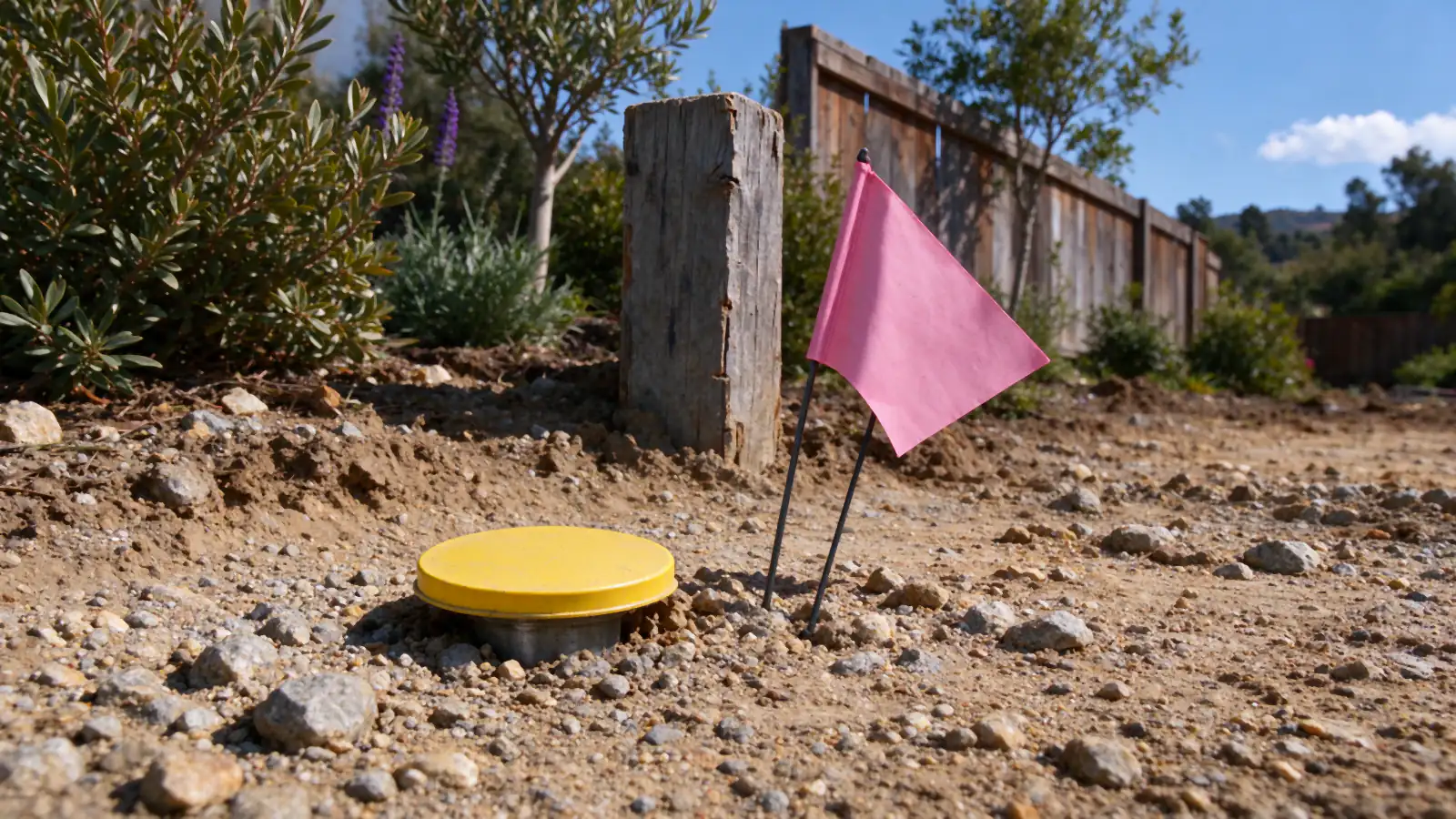
What isn’t a marker. The old fence, a sprinkler line, the edge of the lawn, a curb, a utility’s paint marks and a contractor’s stakes. DigAlert white paint marks where digging will happen; colored utility marks show buried lines; neither says anything about the boundary.
Checking what you have before you hire anyone
You can do a useful first pass yourself:
- Get the recorded map for your tract and find your lot’s corner distances.
- Look for pins at the corners, probing gently or using a metal detector. Check right beside existing posts and walls.
- If you find two pins on the line the fence will follow, measure between them and compare with the map.
- Look for pins on the neighbor’s side of the shared corners too, with their permission.
A clean match between two found pins and the map, with a neighbor who agrees, is usually enough to lay out a fence set slightly inside the line. A missing pin, a pin that’s bent or loose, a distance that doesn’t match, or a neighbor who measures it differently are the signs to stop. None of this certifies anything; it tells you whether you need someone who can.
What a licensed land surveyor does
Locating a boundary is land surveying, which California licenses on its own. A licensed land surveyor researches the recorded maps and earlier surveys, finds the existing monuments, checks them against each other, and resets any that are missing. For a fence, ask them to stake or flag the line along the full run at the points you’ll build between, and to mark any offsets you’ve agreed with the neighbor. Where new monuments are set, the surveyor may have to file a map with the county, which leaves a record the next owner can use.
A fence contractor works from that result. On the site visit, the fence line is walked against the pins or the survey stakes, and the string line for the build is set from them. What a fence contractor can’t do is decide where the boundary is, and you shouldn’t accept an offer to “find the line” by eye. There’s no price for a survey on this site; it depends on the lot, the records and how many corners need work, so get the quote from the surveyor directly.
When a survey is worth it
The case for paying for a survey grows with what it would cost to be wrong:
- Pins missing or disturbed at either end of the run.
- A neighbor who disagrees about the line, or a history of disputes.
- A fence on the line itself, shared under Civil Code 841, where both owners’ footings sit at the boundary. See the good neighbor fence law guide.
- Block walls and retaining walls. Masonry is expensive to move, the footing is wider than the wall, and on a slope the wall’s location affects drainage and grading. See block wall installation and retaining wall installation.
- Long runs on acreage in the wine country, De Luz or Fallbrook, where corners are far apart and terrain hides them. Horse fence installation and hillside fence installation jobs often fall here.
- A front yard or corner lot, where the height limit depends on exactly where the setback starts. The height rules guide explains why.
- A sale coming up, when a buyer’s title company may look closely at what sits where.
You can often skip it on a like-for-like fence replacement inside your own yard, with clear pins at both ends that match the map and a neighbor who agrees.
Found the pins, or can't find them?
Send photos of the corners and the old fence. We'll tell you whether the line is clear enough to build from.
On the line or inside it?
Once the line is known, there are two ways to place the fence. On the line, it’s a shared fence: both owners presumptively split the reasonable cost, and both have an interest in it. A few inches inside your line, it’s yours: you choose the material, maintain it, and pay for it. A concrete footing is wider than the post it holds, so a post set exactly on the line puts footing on both lots. If you want the fence to be yours alone, set it far enough inside that the footing stays on your side.
Either way, write down what was agreed and keep it with the house papers. A short note with the survey or pin photos, the offset and both signatures saves the next owner the same argument.
Easements and other limits on your own land
A survey shows where you can build in terms of ownership. Your title report and the recorded map show where you may not want to. Utility and drainage easements often run along rear and side lines in tracts. A fence inside an easement can block access the holder is entitled to, and depending on the easement’s terms you may have to remove it, at your cost, when they need in. Drainage swales between lots need to keep flowing; Temecula’s block wall standard says plainly that walls may not obstruct a water course or natural drainage. And the strip between a front lot line and the curb can be public right-of-way, where Temecula requires an encroachment permit before construction.
Temecula’s pool permit checklist (CD15) asks for the property lines and every easement to be shown on the site plan, which gives an idea of how seriously the city treats them. If you’re building a pool enclosure, the pool fence requirements guide covers the rest of that plan.
Old fences and long-standing arrangements
Sometimes the question isn’t where the line is but whether decades of use changed anything. “The fence has been there 30 years, so isn’t that strip ours now?” is a legal question with specific requirements, and neither a surveyor nor a fence contractor can answer it. Talk to a real estate attorney before you build on the strength of it.
Where the survey fits in the project
Settle the line first, because everything after it refers to it: the neighbor notice describes the fence’s location, the HOA submittal shows it on a drawing, the DigAlert dig area is marked along it, and the quote measures its length. The fence planning guide puts those steps in order, and the cost estimator gives a range once the footage is known.
To talk through a fence line, call (951) 944-2778 or send photos of the corners.