
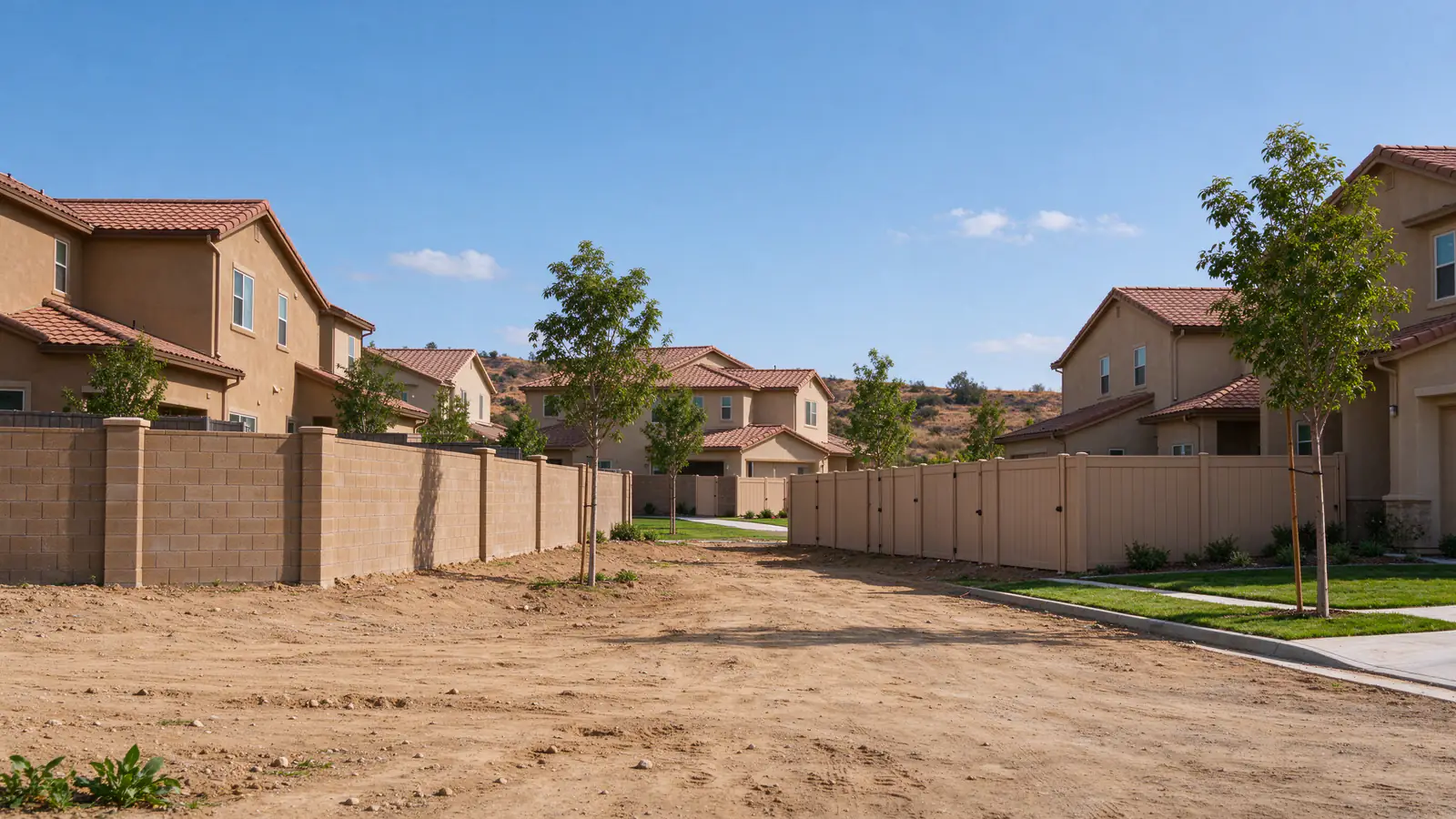
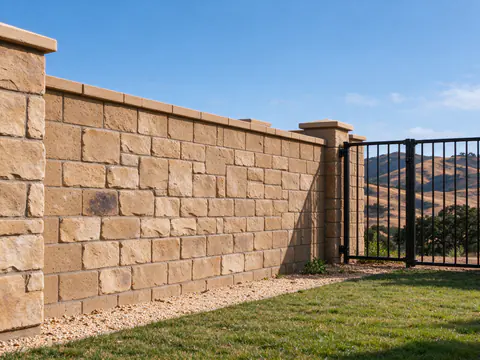
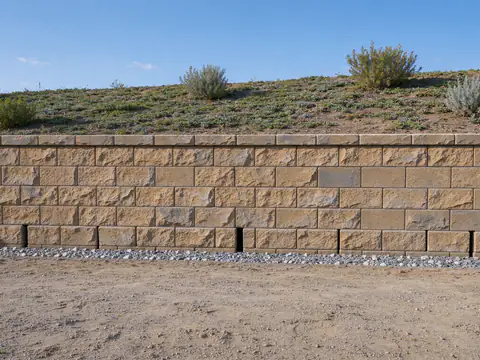
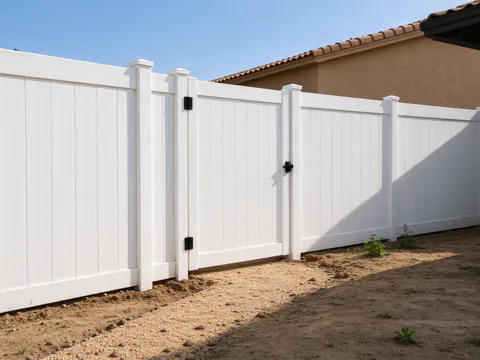
French Valley and Winchester have no city hall, so a wall permit here comes from Riverside County Building & Safety in Riverside, not from Temecula or Murrieta next door. Census figures also give French Valley the newest housing of any area covered here: 90.2% of its homes were built in 2000 or later. Cask Fence Temecula manages fence, gate and wall projects in both unincorporated communities, with licensed and insured contractors doing the installation: block walls and retaining walls, vinyl and wood fences, and new gates in existing tract walls.
County permits, not city ones
Being unincorporated changes who answers the questions. Fence height limits for French Valley and Winchester come from Riverside County’s zoning ordinance, Ordinance 348, and the county issues the permits. We confirm the limits for each address with the county before a design is fixed, rather than borrowing a neighboring city’s numbers. The county office is at 4080 Lemon St in Riverside, phone (951) 955-1800, and its Building & Safety site has the standard plans and handouts.
The state code sets the permit threshold. Under the 2025 California Residential Code, a fence of 7 ft or less is exempt from a building permit, and a retaining wall is exempt only up to 4 ft measured from the bottom of its footing, and only if nothing above it adds load. Anything past those lines goes to the county.
A housing stock that is almost all new tract
The Census count for French Valley is 12,000 homes. Of those, 94.3% are single-family detached, 87.4% are owner-occupied and 90.2% were built in 2000 or later. That’s a market of owners in newer tracts, and it shapes what a fence project usually is here: changing, extending or tying into fencing the builder already put in, instead of replacing something decades old.
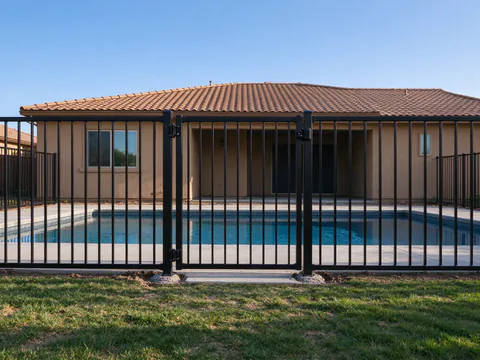
Where a tract has an association, its architectural review comes before any permit; the HOA approval guide covers the submittal. A side yard gate cut into a block wall, a taller privacy section, an automatic gate at an RV pad or a pool fence for a new pool are the sort of additions a near-new lot can call for. On a shared side or rear line, Civil Code 841 calls for 30 days’ written notice to the neighbor first, which the good neighbor fence law guide walks through.
Monserate and Domino: two hardpans
The USDA soil survey maps Monserate sandy loam at the French Valley sample point, with a duripan about 71 cm, roughly 28 inches, below the surface. Winchester’s point maps Domino silt loam, a saline-alkali soil, with a duripan about 69 cm down. A cemented layer at that depth can stop an auger partway through a post hole or a pilaster footing, and getting through it takes a rock bit, a heavier machine or a jackhammer, with more time per hole.
These are point samples. Graded tract lots sit on engineered fill, and the regional wall standards call for footings in undisturbed soil or properly compacted fill. What’s under a given yard is found on the site visit. Hardpan also slows water soaking down, so rain can sit on top of it behind a wall. The fence posts and soil guide explains how post depth is set when digging gets hard.
County wall standards and the tract drain rule
Riverside County’s 284-255 retaining wall standard and 284-256 block-wall-atop-2-ft-retaining standard share their tables with Temecula’s and Murrieta’s, all from the Western Riverside County Code Uniformity Program. One county note matters in tracts: the option of leaving head joints open in the first course as a drain is not allowed there. A tract retaining wall needs a cubic foot of clean gravel per foot of wall and a 4 in. perforated pipe sloped to drain.
The county’s tract block wall inspection program is for builders, not homeowners, and retaining walls never qualify for it. For wind, southwest Riverside County is outside the county’s special wind regions, and engineered walls here are designed for Exposure C. Neither standard covers a wall carrying a driveway, a structure or another wall above it; those are engineered.
Building onto a wall the builder left
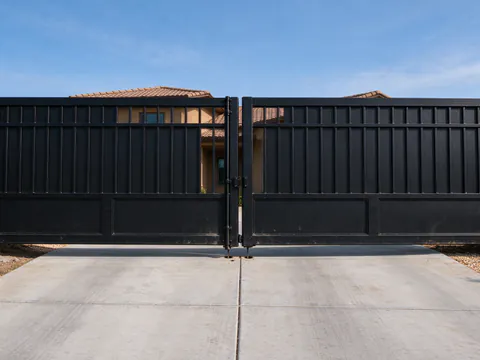
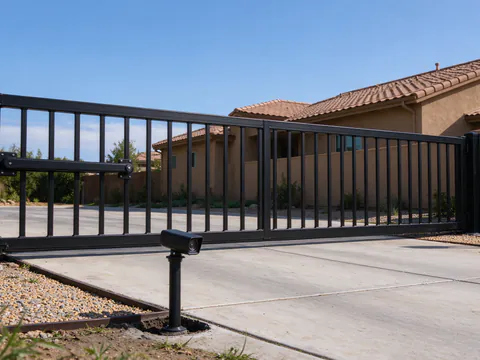
Tying new work into an existing tract wall is its own problem. A gate opening cut into block needs a pilaster or post on each side able to carry the leaf. Temecula’s CD-24 pilaster sheet, part of the same regional program, shows the limits of a standard pilaster: only open fencing such as iron between pilasters, and gates no wider than 4 ft or heavier than 200 lb per pilaster. The county’s requirement for a particular gate is confirmed per project, but a wide RV or driveway gate is past that standard detail and needs its own posts or an engineered design. The swing vs sliding gate guide compares the two for tight side yards.
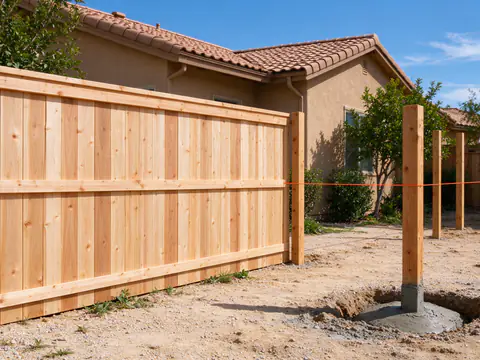
Then there’s height. Adding height on top of an existing wall changes its loads, so it isn’t a matter of stacking more block. Where the yards differ in height, the county’s 284-256 detail covers a privacy wall of up to 6 ft above a retaining base of no more than 2 ft; anything taller below goes to full retaining design. A wood or vinyl screen set on its own posts inside the line is often simpler, and the privacy fence styles guide shows the options.
What a French Valley or Winchester project involves
A first call covers the purpose and the run. A site visit then walks the line for survey pins, grade, rock, drainage and access between houses. HOA approval, neighbor notice, the county permit if one applies and a DigAlert ticket at least two working days before digging come next. Then posts are set and cured, rails and panels go up and gates are hung. The final walk checks plumb, gate swing and latch, and cleanup. Fencing falls under C-13, block under C-29 masonry and concrete under C-8, and each piece goes to a contractor licensed for it.
Both center points map outside any CAL FIRE hazard zone, though zones vary by address, and the proposed Zone 0 rules would only apply in Very High zones. For a budget, see the fence cost guide or the cost estimator, then send the address and what you have in mind.