Cask Fence Temecula plans and manages commercial and security fencing for businesses, multifamily properties, yards and job sites in Temecula and the surrounding cities of southwest Riverside County. The work is carried out by licensed and insured contractors, with each part going to a contractor licensed for it: C-13 for the fence and gates, C-29 for any masonry, C-8 for concrete flatwork, and an electrical contractor for gate power. What we do is plan the job, line up the paperwork and keep it moving. On a commercial site the fence itself is rarely the hard part. The gates, the fire department’s access rules, the permits and the schedule around a working property are, and this page walks through each. For smaller jobs built around a single material, the chain link fence page and the wrought iron fence page go deeper.
Security and perimeter fencing
A perimeter fence does three things: it marks the line, it slows people down and it channels everyone through the gates you control. How much security a fence adds depends on how hard it is to climb, cut or lift, and how long that takes.
Height is the first lever. A taller fence is harder to climb and harder to pass objects over. Fabric and panel design is the second: heavier-gauge chain link with a smaller mesh gives fewer hand and toe holds, and tall steel pickets with no horizontal rail near the top are hard to get over. The third is the bottom edge. A fence that can be lifted or dug under isn’t much of a barrier, which is why a bottom rail, tension wire or a concrete curb along the base matters on a secure line.
Barbed wire and barbed tape are a separate decision. Whether they are allowed depends on the zoning district and use, which are confirmed per project. Where an automated gate is involved, the gate standard keeps barbed tape at 8 feet or higher and barbed wire at 6 feet or higher on the gate.
Before any of that, the line itself has to be right. On a commercial parcel an old fence is a poor guide to the property line, and a survey settles it; the property line survey guide explains when one is worth commissioning.
Security fence installation: chain link and steel
Most commercial perimeters in the area use one of two systems.
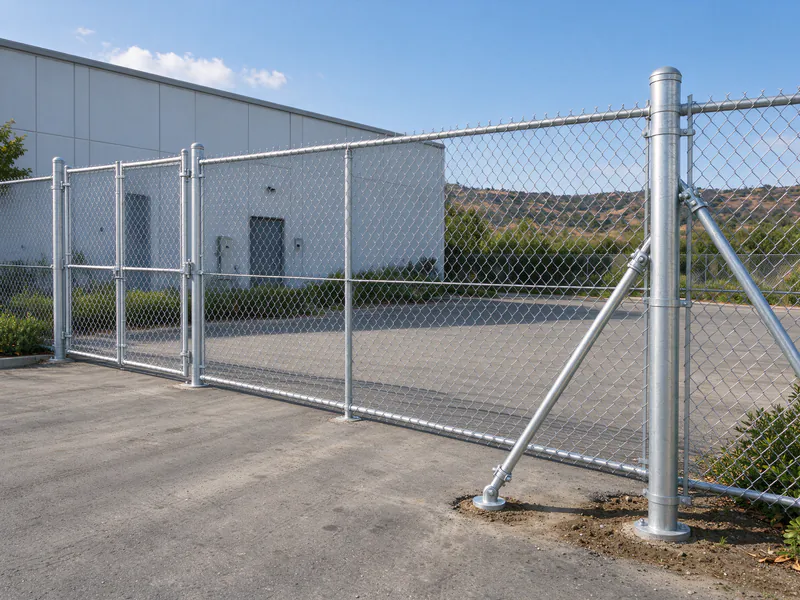
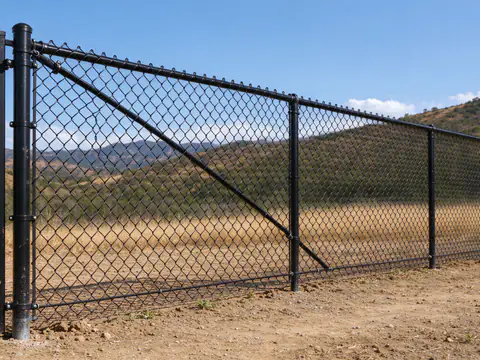
Commercial chain link is the workhorse for yards, storage, equipment areas, utility enclosures and back lot lines. Compared with a residential fence, it uses heavier wire, larger posts, stronger top rails and sometimes a bottom rail as well as tension wire. Black vinyl coating makes it much less obvious from the street.
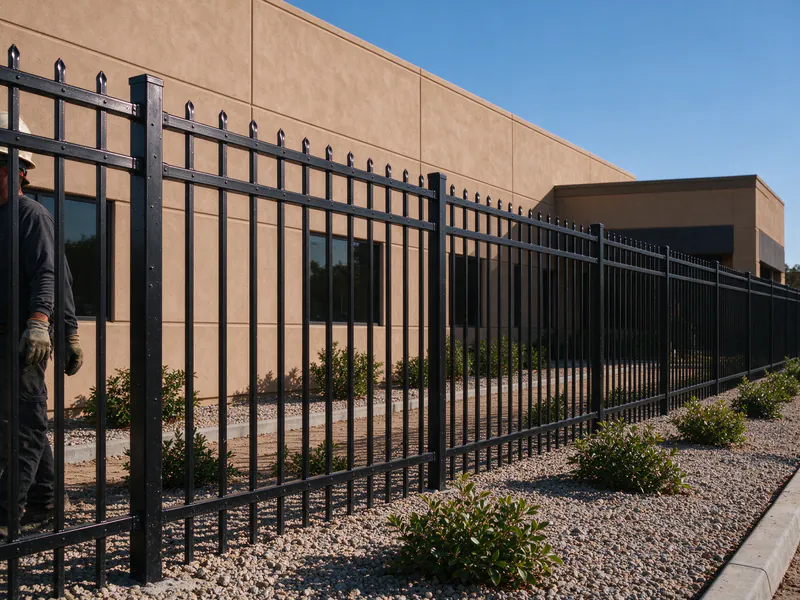
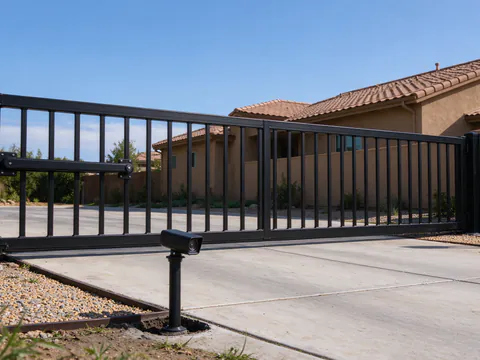
Ornamental steel is the choice for frontage, entries, offices and multifamily communities, where the fence needs to look finished. Tall tubular steel pickets with a flat top rail, or with the top rail set below the picket ends, are hard to climb and keep sight lines open for staff and patrol.
Either way, the posts and footings carry the job. Temecula’s Building & Safety handout puts design wind at 97 mph with Exposure C. A tall chain link fence with windscreen, or a solid steel panel, catches far more of that than open fabric. Federal soil survey data shows a cemented hardpan layer around 2 to 3 feet down in parts of Temecula, which slows drilling and can change footing plans. The fence posts and soil guide explains why there is no single right depth.
Commercial gates, operators and fire department access
Gates are where commercial projects get complicated, because three sets of rules meet at the driveway.
The fire code. Under California Fire Code 503.5 and 503.6, gates across fire apparatus access roads have to be approved by the fire code official, need an approved means of emergency operation and must be kept working at all times. Riverside County Fire sets out how that works locally:
| Requirement | Riverside County Fire source |
|---|---|
| Security gate across a fire access road at least 14 ft wide and 1 ft wider than the road on each side | TP 22-002 |
| Manual gates locked only with a Knox padlock or Knox box on the approach side | TP 22-002, TP 06-003 |
| A Knox key switch on all electronic gates, installed by a licensed gate contractor; the gate opens and stays open until reset | TP 06-003 |
| Mounting location for Knox switches submitted to the fire department before installation | TP 06-003 |
| New motorized gates fitted with optical receivers for emergency vehicle preemption and a function test witnessed by the fire marshal’s office | TP 22-002, OFM-01A |
| On power loss, a gate that one firefighter can push open, or a generator or capacitor that opens it automatically | OFM-01A |
| Gated entries at least 46 ft from a major street on commercial and tract projects | OFM-01A |
| Pedestrian gate at least 3 ft wide | TP 22-002 |
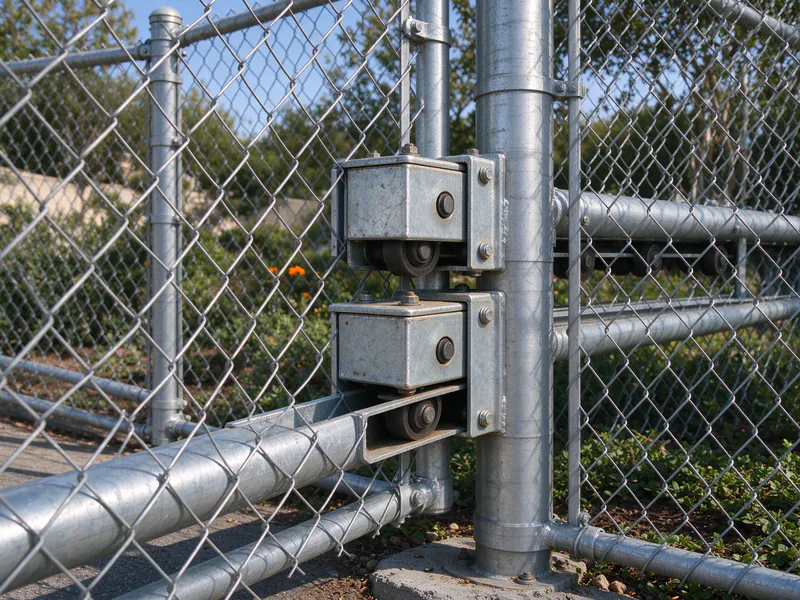
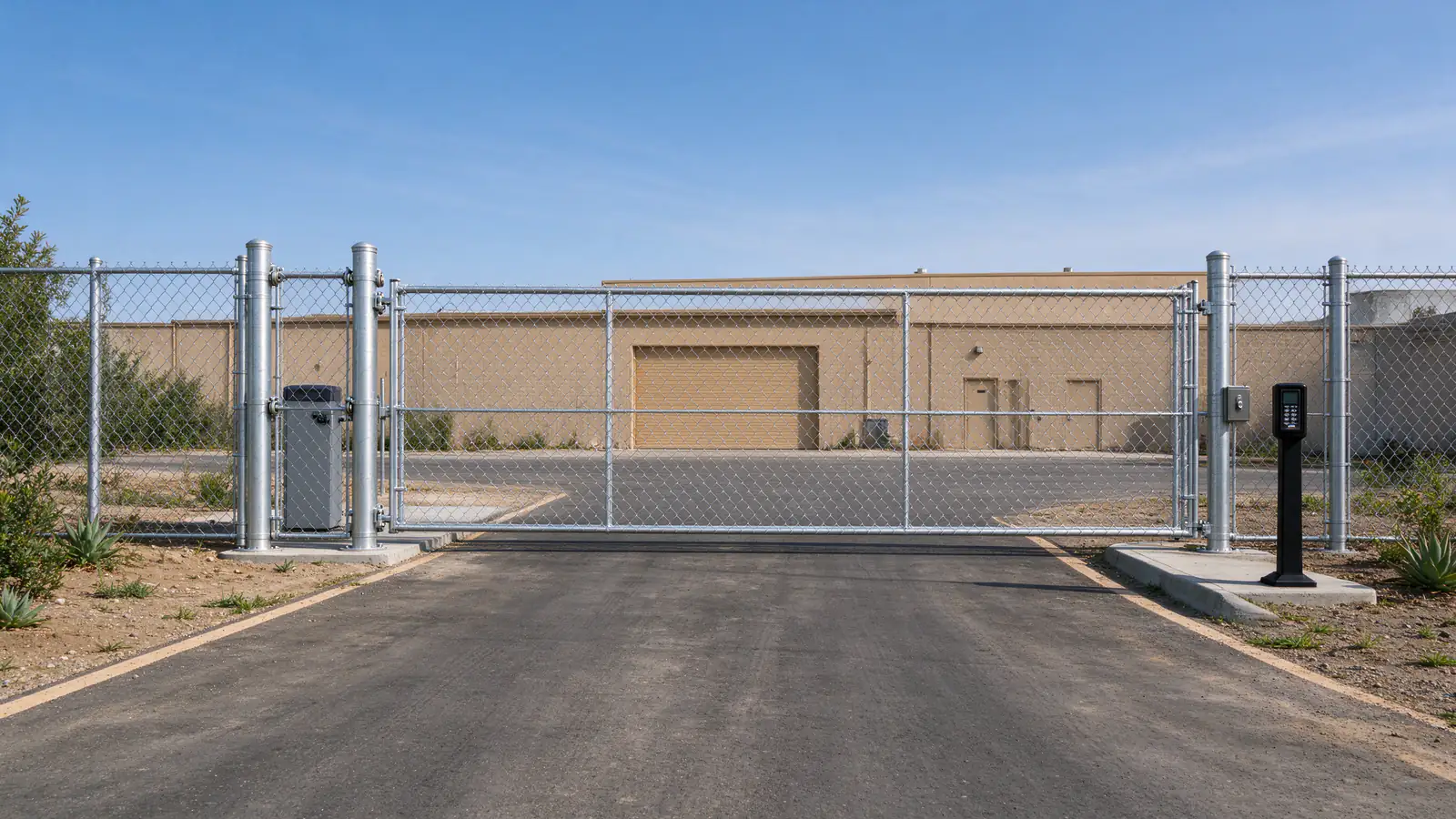
The operator standard. Electric gate operators have to be listed to UL 325, and gates built for automation have to meet ASTM F2200. UL 325 sorts operators by use: a single home’s driveway is Class I, a commercial or multifamily property open to the public is Class II, and industrial sites closed to the public are Class III or IV. The operator must be listed for its class. It also needs at least two independent means of entrapment protection, such as photo eyes and edge sensors, in each direction where there is a risk, and it won’t run normally without them. Slide gates have to be screened from the bottom to at least 6 feet so a 2-1/4 inch sphere can’t pass, and controls go at least 6 feet from the moving gate. Operators are for vehicles only, so a separate pedestrian gate is needed where people walk.
The building department. A gate operator with a new circuit generally means an electrical permit from Temecula Building & Safety, and the electrical work goes to a licensed electrical contractor. The automatic gate page covers operators in more depth, and the swing vs sliding gate guide helps choose the gate type.
Gate across a fire lane?
Send the drive width and how the gate will open. The fire department's rules set the starting point.
Permits and documentation
Commercial fence work tends to need more paper than a backyard job. The residential code exempts fences up to 7 feet from a building permit, but the code path for a commercial site, and its zoning height limits, are confirmed per project with the City of Temecula. The city’s fee schedule lists a non-masonry fence from 6 to 10 feet at $384 for the first 100 linear feet and a fence over 10 feet at $630. The fence height and permit guide covers the residential side.
Fencing that reaches into a sidewalk, parkway or street may need a Public Works encroachment permit. Temecula’s application asks for a traffic control plan where needed, a city business license and a contractor’s license, two working days’ notice for inspection and insurance that names the city as an additional insured. Fire department submittals for gates, shop drawings or product data for gates and operators, and stormwater measures on active sites all fit into the same file. Temecula requires minimum construction stormwater measures on every permitted site, so fence work should not tear up or block silt fence or fiber rolls already in place.
Scheduling around a working site
Fence work on a property that stays open is mostly a sequencing problem. The order of work decides which stretch comes out first, where temporary panels hold the line, how deliveries and customers get in and when gates are out of service. A DigAlert ticket has to be opened at least two working days, and no more than 14 calendar days, before digging, and private lines such as site lighting, irrigation and gate wiring are not marked by the utilities. Fire access roads cannot be blocked at any stage. The fence planning guide covers the general order of a project.
Temporary site fencing
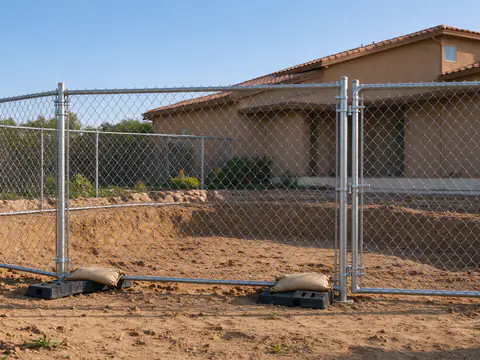
Construction and event sites often need fencing before any permanent fence exists. Riverside County Fire’s guideline requires Knox or breakaway padlocks on gates through construction fencing, construction fencing and gates shown on phasing plans and 3 feet of clear space around hydrants. Cal/OSHA’s excavation rules call for physical barriers at remote excavations, and South Coast AQMD’s dust rule lists upwind fencing and barriers among the control measures for earth-moving. Windscreen makes temporary panels catch much more wind, so screened panels need more bracing and weight. The temporary fence rental page covers the options.
What commercial fencing costs
Commercial projects are priced per project, because height, gauge, gates, operators and fire access requirements change the scope so much. As a starting point, national budgeting ranges run about $8 to $40 per linear foot for galvanized chain link from 4 to 10 feet and about $25 to $85 per linear foot for wrought iron or tubular steel. Heavier wire, taller fabric, coatings and security features push a job toward the top. Labor is part of every number: according to the latest U.S. Bureau of Labor Statistics estimates, fence erectors in the Riverside-San Bernardino-Ontario metro earn a mean $26.95 an hour, about 11% above the $24.29 national mean. That is a wage, not a billing rate. The Temecula fence cost guide breaks down drivers, and the fence cost estimator gives a range for a run. For a written scope, send the site details.