
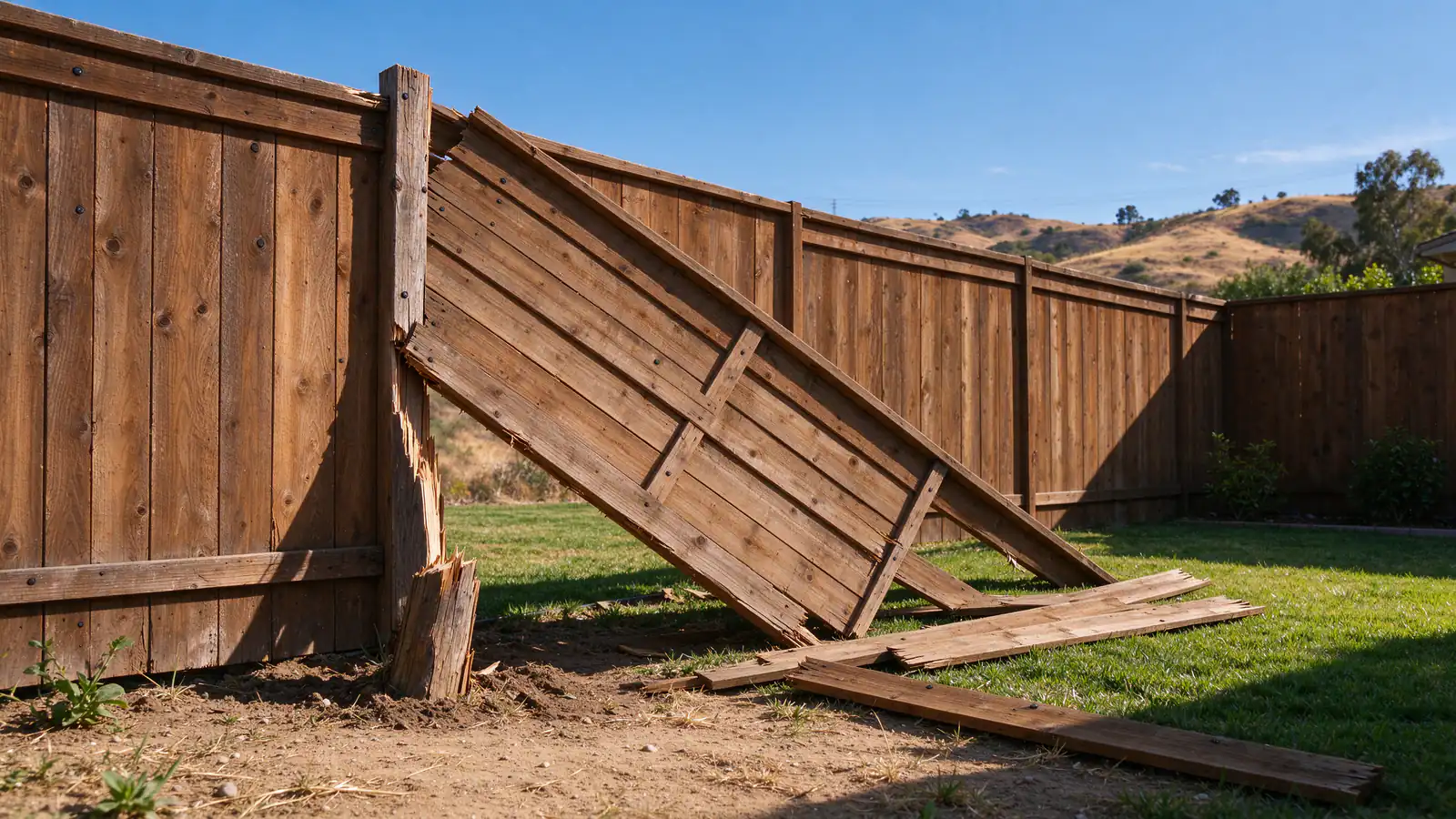
After a Santa Ana windstorm, walk the whole fence line and look before you touch anything: check each post where it meets the ground, then the rails, the boards or panels, and every gate. Solid privacy fences take the hardest hit, and a single snapped post is a different job from a run where every post has tilted the same way.
Why solid fences take the load
Santa Ana winds blow offshore, from the dry interior toward the coast, and a six-foot solid fence across that path works like a sail. The City of Temecula’s building handout lists a design wind speed of 97 mph with Exposure C, the category for open terrain. A solid panel catches that pressure across its full height and passes it into the rails, then the fasteners, then the posts, and finally the footing at the ground line. The post is a lever, and the longest arm is the fence above it.
Open fencing behaves differently. Wrought iron, ranch rail and wire let most of the wind through, so the same gust puts far less force on each post. Board-on-board and shadowbox styles leave small gaps but still behave much like a solid fence. The privacy fence styles guide compares them.
The walk-the-line checklist
Start at one end and work down the fence slowly. Look from your own side unless the neighbor is with you.
Posts at the ground. Look for cracks, a post that has snapped off just above grade, soil heaved up on one side, or a gap opening between the post and its concrete. A wood post that broke at grade often shows soft, dark wood inside, which means rot or termites had already weakened it. The termites and rot guide explains why the ground line fails first.
Lean. Sight down the line. A fence that leans at one post has a local problem. A fence that leans along its whole length has a system problem.
Rails and fasteners. Rails pulled off their brackets, split at the nail line or hanging loose mean the wind load moved through the connections. Vinyl rails can pop out of their post routes, and vinyl can crack, especially where it was already brittle.
Boards and panels. Missing boards are the easy part. A panel that bowed and sprang back can hide a cracked rail.
Gates. Swing every gate. A gate that drags, won’t latch or sits lower on the latch side has usually moved its hinge post. The sagging gate guide covers what that tells you.
Walls under the fence. If the fence sits on a block or retaining wall, look at the wall too. New cracks or a wall that has moved need a masonry or engineering look, not a fence repair.
One post or the whole run?
This is the decision that sets the cost. If one or two posts broke or leaned and the posts on either side are solid and plumb, replacing those posts and reattaching the rails is usually enough. A national budgeting range for a fence post replacement is about $120 to $400 per post, and a typical repair job runs about $200 to $950.
If most posts tilted the same direction, several failed at grade, the boards are brittle and the fence is decades old, the wind found a fence that was already near the end. Patching it can mean paying for repairs on a line that still needs replacing. The repair or replace guide walks through the signs, and the fence repair assessment gives a planning answer from a few questions. Either way, posts here are sized to the fence height, the wind and the soil at your lot, not to a fixed depth; the posts and soil guide explains why.
Safety first, paperwork second
Treat any downed wire near a fence as live and keep everyone away. If a fallen section opened a pool barrier, the pool is unprotected until the gap is closed, so keep the area locked off and consider a temporary panel; temporary fence rental covers that kind of stopgap. Keep pets in until the line is whole.
Don’t dig new post holes in a hurry. Any digging needs a DigAlert ticket at least two working days ahead, and the private lines to pool equipment and landscape lighting won’t be marked. On a shared fence, California Civil Code 841 presumes neighbors share the reasonable cost and asks for 30 days’ written notice describing the work; the good neighbor fence law guide has the details.
Cask Fence Temecula plans and manages fence repair and replacement across Temecula and southwest Riverside County, with the work carried out by licensed and insured contractors. Send a few photos of the damage through the contact page or call (951) 944-2778, and say whether the fence is shared or part of a pool barrier.