
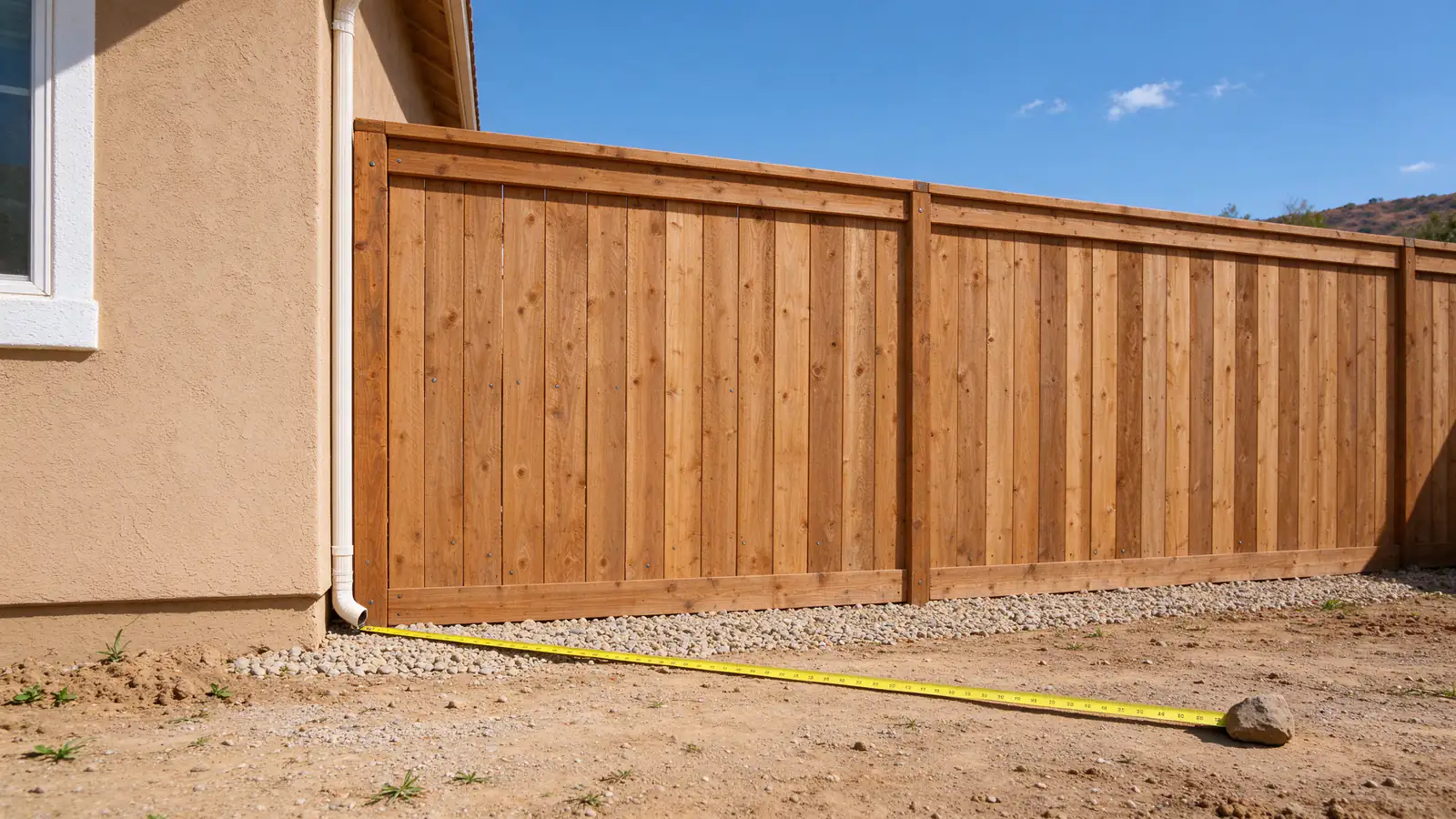
California’s proposed Zone 0 rules would bar new combustible fences within five feet of a home in the highest-hazard areas, let existing fences stay and be repaired, and require a noncombustible section where a fence or gate attaches to the house within five years. Those details come from a Board of Forestry staff memo released in July 2026. The rules are moving toward adoption, but their final text and effective date haven’t been confirmed at an official source, so treat everything below as proposed.
What the draft says about fences
The Board of Forestry and Fire Protection has been writing Zone 0 regulations under AB 3074, the state law that created the ember-resistant zone around homes. A July 2026 staff memo to the Board set out how the draft treats fences:
| Situation | What the draft would do |
|---|---|
| New combustible fence within 5 ft of a structure | Prohibited |
| Existing combustible fence within 5 ft | May remain and be repaired with the same materials |
| Fence or gate that attaches to an occupied structure | Noncombustible section required within five years, such as a noncombustible gate |
| Fence more than 5 ft from the structure | Unaffected |
| New construction | Applies immediately; existing homes phased |
The reasoning is the same one behind the rest of Zone 0. Embers land against walls, and a wood fence that touches the house can carry fire straight to the siding or eaves. A metal gate or masonry section at the connection breaks that path.
What isn’t settled
The memo set the draft for Board consideration in August 2026, and staff expected the rules could take effect after the Office of Administrative Law approved them. Final adoption and the effective date have not been confirmed from an official source for this article, and the Board’s own Zone 0 page is the place to check. Until then, the details above could change, including the five-year window and what counts as noncombustible.
Does it reach your address?
Only if the parcel is in a Very High zone in a local responsibility area or anywhere in a state responsibility area. In the Temecula area the answer changes block by block. CAL FIRE’s sample points put the Redhawk area of Temecula, the Lake Elsinore and Wildomar city centers, and the wine country, La Cresta, the Santa Rosa Plateau and De Luz in Very High zones. Harveston’s point maps High, Canyon Lake’s Moderate, and the Murrieta, Menifee, French Valley and Fallbrook center points fall outside a mapped zone. Those are single points, not answers for a street. Temecula owners can look up an address on the city’s fire hazard severity map; elsewhere, CAL FIRE’s map gives the zone.
What to do now
Don’t tear out a sound fence. Under the draft, an existing fence could stay and be repaired. Removing it early buys nothing.
Measure the five feet. Walk out five feet from the house along each fence that runs toward it. That’s the length the rule would care about, and it’s often a single panel, a gate or both.
Plan the connection at the next replacement. If a side yard fence or gate is due anyway, that’s the simplest time to build the section nearest the house in metal or masonry, which would meet the draft. Wrought iron, aluminum and a short block return are the usual answers, and gate installation covers the gate itself.
Mind the HOA. A metal gate in a wood fence line changes how it looks, so the association may need to approve it. The HOA approval guide covers that step.
Know your material. Vinyl is still a combustible material: it softens in heat and burns in a fire. The vinyl in heat and fire guide explains how it behaves.
Cask Fence Temecula plans and manages fence and gate work in Temecula and southwest Riverside County, carried out by licensed and insured contractors. The fire-resistant fence page goes further on materials, the planning guide covers the rest of a fence decision, and the contact page is the way to send photos of where your fence meets the house.